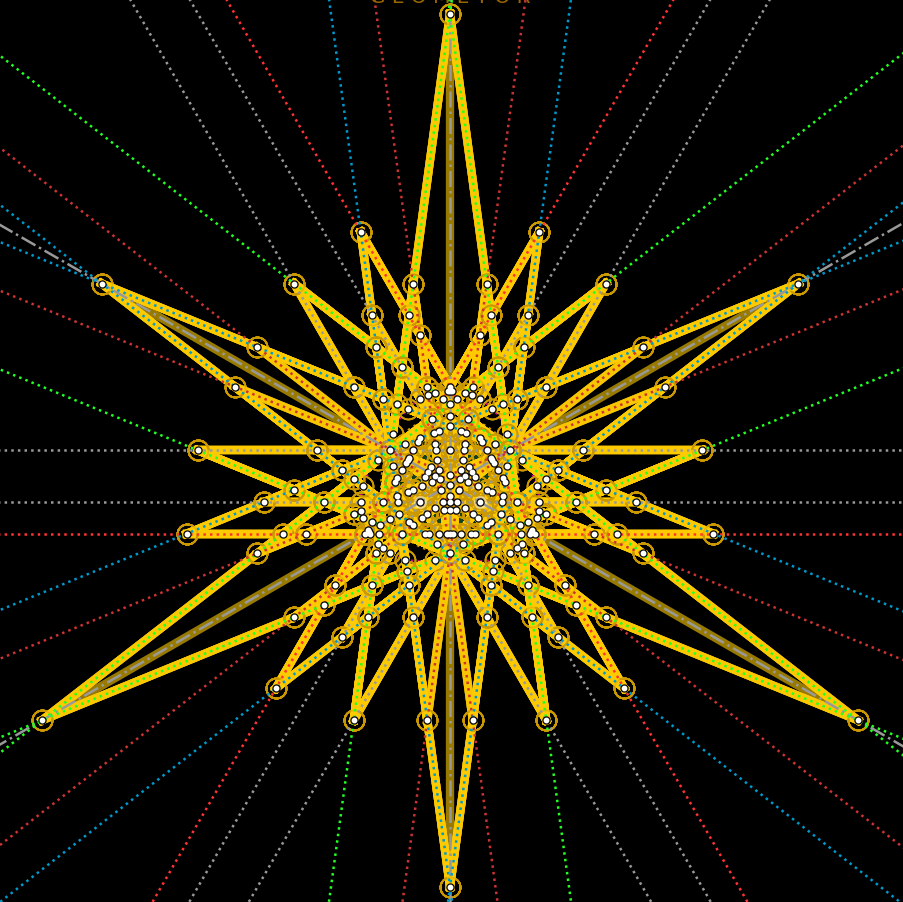
Commentary on Propositions I.1–I.15: Triangles, Congruence & Perpendiculars — GEOMETOR Commentary & Concordance Notes
GEOMETOR Philosophical & Mathematical Commentary
Zeno of Sidon’s Continuity & Uniqueness Critiques (`Friedlein 214–218`): In Prop. I.1, two questions arise that modern axiomatics (Pasch, Hilbert) later formalized: (a) why must the two circles intersect? and (b) as Zeno of Sidon asked, how do we know the two radii $CA, CB$ do not share a common segment near $C$? In geometor/model, exact polynomial intersection of the two unit circles $(x)^2 + y^2 = 1$ and $(x - 1)^2 + y^2 = 1$ algebraically exhibits the two conjugate equilateral vertices $(1/2, \pm \sqrt{3}/2)$ over $\mathbb{Q}(\sqrt{3})$, while Zeno’s uniqueness critique highlights the implicit uniqueness content of Postulates 1–2 defended by Posidonius.
Pappus’s Zero-Construction Symmetry Proof of `I.5` (`Friedlein 249–250`): Preserved exclusively here (proclus:in-euclid:249.20-250.12), Pappus's proof of Prop. I.5 conceives the single isosceles triangle $ABC$ ($AB = AC$) simultaneously as $\triangle ABC$ and $\triangle ACB$, applying Prop. I.4 directly without a single auxiliary line—an early triumph of transformational/reflection symmetry in synthetic geometry.
Trisection, Indivisible Lines & Oenopides’ Gnomon (`Friedlein 272–289`): Proclus’s distinction between straightedge-and-compass angle bisection (I.9) and general angle trisection (Friedlein 272, requiring cubic/transcendental curves—conics, conchoids, or quadratrices) anticipates Wantzel’s 1837 algebraic degree criterion ($2^k$ vs. degree $3$), while Oenopides' astronomical perpendicular (I.12, Friedlein 283, 7–10) anchors Book I’s constructive restrictions in classical celestial measurement.
Friedlein Loci Cited in GEOMETOR (42 Loci in pp. 208–305)
Friedlein 208, 21 (text) — Commentary on Prop. I.1: why Euclid opens Book I with the problem of constructing the equilateral triangle. -
euclid(proclus:in-euclid:208.21): Heath Vol. I, p. 130 [folio0144]Friedlein 210, 18 (text) — Symbolic and cosmic primacy of the equilateral triangle (Plato’s Timaeus) alongside its deductive role in Book I. -
euclid(proclus:in-euclid:210.18): Heath Vol. I, p. 31 [folio0045]Friedlein 211, 1–212, 4 (text) — Definition of Lemma (λαμβανόμενον requiring confirmation) vs. Case (ptosis), Porism, Objection (enstasis), and Reduction (apagoge). -
euclid(proclus:in-euclid:211.1-212.4): Heath Vol. I, p. 133 [folio0147]Friedlein 211, 19 (text) — Definition of geometrical Analysis (ascent to admitted principles) and Synthesis, attributed to Plato’s transmission to Leodamas of Thasos. -
euclid(proclus:in-euclid:211.19): Heath Vol. I, p. 38 [folio0052]Friedlein 211, 19–23 (text) — Plato hands down the analytical method to Leodamas, through which many discoveries in geometry were made. -
euclid(proclus:in-euclid:211.19-23): Heath Vol. I, p. 36 [folio0050]Friedlein 212, 5–11 (text) — Meaning of Case (ptosis): varying configurations of a construction that preserve the same demonstrative force. -
euclid(proclus:in-euclid:212.5-11): Heath Vol. I, p. 134 [folio0148]Friedlein 212, 14 (text) — Dual meaning of Porism: a corollary won as a windfall from another demonstration vs. an intermediate inquiry seeking to find an existing thing (as in Euclid’s Porisms). -
euclid(proclus:in-euclid:212.14): Heath Vol. I, p. 13 [folio0027]Friedlein 212, 18–23 (text) — Aristotelian Objection (enstasis) in geometry: blocking either the construction or the demonstration. -
euclid(proclus:in-euclid:212.18-23): Heath Vol. I, p. 135 [folio0149]Friedlein 212, 24–213, 11 (text) — Geometric Reduction (apagoge), exemplified by Hippocrates of Chios’s reduction of duplicating the cube to finding two mean proportionals. -
euclid(proclus:in-euclid:212.24-213.11): Heath Vol. I, p. 135 [folio0149]Friedlein 214, 18 (text) — Zeno of Sidon’s Epicurean critique of Prop. I.1 (what if two straight lines share a common segment?) and Posidonius’s refutation book against Zeno. -
euclid(proclus:in-euclid:214.18): Heath Vol. I, p. 196 [folio0210]Friedlein 215, 24 (text) — Posidonius’s reply to Zeno of Sidon: Postulate 2 implicitly guarantees that a finite straight line can be produced in one unique straight continuation. -
euclid(proclus:in-euclid:215.24): Heath Vol. I, p. 197 [folio0211]Friedlein 217, 10 (text) — Critique of attempting to prove uniqueness of straight segments from circle bisection without circularity. -
euclid(proclus:in-euclid:217.10): Heath Vol. I, p. 198 [folio0212]Friedlein 221, 7–11 (text) — Commentary on Prop. I.2: enumeration of geometric cases depending on whether the given point lies on the segment, at its extremity, or outside it. -
euclid(proclus:in-euclid:221.7-11): Heath Vol. I, p. 129 [folio0143]Friedlein 234, 21 (text) — Commentary on Prop. I.4: why this is the first Theorem in the Elements and why SAS congruence relies on superposition (epharmoge) without prior theorems. -
euclid(proclus:in-euclid:234.21): Heath Vol. I, p. 128 [folio0142]Friedlein 241, 19–243, 11 (text) — Carpus of Antioch (in his Astronomical Treatise) vs. Geminus on whether Problems precede Theorems in natural order. -
euclid(proclus:in-euclid:241.19-243.11): Heath Vol. I, p. 127 [folio0141]Friedlein 241, 21 (text) — Citation of Carpus the Mechanician (‘Carpus of Antioch’) on the methodological priority of Problems. -
euclid(proclus:in-euclid:241.21): Heath Vol. I, p. 44 [folio0058]Friedlein 242, 16 (text) — Proclus’s synthesis resolving Carpus and Geminus: problems predominate in genesis/art, theorems in dignity and contemplative science. -
euclid(proclus:in-euclid:242.16): Heath Vol. I, p. 140 [folio0154]Friedlein 248, 22–249, 19 (text) — Proclus’s alternative proof of Prop. I.5 (isosceles base angles) taking points inside the equal sides rather than producing them. -
euclid(proclus:in-euclid:248.22-249.19): Heath Vol. I, p. 254 [folio0268]Friedlein 249, 20–250, 12 (text) — Pappus of Alexandria’s celebrated zero-construction symmetry proof of Prop. I.5, comparing triangle ABC with itself as ACB. -
euclid(proclus:in-euclid:249.20-250.12): Heath Vol. I, p. 254 [folio0268]Friedlein 250, 20 (text) — Thales of Miletus’s discovery of Prop. I.5, calling the equal base angles ‘similar’ (homoias) in archaic fashion. -
euclid(proclus:in-euclid:250.20): Heath Vol. I, p. 252 [folio0266]Friedlein 251, 2–11 (text) — Geminus’s classification of theorems and introductory transition to the theory of geometric conversion. -
euclid(proclus:in-euclid:251.2-11): Heath Vol. I, p. 41 [folio0055]Friedlein 252, 5 (text) — Commentary on Prop. I.6: exact theory of complete/leading conversion vs. partial conversion, developed by Menaechmus and Amphinomus. -
euclid(proclus:in-euclid:252.5): Heath Vol. I, p. 256 [folio0270]Friedlein 254, 22–27 (text) — Logical structure of Reductio ad Absurdum (apagoge eis adynaton): assuming the contradictory of the conclusion alongside the hypothesis to refute a known truth. -
euclid(proclus:in-euclid:254.22-27): Heath Vol. I, p. 136 [folio0150]Friedlein 255, 8–26 (text) — Correspondence between Reductio ad Absurdum and geometric Analysis, and why difficult converses are characteristically established indirectly. -
euclid(proclus:in-euclid:255.8-26): Heath Vol. I, p. 137 [folio0151]Friedlein 269 (text) — Commentary on Prop. I.8: Philo of Byzantium’s elegant direct three-case proof of SSS congruence without needing Lemma I.7, and terminology of circumference. -
euclid(proclus:in-euclid:269): Heath Vol. II, p. 111 [folio0117]Friedlein 270, 5–24 (text) — Commentary on Prop. I.9: refutation of objections to Euclid’s angle-bisection construction (ensuring the inner equilateral vertex lies cleanly within the angle). -
euclid(proclus:in-euclid:270.5-24): Heath Vol. I, p. 45 [folio0059]Friedlein 272, 3–7 (text) — Why trisecting a general rectilinear angle transcends straightedge and compass, requiring Nicomedes’ conchoids, Hippias’s quadratrices, or Archimedes’ spirals. -
euclid(proclus:in-euclid:272.3-7): Heath Vol. I, p. 161 [folio0175]Friedlein 272, 10 (text) — Historical record of angle-trisection curves (Nicomedes, Hippias, Archimedes) in Hellenistic geometry. -
euclid(proclus:in-euclid:272.10): Heath Vol. I, p. 26 [folio0040]Friedlein 277, 25–279, 4 (text) — Commentary on Prop. I.10: refutation of Xenocrates’ doctrine of indivisible lines (atomoi grammai) from the universal bisectability of segments. -
euclid(proclus:in-euclid:277.25-279.4): Heath Vol. I, p. 268 [folio0282]Friedlein 279, 16–280, 4 (text) — Apollonius of Perga’s symmetric two-circle construction for bisecting a finite straight line (Prop. I.10) without first invoking Prop. I.9. -
euclid(proclus:in-euclid:279.16-280.4): Heath Vol. I, p. 268 [folio0282]Friedlein 280, 9 (text) — Commentary on Prop. I.11: relation between bisecting a segment and erecting a perpendicular at a given point. -
euclid(proclus:in-euclid:280.9): Heath Vol. I, p. 32 [folio0046]Friedlein 282, 8 (text) — Apollonius’s alternative construction for erecting a perpendicular to a straight line from a point on it (Prop. I.11). -
euclid(proclus:in-euclid:282.8): Heath Vol. I, p. 270 [folio0284]Friedlein 283, 7–10 (text) — Commentary on Prop. I.12: Oenopides of Chios first investigated dropping a perpendicular for astronomy and called the perpendicular ‘drawn gnomon-wise’ (kata gnomona). -
euclid(proclus:in-euclid:283.7-10): Heath Vol. I, p. 271 [folio0285]Friedlein 283, 9 (text) — Archaic Greek terminology of Oenopides: calling the perpendicular kata gnomona because the sundial gnomon stands at right angles to the horizon. -
euclid(proclus:in-euclid:283.9): Heath Vol. I, p. 181 [folio0195]Friedlein 286, 12–289, 6 (text) — Continuity analysis of circle-line intersection in Prop. I.12 and the three-case classification of objections. -
euclid(proclus:in-euclid:286.12-289.6): Heath Vol. I, p. 272 [folio0286]Friedlein 297, 1–298, 10 (text) — Commentary on Prop. I.14: Porphyry’s precision regarding the ‘on opposite sides’ condition in proving two adjacent supplementary rays form one straight line. -
euclid(proclus:in-euclid:297.1-298.10): Heath Vol. I, p. 24 [folio0038]Friedlein 298, 14–24 (text) — Commentary on Prop. I.15: exact distinction between adjacent angles (ephexes) and vertical angles (kata koryphen). -
euclid(proclus:in-euclid:298.14-24): Heath Vol. I, p. 278 [folio0292]Friedlein 299, 3–6 (text) — Eudemus’s testimony that Thales first discovered the equality of vertical angles (Prop. I.15), while Euclid first gave its scientific demonstration. -
euclid(proclus:in-euclid:299.3-6): Heath Vol. I, p. 278 [folio0292]Friedlein 303–304 (text) — Excursus on Porisms following Prop. I.15: distinction between Corollary-Porisms and the higher Porisms of Euclid’s lost three-book treatise. -
euclid(proclus:in-euclid:303-4): Heath Vol. I, p. 82 [folio0096]Friedlein 303, 6 (text) — Characterization of a Porism as an unintended ‘windfall’ or ‘gain’ (kerdos) emerging directly from a completed demonstration. -
euclid(proclus:in-euclid:303-6): Heath Vol. II, p. 175 [folio0181]Friedlein 304–305 (text) — Examples of geometric corollaries and porismatic deductions in the Elements. -
euclid(proclus:in-euclid:304-5): Heath Vol. II, p. 98 [folio0104]Friedlein 304, 2 (text) — Classification of Porisms into geometric vs. arithmetic, following either theorems (as I.15 Porism) or problems (as IV.15 Porism). -
euclid(proclus:in-euclid:304-2): Heath Vol. II, p. 109 [folio0115]