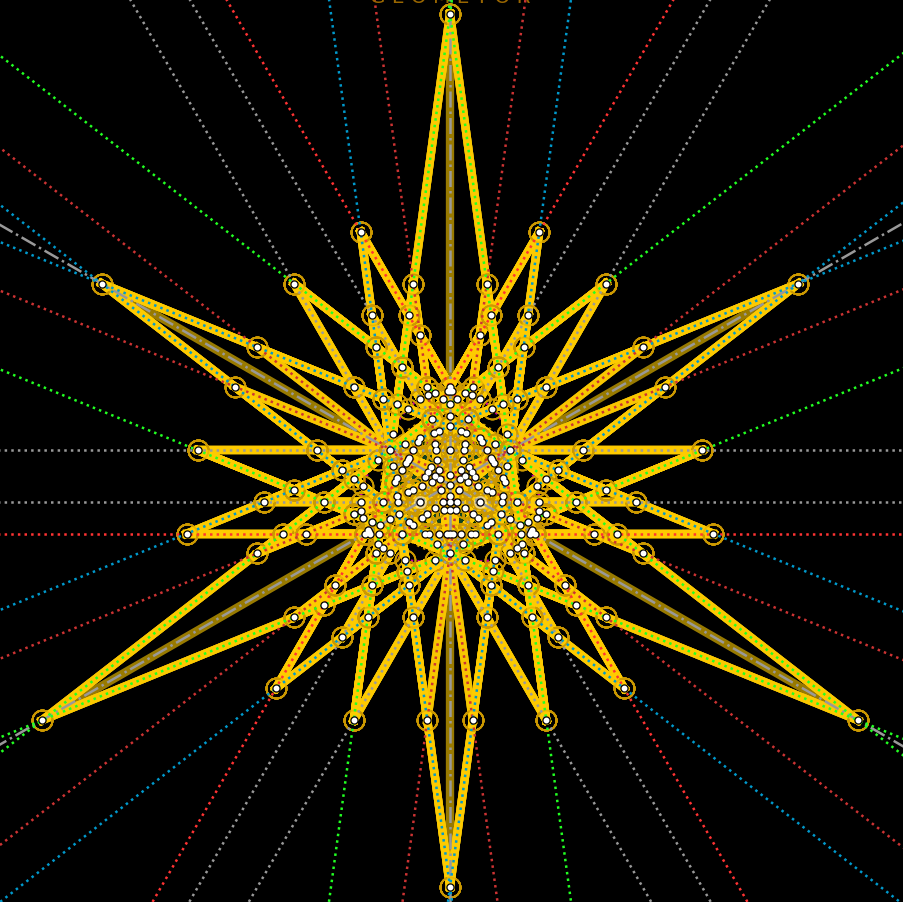
The Divided Line — Synopsis
The Four Segments, Dianoia vs. Noēsis & Equal Middle Segments · Republic VI, 509d–511e
Architectural Thesis
Unit III unites the two monumental architects of Western mathematical epistemology—Book VI’s Divided Line (509d–511e) and Book VII’s Curriculum of the Five Mathematical Sciences & Dialectic (525a–534e):
The Divided Line & Geometric Equality of Middle Segments (VI, 509d–511e): Socrates instructs Glaucon to cut a line AE unequally at C into the Visible (AC) and Intelligible, and to subdivide each realm in the same ratio (\(1 : r\)). By pure algebraic necessity (\(AB : BC = CD : DE = AC : CE = 1 : r\)), the sensible segment of pistis (BC) is strictly equal to the mathematical segment of dianoia (CD), materialized by the geometric mean ordinate BG on semicircle (M, C)—reflecting the exact ontological law that geometry redeploys physical things of pistis as visible diagrams!
Methodological Critique of Geometric Hypotheses (VI, 510c–511d): Geometers hypothesize the odd and even, the figures, and the three kinds of angles as self-evident without giving an account of them, using drawn squares and diagonals only to behold the Square itself and the Diagonal itself through dianoia, whereas noēsis ascends without images to the unhypothetical principle.
Stephanus Overview
Section |
Stephanus Span |
Mathematical & Philosophical Argument |
Tracks |
|---|---|---|---|
III.1 The Divided Line |
|
Eikasia, pistis, dianoia, noēsis; geometric hypotheses & diagrams. |