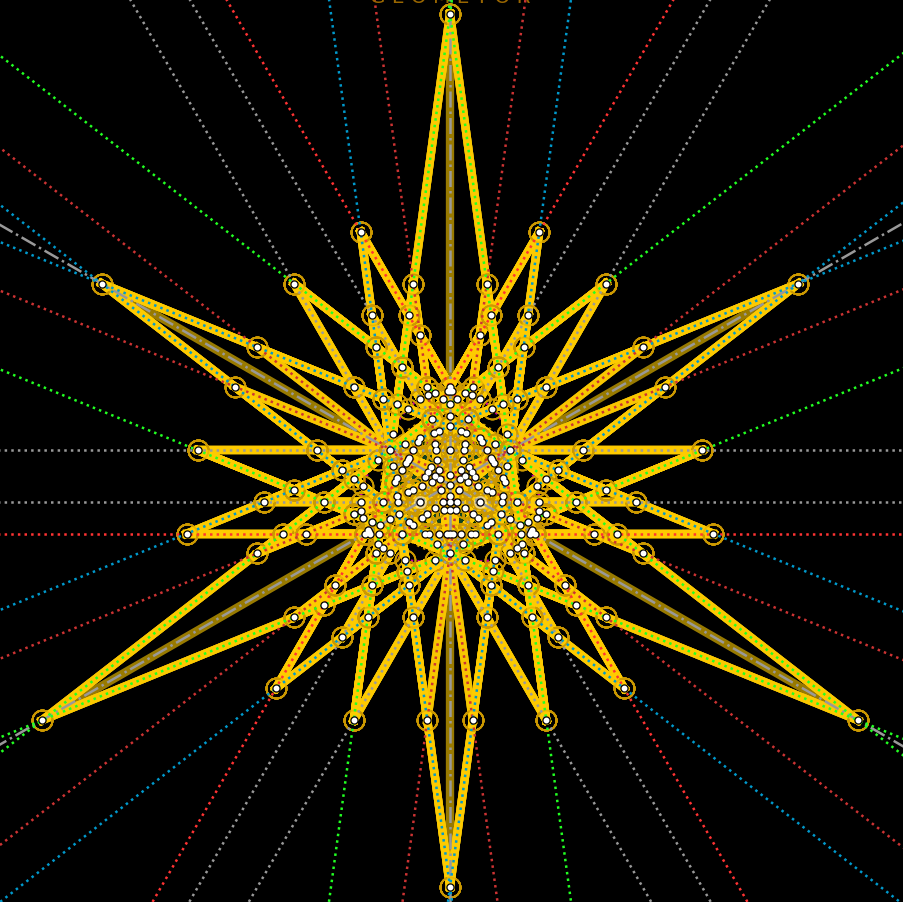
Timaeus

Τίμαιος — Cosmic Proportion, the World-Soul & the Five Regular Solids

ΠΛΑΤΩΝΟΣ ΤΙΜΑΙΟΣ
Timaeus

Author: Plato of Athens (c. 428–348 BC)
Critical Greek Text: John Burnet (Platonis Opera, Tomus IV, Oxford Classical Texts, 1902)
English Translation: Benjamin Jowett (3rd ed., Oxford University Press, 1892)
GEOMETOR Digital Edition: Synchronized English, Greek (Burnet OCT), Summary & Notes Tracks

«δεσμῶν δὲ κάλλιστος ὃς ἂν αὑτὸν καὶ τὰ συνδούμενα ὅτι μάλιστα ἓν ποιῇ, τοῦτο δὲ πέφυκεν ἀναλογία κάλλιστα ἀποτελεῖν.»

“And the fairest of bonds is that which makes itself and the things bound together one to the utmost degree; and geometric proportion is by nature suited to accomplish this most nobly.” — Timaeus 31c2–4


Mathematical Passages

Timaeus 31c-36d: Arithmetic, Geometric, and Harmonic Means & Circles of the World-Soul ( O B ): (x - (3))^2 + (y - (0))^2 - (9) = 0 ( O J ): (x - (3))^2 + (y - (0))^2 - (1) = 0 [ J H ]: (-2*sqrt(2)/9)*x + (8/9)*y + (4*sqrt(2)/9) = 0 [ A B ]: (0)*x + (1)*y + (0) = 0 [ J D ]: (1)*x + (0)*y + (-2) = 0 [ O G ]: (-2*sqrt(2))*x + (-1)*y + (6*sqrt(2)) = 0 [ P Q ]: (-3)*x + (3*sqrt(3))*y + (9) = 0 A = (0, 0) B = (6, 0) J = (2, 0) G = (2, 2*sqrt(2)) H = (26/9, 2*sqrt(2)/9) P = (3 - 3*sqrt(3)/2, -3/2) Q = (3*sqrt(3)/2 + 3, 3/2) O = (3, 0) A B J G H P Q O

Proportional Bond & Harmonic Scale of the World-Soul

«δεσμῶν δὲ κάλλιστος ὃς ἂν αὑτὸν καὶ τὰ συνδούμενα ὅτι μάλιστα ἓν ποιῇ, τοῦτο δὲ πέφυκεν ἀναλογία κάλλιστα ἀποτελεῖν.»

“And the fairest of bonds is that which makes itself and the things bound together one to the utmost degree; and geometric proportion is by nature suited to accomplish this most nobly.” — Timaeus 31c2–4

Timaeus 54d-55a: Six Elementary 1:sqrt(3):2 Scalene Right Triangles Forming the Cosmic Face ( G M1 ): (x - (0))^2 + (y - (0))^2 - (1) = 0 ( G A ): (x - (0))^2 + (y - (0))^2 - (4) = 0 [ M1 C ]: (0)*x + (1)*y + (1) = 0 [ C A ]: (-3)*x + (-sqrt(3))*y + (2*sqrt(3)) = 0 [ A B ]: (3)*x + (-sqrt(3))*y + (2*sqrt(3)) = 0 [ M1 G ]: (1)*x + (0)*y + (0) = 0 [ B G ]: (-1)*x + (sqrt(3))*y + (0) = 0 [ C G ]: (-1)*x + (-sqrt(3))*y + (0) = 0 A = (0, 2) B = (-sqrt(3), -1) M1 = (0, -1) M2 = (sqrt(3)/2, 1/2) M3 = (-sqrt(3)/2, 1/2) G = (0, 0) A B M1 M2 M3 G

Elementary Triangles & Cosmic Polyhedra

«τὰ δὲ τρίγωνα πάντα ἐκ δυοῖν ἄρχεται τριγώνοιν, μίαν μὲν ὀρθὴν ἔχοντος ἑκατέρου γωνίαν, τὰς δὲ ὀξείας· ὧν τὸ μὲν ἕτερον ἑκατέρωθεν ἔχει μέρος γωνίας ὀρθῆς πλευραῖς ἴσαις διῃρημένης, τὸ δ’ ἕτερον ἀνίσους ἄνισα μέρη νενεμημένης.»

“All triangles derive their origin from two triangles, each having one right angle and two acute: one having on either side a half-right angle bounded by equal sides, the other unequal parts allotted to unequal sides.” — Timaeus 53c8–d4


Scholarly Apparatus

Master Stephanus Concordance · Index of Persons · Platonic Glossary · Bibliography