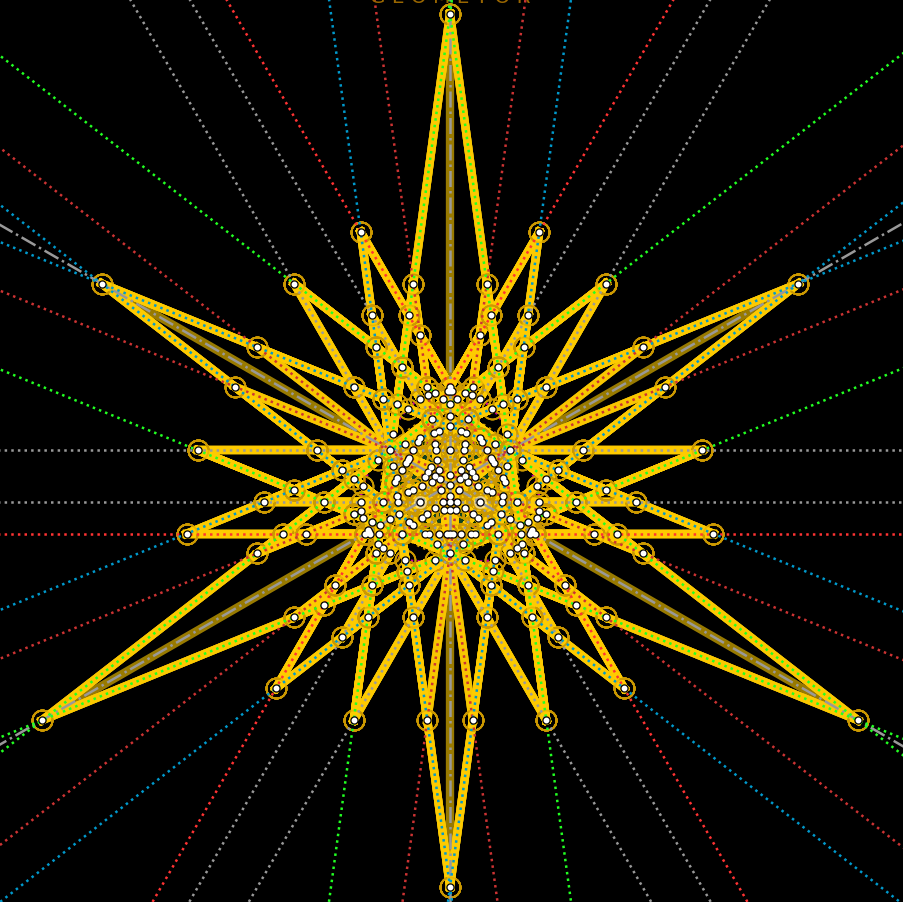
Pure Geometric Beauty by Compass & Rule
True Aesthetic Purity: Surfaces and Solids of Compass, Rule & Square (Phil. 51b–52c)
VI.4 Pure Geometric Beauty Constructed by Compass, Rule & Square (Phil. 51b–52c)
English Translation by Benjamin Jowett (3rd ed., 1892) · Project Gutenberg #1744 (Jowett 3rd ed., 1892)
SOCRATES: True pleasures are those which are given by beauty of colour and form, and most of those which arise from smells; those of sound, again, and in general those of which the want is painless and unconscious, and of which the fruition is palpable to sense and pleasant and unalloyed with pain.
PROTARCHUS: Once more, Socrates, I must ask what you mean.
f. Phil. 51dSOCRATES: My meaning is certainly not obvious, and I will endeavour to be plainer. I do not mean by beauty of form such beauty as that of animals or pictures, which the many would suppose to be my meaning; but, says the argument, understand me to mean straight lines and circles, and the plane or solid figures which are formed out of them by turning-lathes and rulers and measurers of angles; for these I affirm to be not only relatively beautiful, like other things, but they are eternally and absolutely beautiful, and they have peculiar pleasures, quite unlike the pleasures of scratching. And there are colours which are of the same character, and have similar pleasures; now do you understand my meaning?
PROTARCHUS: I am trying to understand, Socrates, and I hope that you will try to make your meaning clearer.
SOCRATES: When sounds are smooth and clear, and have a single pure tone, then I mean to say that they are not relatively but absolutely beautiful, and have natural pleasures associated with them.
PROTARCHUS: Yes, there are such pleasures.
SOCRATES: The pleasures of smell are of a less ethereal sort, but they have no necessary admixture of pain; and all pleasures, however and wherever experienced, which are unattended by pains, I assign to an analogous class. Here then are two kinds of pleasures.
PROTARCHUS: I understand.
f. Phil. 51eSOCRATES: To these may be added the pleasures of knowledge, if no hunger of knowledge and no pain caused by such hunger precede them.
PROTARCHUS: And this is the case.
f. Phil. 52aSOCRATES: Well, but if a man who is full of knowledge loses his knowledge, are there not pains of forgetting?
PROTARCHUS: Not necessarily, but there may be times of reflection, when he feels grief at the loss of his knowledge.
f. Phil. 52bSOCRATES: Yes, my friend, but at present we are enumerating only the natural perceptions, and have nothing to do with reflection.
PROTARCHUS: In that case you are right in saying that the loss of knowledge is not attended with pain.
SOCRATES: These pleasures of knowledge, then, are unmixed with pain; and they are not the pleasures of the many but of a very few.
f. Phil. 52cPROTARCHUS: Quite true.
SOCRATES: And now, having fairly separated the pure pleasures and those which may be rightly termed impure, let us further add to our description of them, that the pleasures which are in excess have no measure, but that those which are not in excess have measure; the great, the excessive, whether more or less frequent, we shall be right in referring to the class of the infinite, and of the more and less, which pours through body and soul alike; and the others we shall refer to the class which has measure.
PROTARCHUS: Quite right, Socrates.