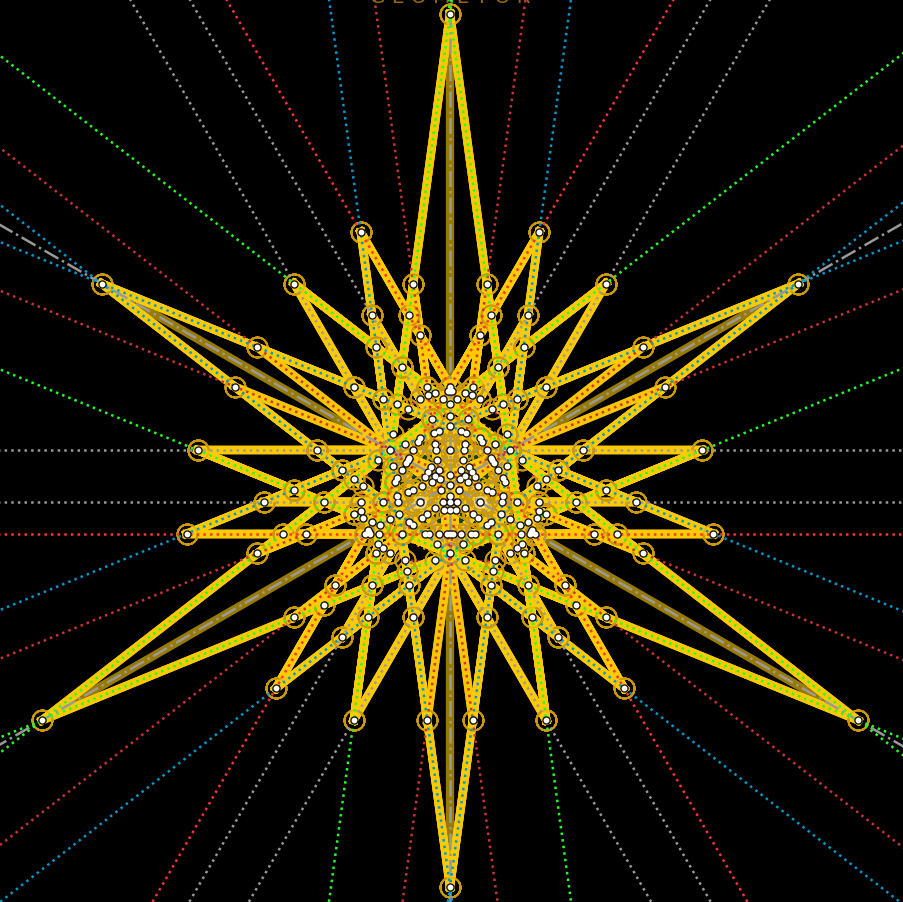
A single instance of Pappus’s Hexagon Theorem fixes an ordering of the two collinear triples
$(A_0, A_1, A_2)$ on carrier $a$ and $(B_0, B_1, B_2)$ on carrier $b$. Yet the nine cross-lines
$\{[A_i B_j] : 0 \le i, j \le 2\}$ exist independently of how the indices on $b$ are labeled!
Hold $(A_0, A_1, A_2)$ fixed and let the symmetric group $S_3$ of order $3! = 6$ permute
the labels on $b$ via $\sigma = (\sigma_0, \sigma_1, \sigma_2) \in S_3$. Each permutation
inscribes a distinct hexagon
determine a distinct Pappus line $p_\sigma$. Across all six elements of $S_3$, the nine
cross-lines meet in 18 cross-join intersections arranged three-by-three along six Pappus
lines—splitting cleanly by permutation parity into the alternating subgroup
$A_3 = \{(0,1,2),\, (1,2,0),\, (2,0,1)\}$ (even, 3-cycles) and its odd coset
$S_3 \setminus A_3 = \{(0,2,1),\, (1,0,2),\, (2,1,0)\}$ (odd, transpositions).
Exact Six $S_3$ Pappus Lines on preset="steiner" ($A = [(1,0),(2,0),(3,0)]$, $B = [(0,2),(3,1),(5,\tfrac{1}{3})]$)
Jakob Steiner’s Theorem (1828): The Two Star Points
In 1828, Jakob Steiner discovered a remarkable higher-order concurrency hidden inside the
six Pappus lines: they do not meet in 15 generic points, nor do all six concur at a single point.
Instead, concurrency respects permutation parity:
The three even Pappus lines ($\sigma \in A_3$, amber) concur at a single point, the even
Steiner Star point $S_+$.
The three odd Pappus lines ($\sigma \in S_3 \setminus A_3$, magenta) concur at a second
point, the odd Steiner Star point $S_-$.
step Trace the three even ($A_3$) Pappus lines: p012,
p120, and p201.
step Verify their exact concurrency at the even Star point S_+
$= \left(\frac{80}{39},\, \frac{7}{26}\right)$:
$3\left(\frac{80}{39}\right) + 18\left(\frac{7}{26}\right) = \frac{80 + 63}{13} = 11$,
$9\left(\frac{80}{39}\right) + 2\left(\frac{7}{26}\right) = \frac{240 + 7}{13} = 19$, and
$3\left(\frac{80}{39}\right) - 8\left(\frac{7}{26}\right) = \frac{80 - 28}{13} = 4$.
step Trace the three odd ($S_3 \setminus A_3$) Pappus lines:
p021, p102, and
p210.
step Verify their exact concurrency at the odd Star point S_-
$= \left(\frac{5}{3},\, -\frac{1}{2}\right)$, and join the two Star points along the dashed
violet Steiner lineS_+S_- ($12x - 6y = 23$).
Inspecting each permutation $\sigma \in S_3$ individually reveals how cycling $(B_0, B_1, B_2)$
sweeps the three even Pappus lines around $S_+$ while transposing any pair switches parity into
the odd pencil around $S_-$:
In GEOMETOR’s original 2023 pappus.py exploration ($A = [(0,0), (1,0), (3,0)]$ on $y = 0$
and $B = [(0,1), (3/2, 1), (5/2, 1)]$ on $y = 1$), constructing all nine cross-lines uncovered
both a subtle projective phenomenon and exact rational Star coordinates:
Because $[A_0 B_1]$ and $[A_1 B_2]$ share exact slope $\frac{2}{3}$, one of the 18 cross-join
pairs meets at an ideal point on the line at infinity, leaving 17 finite cross-join
meets in $\mathbb{Q}^2$. On the odd transposition $\sigma = (2, 1, 0)$, that parallel
cross-join pair $[A_0 B_1] \parallel [A_1 B_2]$ directs its Pappus line along exact slope
$\frac{2}{3}$ toward the ideal meet!
All three even Pappus lines meet inside the central strip at the exact rational Star point
while the three odd Pappus lines concur far in the first quadrant at
$S_- = \left(10,\; \frac{38}{3}\right)$.
step Observe the three even Pappus lines p012,
p120, and p201 converging inside
the parallel carrier band at S_+ $= \left(\frac{90}{73}, \frac{38}{73}\right)$.