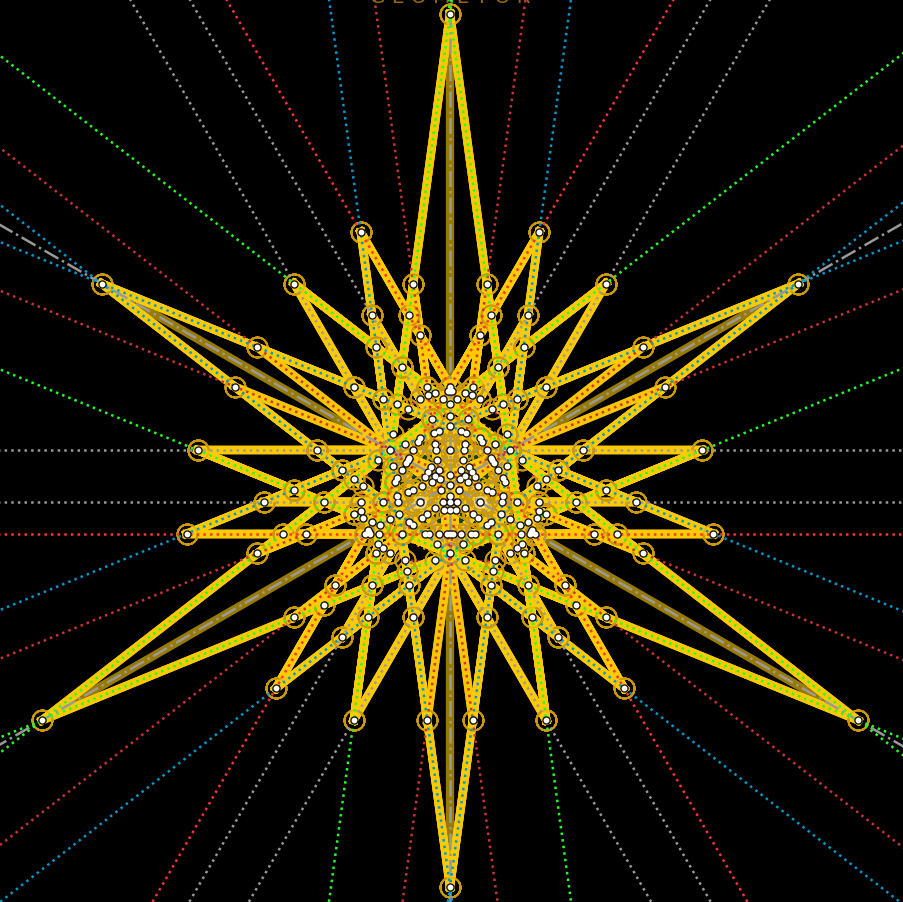
The Hexagon Theorem Step-by-Step
General Projective Construction (Synagoge VII.139)
Let $a$ and $b$ be two distinct lines in the plane meeting at $O$, carrying triples $(A_0, A_1, A_2)$ and $(B_0, B_1, B_2)$ respectively. Connecting alternating vertices in the cyclic order
forms a self-intersecting Pappus hexagon inscribed between the two lines. Its six sides group naturally into three pairs of opposite cross-joins:
Geometric Element |
Incidence Definition |
Exact SymPy Coordinates / Equation |
|---|---|---|
Carrier $a$ |
$[A_0 A_2]$ through $(0,0), (2,0), (5,0)$ |
$y = 0$ |
Carrier $b$ |
$[B_0 B_2]$ through $(0,2), (2,3), (6,5)$ |
$-3x + 6y - 12 = 0$ |
Perspective Apex $O$ |
$a \cap b$ |
$(-4, 0)$, spread $s(a, b) = \frac{1}{5}$ |
Cross-Join Meet $M_{01}$ |
$[A_0 B_1] \cap [A_1 B_0]$ |
$\left(\frac{4}{5},\, \frac{6}{5}\right)$ |
Cross-Join Meet $M_{20}$ |
$[A_2 B_0] \cap [A_0 B_2]$ |
$\left(\frac{60}{37},\, \frac{50}{37}\right)$ |
Cross-Join Meet $M_{12}$ |
$[A_1 B_2] \cap [A_2 B_1]$ |
$\left(\frac{10}{3},\, \frac{5}{3}\right)$ |
Pappus Line $p$ |
$[M_{01} M_{12}]$ containing $M_{20}$ |
$-7x + 38y - 40 = 0$ |
Universal Homogeneous Symbolic Proof
Beyond any specific rational instance, verify_pappus_symbolic() proves Pappus’s Hexagon
Theorem universally over the eight-variable polynomial ring
$\mathbb{Z}[a_0, a_1, a_2, b_0, b_1, b_2, m, c]$:
By an affine frame choice, take carrier $a$ as $y = 0$ with homogeneous points $A_i = [a_i : 0 : 1]$, and take carrier $b$ as $y = m x + c$ with homogeneous points $B_j = [b_j : m b_j + c : 1]$ (simultaneously covering oblique lines $m \ne 0$ and parallel lines $m = 0, c \ne 0$).
In $\mathbb{P}^2$, both joining two points and intersecting two lines are given by the 3D vector cross product $\times$:
\[M_{01} = (A_0 \times B_1) \times (A_1 \times B_0), \quad M_{12} = (A_1 \times B_2) \times (A_2 \times B_1), \quad M_{20} = (A_2 \times B_0) \times (A_0 \times B_2).\]The three points $M_{01}, M_{12}, M_{20}$ are collinear if and only if their $3 \times 3$ homogeneous determinant vanishes:
\[\begin{split}\det \begin{bmatrix} M_{01} \\ M_{12} \\ M_{20} \end{bmatrix} \equiv 0 \quad \text{in } \mathbb{Z}[a_0, a_1, a_2, b_0, b_1, b_2, m, c].\end{split}\]Expanding this degree-12 polynomial in SymPy cancels every monomial identically to
0—a direct computational manifestation of the commutativity of polynomial multiplication!
Homologous Type Triangles (square, circle, diamond)
In GEOMETOR’s pappus-3.py investigation, the three indices $\{0, 1, 2\}$ are assigned
three structural types—square ($0$), circle ($1$), and diamond ($2$)—so that each
cross-join meet inherits the complementary index missing from its pair:
Square ($0$): A0, B0, and opposite meet M12 form △square (exact area $\frac{10}{3}$).
Circle ($1$): A1, B1, and opposite meet M20 form △circle (exact area $\frac{21}{37}$).
Diamond ($2$): A2, B2, and opposite meet M01 form △diamond (exact area $\frac{111}{10}$).