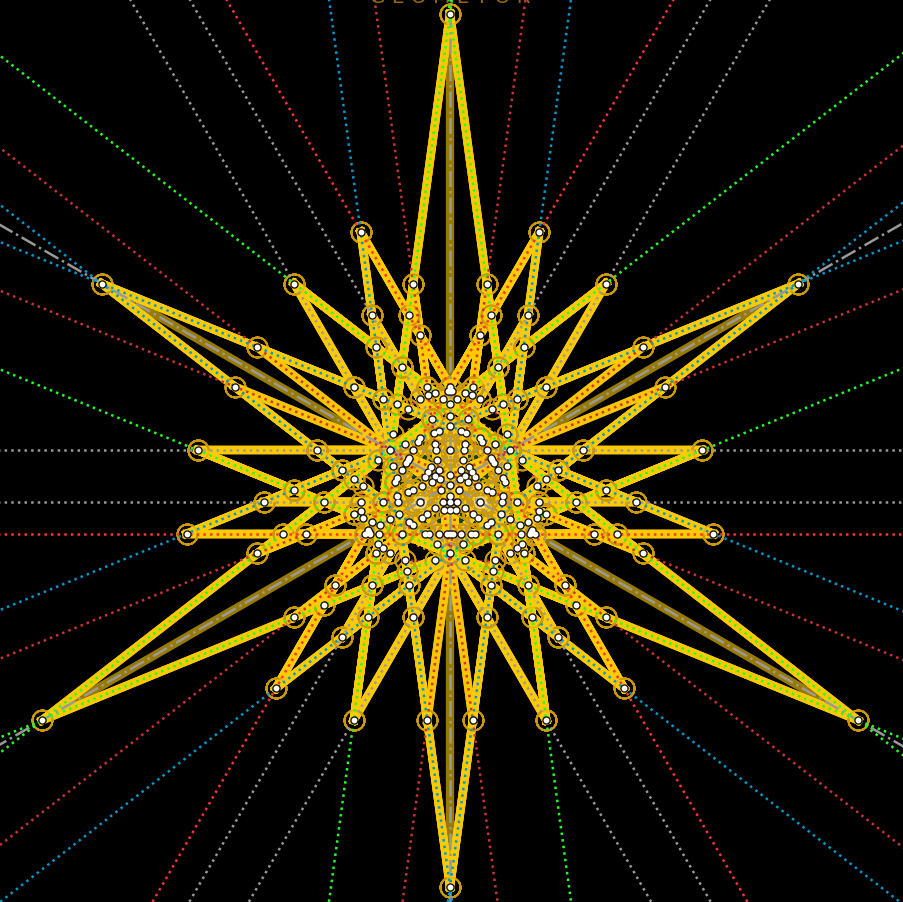
Golden-Section Specialization in $\mathbb{Q}(\phi)$
Modern Geometric Synthesis · Algebraic Invariants in the Golden Field
When the diameter segments stand in the square of the golden ratio, $a = 1$ and $b = \phi^2 = \phi + 1$ (where $\phi = \frac{1 + \sqrt{5}}{2}$), the total diameter has length $1 + \phi^2 = \phi + 2 = \sqrt{5}\,\phi$, and Pappus’s semicircle exhibits algebraic closure over $\mathbb{Q}(\phi)$:
Here OB gives the arithmetic mean:
\[A = \frac{1 + \phi^2}{2} = \frac{\phi + 2}{2},\]
the geometric mean DB equals the golden ratio itself:
\[G = \sqrt{1 \cdot \phi^2} = \phi,\]
and the harmonic mean BF equals:
\[H = \frac{2 \cdot 1 \cdot \phi^2}{1 + \phi^2} = \frac{2\phi^2}{\phi + 2} = \frac{2\phi}{\sqrt{5}},\]
confirming the fundamental identity:
\[A \cdot H = \left(\frac{\phi + 2}{2}\right)\left(\frac{2\phi^2}{\phi + 2}\right) = \phi^2 = G^2\]
and $(A, C; D, T) = -1$ at T with zero floating-point approximation in geometor.pappus.construct_three_means().