
CHAPTER LXVII
How It Is Manifestly Demonstrated That Every Lateral Pyramid Is One-Third (Subtripla) of Its Column, and Why Every Polygon of N Sides Resolves into N − 2 Triangles.
To make clear to the eye why every lateral pyramid is one-third (subtripla) of its corresponding lateral column, we set forth the demonstration from the seventh of the twelfth book (the sixth and eighth of the twelfth in Campanus) and the thirty-second of the first book:
Resolution of Every Prism into Triangular Prisms (Corpi Seratili) and Triangulation of Polygons ([XII.7], [I.32])
Every three-sided column (corpo seratile) is divisible into three equal triangular pyramids, and is therefore triple (\(3 : 1\)) each of them ([XII.7], Campanus XII.6).
Every \(n\)-sided polygon is resolvable into \(n - 2\) triangles by drawing diagonals from one vertex to the non-adjacent vertices ([I.32] Corollary), and therefore every \(n\)-sided lateral column is resolvable into \(n - 2\) triangular columns (corpi seratili), each of which is triple its pyramid; hence the whole lateral column is triple (\(3 : 1\)) the whole lateral pyramid!
Proof and General Polygon Triangulation Rule ([XII.7], [I.32])
The Triangular Column (*:term:`Corpo Seratile <corpo-seratile>`*): In the sixth of the twelfth (Campanus numbering), our philosopher proves that a triangular prism (:term:`corpo seratile <corpo-seratile>`) is divided by two diagonal plane cuts into three equal triangular pyramids having triangular bases, so that the :term:`corpo seratile <corpo-seratile>` is triple (\(3 : 1\)) its pyramid.
The Quadrilateral Column: Take any four-sided column. Since its base \(abcd\) is a quadrilateral (4 angles and 4 sides), drawing a single diagonal \(bd\) from one corner to the opposite corner (see the marginal diagram
0057.g1.pngon Folio 0057) resolves the quadrilateral base \(abcd\) into two triangles \(abd\) and \(bcd\). Passing a vertical plane through the diagonal \(bd\) resolves the entire quadrilateral column into two triangular columns (*doi :term:`corpi seratili <corpo-seratile>`*), and resolves its quadrilateral pyramid into two triangular pyramids. Since each :term:`corpo seratile <corpo-seratile>` is triple its triangular pyramid, both :term:`corpi seratili <corpo-seratile>` together (the whole quadrilateral column) are triple both triangular pyramids together (the whole quadrilateral pyramid)!The Pentagonal Column: Take any five-sided column, whose base is the pentagon \(abcde\) (see the marginal diagram
0057.g2.pngon Folio 0057). From a single vertex \(a\), draw the two pentagonal chords (corde pentagoniche) \(ac\) and \(ad\) to the two opposite vertices \(c\) and \(d\). This resolves the pentagon \(abcde\) into three triangles \(abc\), \(acd\), and \(ade\), and resolves the pentagonal column into three triangular columns (*tre :term:`corpi seratili <corpo-seratile>`*), each triple its pyramid; hence all three together (the whole pentagonal column) are triple all three pyramids together (the whole pentagonal pyramid)!Universal Law of Polygon Triangulation (:just:`I.32` Scholium): In general, as demonstrated upon the thirty-second of the first, every polygonal figure of :math:`n` angles (and :math:`n` sides) is minimally resolved into :math:`n - 2` triangles (in tanti triangoli quanti sonno li suoi angoli ouer lati men doi):
A quadrilateral (4 sides) resolves into \(4 - 2 =\) 2 triangles;
A pentagon (5 sides) resolves into \(5 - 2 =\) 3 triangles;
A hexagon (6 sides) resolves into \(6 - 2 =\) 4 triangles;
et sic in reliquis.
Praise of Euclid of Megara and Book X of the Elements
How deeply obligated we are, most lofty Duke, to the Ancients who by their long nightly vigils illuminated our minds—and above all to our Euclid of Megara (al nostro Megarense Euclide), who in an orderly chain gathered the discoveries of his predecessors and added his own with such diligent demonstrations throughout his sublime volume! Truly his intellect shows itself not human, but divine (non humano ma divino)—most especially in his tenth book (nel suo decimo), where he exalted human reason as high as is permitted to mortal man; nor can I comprehend how anyone could have spoken more sublimely of those most abstract irrational lines (linee abstractissime irrationali), whose science is the deepest above all others in the judgment of those who know best!
Marginal Woodcut Diagrams (Paganini 1509)
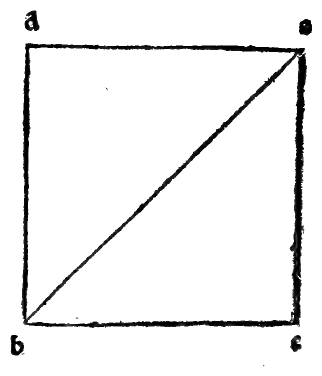
Folio 0057 Diagram 1
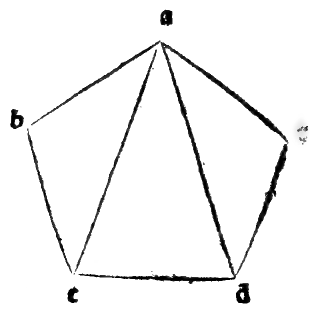
Folio 0057 Diagram 2