
CHAPTER LV
On the Way to Know How to Form Still More Bodies Beyond Those Mentioned, How Their Forms Proceed to Infinity, and Why Plato Assigned the Five Regular Bodies to the Five Simple Bodies of the Universe.
From what has been shown in the preceding chapters, most lofty Duke, any speculative intellect can readily understand how infinitely many more dependent bodies (in infinito) can be formed beyond those already described, and why the divine philosopher Plato in his Timaeus assigned the five regular bodies alone to the five simple bodies of the universe.
1. How Dependent Bodies Proceed to Infinity
Just as in plane geometry the number of equilateral and equiangular polygons increases without end—from the triangle (3 sides), square (4), pentagon (5), hexagon (6), heptagon (7), octagon (8), and so on in infinito—and just as in [XII.17] (Chapter LIV) we divided the sphere by meridians and parallels to produce the 72-base body, so by continually bisecting the arcs of the sphere or by repeatedly truncating (tagliando / abscindendo) the solid angles and edges of any regular or dependent polyhedron, and again elevating pyramids upon the resulting faces, new polyhedral forms of 100, 200, or 1,000 bases can be generated to infinity, approaching ever closer to the roundness of the sphere!
Yet none of these infinite dependent bodies can ever be regular in the strict sense (having all faces equal and of one single kind, all edges equal, and all solid angles equal), for as we proved demonstratively in Chapter XXV ([XI.21], [I.32]), only five such bodies can exist in nature.
2. Why Plato in the Timaeus Assigned the Five Regular Solids to the Five Simple Elements
Because there are in the entire created universe five simple bodies—namely the four sublunary elements (Earth, Fire, Air, and Water) and the fifth essence, the Universal Heaven (il Cielo / Quinta Essentia)—Plato, arguing as a most profound geometer and mathematician, matched each of the five simple bodies to the one regular solid whose geometric properties correspond to its natural motion and character:
The Cube (6 Square Faces, 8 Solid Angles) — Assigned to Earth (*Terra*): Among all the elements, Earth is the most immobile, fixed, heavy, and stable, resting at the center of the world. And among the five regular solids, none sits more firmly and immovably upon its base than the cube (exacedron), bounded by six flat square faces at right angles; whereas a sphere touches a plane at a single point and rolls at the slightest impulse, the cube rests flat and unshakable.
The Tetracedron (4 Triangular Faces, 4 Solid Angles) — Assigned to Fire (*Fuoco*): Fire is the lightest, sharpest, most penetrating, and quickest to ascend of all the elements, rising upward into a sharp flame (whence the very name pyramis comes from the Greek pyr, meaning fire!). And among the five regular bodies, the tetracedron has the fewest faces (4), the smallest volume for its surface, and the sharpest, most acute solid angles (each contained by only three plane angles totaling two right angles, \(180^{\circ}\)), so that it pierces and divides all things.
The Octocedron (8 Triangular Faces, 6 Solid Angles) — Assigned to Air (*Aria*): Air is next to fire in subtlety, mobility, and lightness. The octocedron, having 8 equilateral triangular faces and 6 four-triangle vertices (totaling \(2\frac{2}{3}\) right angles), is intermediate in mobility and acuteness between the sharp tetracedron of Fire and the rounder ycocedron of Water.
The Ycocedron (20 Triangular Faces, 12 Solid Angles) — Assigned to Water (*Acqua*): Water is heavier and more fluid, flowing downward and spreading across the earth rather than ascending like flame. Accordingly, Plato assigned to Water the ycocedron, which has the greatest number of faces (20 triangles) and the most obtuse, rounded solid angles (each formed by 5 triangles totaling \(3\frac{1}{3}\) right angles) among the bodies bounded by triangles, so that it is closest to a rolling drop that flows and descends.
The Duodecedron (12 Pentagonal Faces, 20 Solid Angles) — Assigned to the Heaven (*Il Cielo / :term:`Quinta Essentia <quinta-essentia>`*): Finally, Plato assigned the duodecedron of 12 regular pentagonal bases to the Universal Heaven:
First, because just as the Heaven is the receptacle and lodging (receptaculo e albergo) of all created things in the universe, so the duodecedron alone (as we proved in Chapter XLVI) is the receptacle of all four of the other regular bodies inscribed within it!
Second, as Alcinous (Alcinovo), Calcidius (Calcidio), Macrobius, and Apuleius observe in their commentaries on Plato’s Timaeus: just as the celestial Zodiac is divided into 12 Signs (12 segni), and each of the 12 Signs is divided into 30 degrees (30 gradi), making 360 degrees in the entire annual revolution of the sun through the heaven, so the duodecedron has 12 pentagonal bases, and when each pentagon is resolved from its center into 5 isosceles triangles and each of those 5 triangles is subdivided by its three medians/altitudes into 6 scalene right triangles, each pentagonal face contains \(5 \times 6 =\) 30 elementary triangles, and all 12 pentagonal faces together contain:
\[12 \times 5 \times 6 = 12 \times 30 = 360\text{ triangles}\]matching the 360 degrees of the Zodiac! (See the two marginal woodcut diagrams
0049.g1.pngand0049.g2.pngon Folio 0049.)
And if a sixth simple element could have existed in nature without a corresponding sixth regular solid, the Supreme Artificer (el summo Opefice) would have seemed lacking in foresight—which is impossible. Nor is the sphere excluded from perfection because only these five are called regular polyhedra: rather, the sphere is most regular above all (sopra tutti regularissima), having no diversity of faces or angles at all, but absolute uniformity everywhere, being the sublime cause and container from which all the other bodies derive!
Marginal Woodcut Diagrams (Paganini 1509)
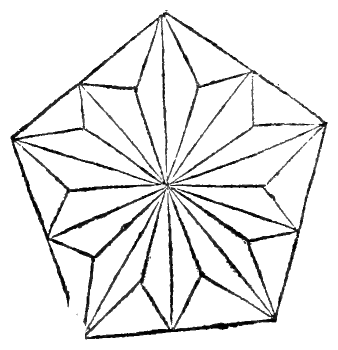
Folio 0049 Diagram 1