
CHAPTER XXVI
How the First Regular Body, Called the Tetracedron or Pyramid of Four Triangular Bases, Is Formed and Placed in the Sphere.
Now that we have shown why there cannot be more than five regular bodies, we shall explain in order how each of them is formed from the given diameter of the sphere in which it is to be inscribed, beginning with the first, called the tetracedron ([XIII.13]).
Construction of the Regular Tetrahedron in a Given Sphere ([XIII.13])
Given the diameter of a sphere, to find the side of the regular pyramid of four equilateral triangular bases (tetracedron) inscribed in that sphere, and to show that the square on the diameter of the sphere is sesquialtera (\(3 : 2\)) to the square on the side of the tetracedron.
Construction and Proof ([XIII.13], [VI.8], [III.31], [XIII.12], [XI.4])
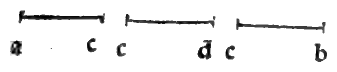
Let \(ab\) be the given diameter of the sphere (see the marginal diagram
0032.g1.pngon Folio 0032). Divide \(ab\) at point \(c\) so that \(ac\) is double \(cb\) (\(ac = 2\,cb\)), whence \(ab\) is triple \(cb\) (\(ac = \frac{2}{3}ab\), \(cb = \frac{1}{3}ab\)).Upon the diameter \(ab\) describe the semicircle \(adb\), and from point \(c\) erect the perpendicular \(cd\) meeting the circumference at \(d\), and join the straight lines \(da\) and \(db\).
Because \(\angle adb\) in a semicircle is a right angle ([III.31]) and \(dc\) is perpendicular to the base \(ab\), by the eighth of the sixth the triangles \(adb\), \(adc\), and \(dcb\) are similar, and \(ac : cd = cd : cb\), so \(cd^{2} = ac \cdot cb\). Moreover, \(ab : ac = da^{2} : ac^{2} \implies da^{2} = ab \cdot ac\).
Since \(ab : ac = 3 : 2\) (the sesquialtera ratio), the square on the diameter of the sphere (\(ab^{2}\)) has to the square on the chord \(da\) (\(da^{2}\)) the ratio \(3 : 2\) (\(da^{2} = \frac{2}{3}ab^{2}\)), and \(da^{2} : cd^{2} = ac : cb = 2 : 1\).
Now construct in a plane a circle whose radius (semidiameter) equals \(cd\), and inscribe in it the equilateral triangle \(efg\). By the twelfth of the thirteenth, the square on the side of an equilateral triangle inscribed in a circle is triple the square on the radius of that circle (\(ef^{2} = 3\,cd^{2}\)).
Because \(ac = 2\,cb\), we have \(da^{2} = ac^{2} + cd^{2} = 4\,cb^{2} + cd^{2}\); and since \(cd^{2} = ac \cdot cb = 2\,cb^{2}\), it follows that \(da^{2} = 2\,cd^{2} + cd^{2} = 3\,cd^{2}\). Therefore \(da^{2} = ef^{2}\), so each side \(ef, fg, ge\) of the equilateral base equals \(da\)!
Erect from the center \(h\) of the circle \(efg\) a perpendicular to the plane of the triangle ([XI.12]) of length \(hk = ac\), and join the vertex \(k\) to \(e, f, g\). By the fourth of the eleventh and the penultimate of the first, each slant edge satisfies:
\[ke^{2} = kh^{2} + he^{2} = ac^{2} + cd^{2} = da^{2}\]Thus all six edges \(ef, fg, ge, ke, kf, kg\) are mutually equal to \(da\), and as the semicircle \(adb\) revolves around the fixed axis \(ab\), its circumference passes simultaneously through all four vertices \(k, e, f, g\).
Therefore the regular tetracedron has been formed and inscribed in the given sphere, and the square on the sphere’s diameter \(ab\) is sesquialtera (\(3 : 2\), or \(1\frac{1}{2}\)) to the square on the edge \(da\) of the tetracedron. For example, if the diameter of the sphere is \(6\) (so its square is \(36\)), the square on the side of the tetracedron is \(24\), and the side itself is \(\sqrt{24}\) (radice de 24).
Marginal Woodcut Diagrams (Paganini 1509)
Folio 0032 Diagram 2