
CHAPTER XVII
On the Eighth Effect, the Converse of the Preceding

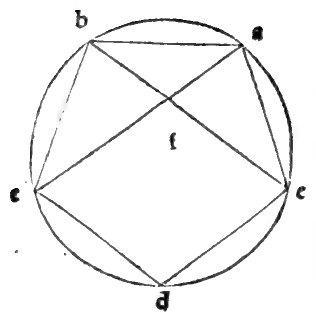
If a line be divided according to the proportion having a mean and two extremes, then for that circle in which the greater part is the side of the inscribed hexagon, the lesser part will always be the side of the regular decagon inscribed in the very same circle ([XIII.9]).
Numerical Demonstration and Ptolemaic Application
For example, if the divided line is $10$, its greater part, which is $\sqrt{125} - 5$, will always be the side of the equilateral hexagon of a circle whose diameter is double $\sqrt{125} - 5$, namely $\sqrt{500} - 10$ ([IV.15]). I say that in that very same circle, the lesser part, $15 - \sqrt{125}$, will be the side of the equilateral decagon inscribed therein.
Of this converse Ptolemy makes great use in the ninth [tenth] chapter of the First Book (prima dictione) of his Almagest to demonstrate the lengths of the chords of circular arcs (la quantità dele corde degli archi del cerchio); and it is similarly demonstrated openly in the commentary upon the aforesaid ninth proposition of the Thirteenth Book ([XIII.9]) geometrically.
Marginal Woodcut Diagrams (Paganini 1509)
Folio 0028 Diagram 1