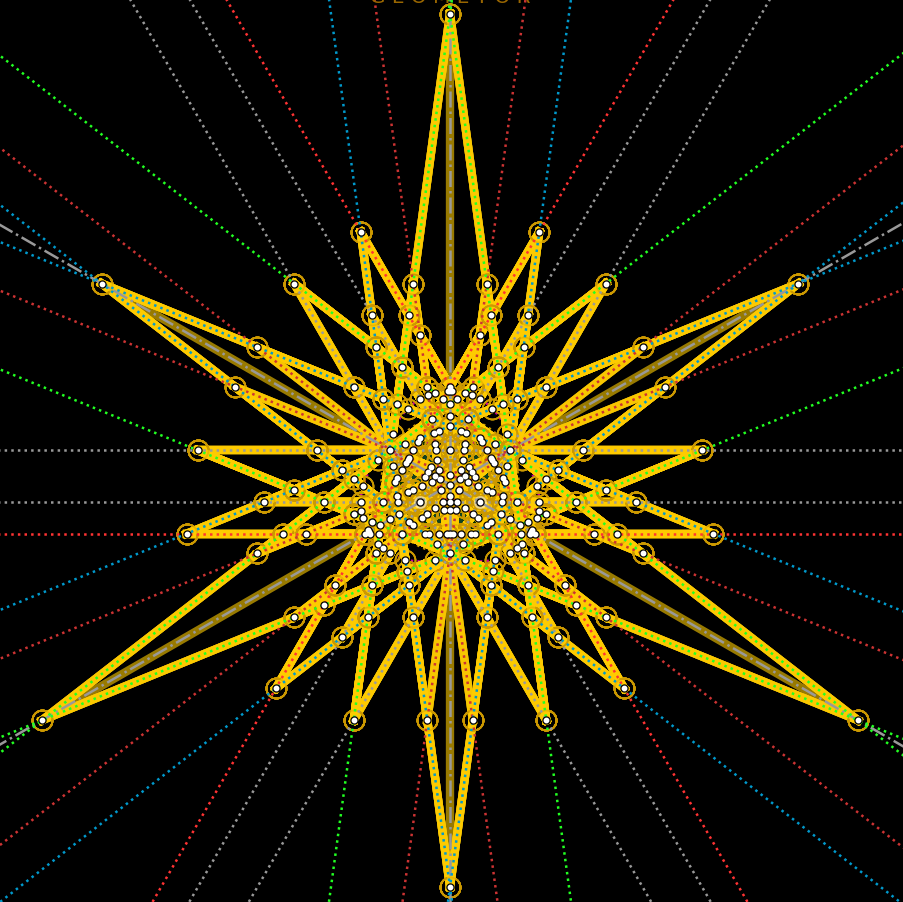
Unit IV — Scholarly & GEOMETOR Symbolic Commentary¶
From Menelaus III.6–III.10 to Converse Collinearities & Projective Trilinear Polarity
1. Exact Symbolic Proof of Spherical Orthocenter Concurrency (Prop. III.10)¶
In spherical_orthocenter_menelaus(), Menelaus’s three-transversal proof of Sphaerica III.10 ([§4.4], Halley pp. 95–97) is verified algebraically on \(S^2(\mathbb{Q})\) alongside the concise Lagrange vector-triple-product identity for altitude normals \(\mathbf{m}_A = (\mathbf{B} \times \mathbf{C}) \times \mathbf{A}\), \(\mathbf{m}_B = (\mathbf{C} \times \mathbf{A}) \times \mathbf{B}\), \(\mathbf{m}_C = (\mathbf{A} \times \mathbf{B}) \times \mathbf{C}\):
and the spherical orthocenter \(\mathbf{H} \propto \mathbf{m}_A \times \mathbf{m}_B\) satisfies exact dihedral orthogonality \((\mathbf{A}\times\mathbf{H})\cdot(\mathbf{B}\times\mathbf{C}) = (\mathbf{B}\times\mathbf{H})\cdot(\mathbf{C}\times\mathbf{A}) = (\mathbf{C}\times\mathbf{H})\cdot(\mathbf{A}\times\mathbf{B}) = 0\) on all three sides simultaneously. Remarkably, Menelaus’s auxiliary great circle ΕΔΘ joining the altitude feet Δ and Ε is literally the orthic axis—the trilinear polar of the orthocenter Ζ!
2. Converse of Menelaus Collinearity Gallery (geometor.menelaus.planar_transversal)¶
Menelaus’s external bisector theorem (Prop. III.6, [§4.1]) and harmonic transversal methods blossom into four classic projective collinearity theorems proved in geometor.menelaus.planar_transversal via the Converse of Menelaus (\(\text{signed product} = -1\)):
External Angle-Bisector Axis (
construct_external_bisector_axis(), planar counterpart of Sphaerica Prop. III.6): on Heronian △ABC (\(a=7, b=20, c=15\), incenter I), the external bisector feet De, Ee, Fe satisfy \((-c/a)(-b/c)(-a/b) = -1\) and lie on the anti-orthic axis DeEe (the trilinear polar of I!).
Pascal’s Hexagrammum Mysticum (
construct_pascal_hexagram(), cf.geometor/pappus): on circle OP1 with rational vertices P1, P2, P3, P4, P5, P6 and diagonal triangle U, V, W, three applications of Planar Menelaus combined with Euclid III.35/36 chord-power identities cancel to \(-1\), aligning opposite-side intersections L, M, N on Pascal’s Mystic Line LM.
Alongside these two constructions, construct_desargues_axis() proves Desargues’s Two-Triangle Theorem via three Menelaus applications on perspective ray-triangles, and construct_monge_exsimilicenters() proves Monge’s Three-Circle Theorem via \((-r_A/r_B)(-r_B/r_C)(-r_C/r_A) = -1\) (see Symbolic Demonstrations for all 10 interactive figures).
3. Projective Menelaus–Ceva Duality & ETC Trilinear Polars (geometor.menelaus.duality_ceva)¶
In construct_trilinear_polar(), concurrent cevians through perspector P meet the sides of △ABC at Dc, Ec, Fc (\(\text{Ceva product} = +1\)). Intersecting the cevian-triangle sides EcFc, FcDc, DcEc with the extended sides of △ABC produces the harmonic conjugates Dm, Em, Fm, flipping all three signs \((-1)^3(+1) = -1\) onto the trilinear polar DmEm! In geometor.menelaus.duality_ceva:
verify_projective_menelaus_ceva_duality()proves that under homogeneous point-line polarity \([x : y : z] \leftrightarrow xX + yY + zZ = 0\) in \(\mathbb{P}^2\), Menelaus’s collinearity of three side-cuts (\(-1\)) and Giovanni Ceva’s concurrency of three vertex-joins (\(+1\), De lineis rectis, 1678) are algebraically dual theorems!etc_trilinear_polar_catalogue()connects directly togeometor/etcacross four canonical Kimberling centers on the integer-incenter Heronian triangle \((15, 7, 20)\):X(1)(Incenter): trilinear polar is the anti-orthic / external-bisector axis!X(2)(Centroid): trilinear polar is the line at infinity \([0 : 0 : 1]\) in \(\mathbb{P}^2\) (medial sides are parallel to reference sides!).X(4)(Orthocenter): trilinear polar is the orthic axis—the exact planar counterpart of Menelaus’s lineΕΔΘin Sphaerica Prop. III.10!X(7)(Gergonne Point): trilinear polar is the incircle chordal / Gergonne axis!