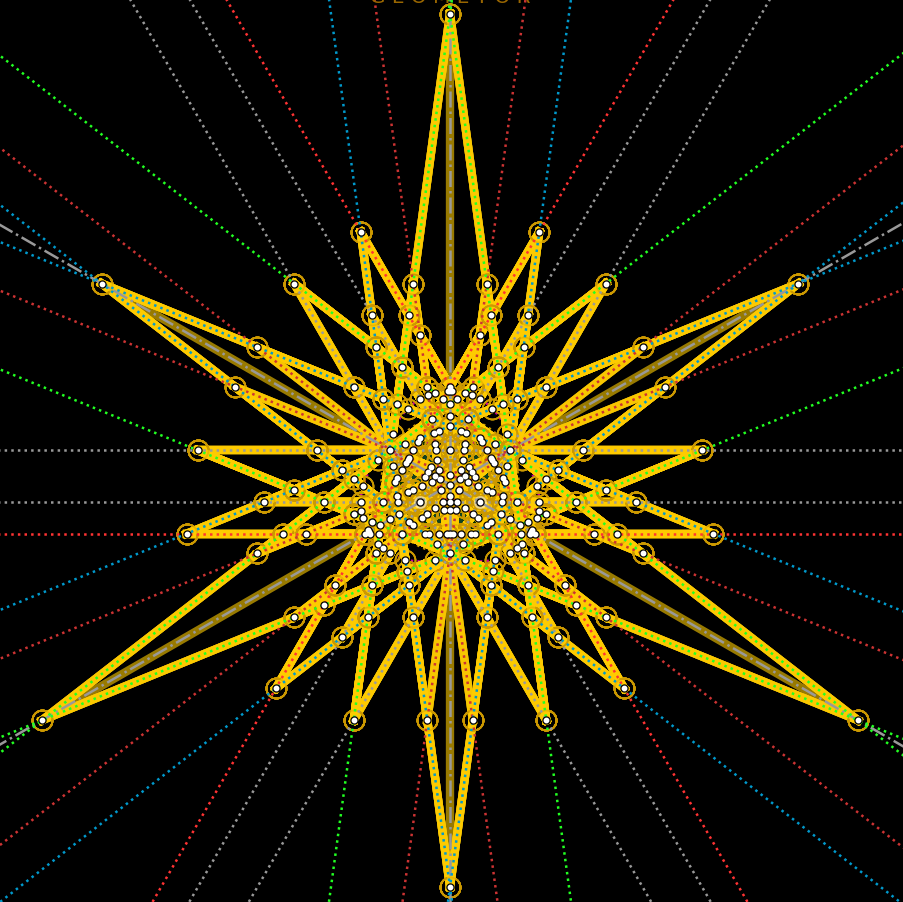
Unit II — Scholarly & GEOMETOR Symbolic Commentary¶
Historiographical Context (Björnbo 1902) & Exact Convexity Interpretation
1. Björnbo (1902) & Halley (1758) on Book II Manuscript Numbering¶
As Axel Anthon Björnbo (1902, §§6–8) documented by comparing Edmond Halley’s Oxford edition (1758, 12 propositions in Book II) against Gerard of Cremona’s Toledo Latin version and Abū Naṣr Manṣūr’s 1007 CE redaction, medieval copyists subdivided Menelaus’s multi-case cevian theorems differently (producing between 8 and 19 numbered propositions), yet every witness preserves the programmatic Theodosian transition ([§2.2], Halley p. 75) verbatim from the Arabic of Isḥāq ibn Ḥunayn / Thābit ibn Qurra. Francesco Maurolico (1558), by contrast, expanded Book II heavily with his own interpolated lemmas, which Halley systematically excised using the Bodleian Huntington Hebrew codex of Jacob ben Machir.
2. Modern Analytic Meaning of Proposition II.10 (Declination & Right Ascension)¶
Let the ecliptic ΘΜΒ meet the celestial equator ΒΤΞΡΧ at the vernal equinox Β with obliquity \(\varepsilon \in (0, \pi/2)\), and let \(\lambda \in [0, \pi/2]\) denote ecliptic longitude measured from Β toward the summer solstice Θ (\(\lambda = \pi/2\)). Along the ecliptic, declination \(\delta(\lambda)\) and right ascension \(\alpha(\lambda)\) obey the spherical right-triangle laws (derived quantitatively in Book III, Prop. III.1 Coroll. 2):
Differentiating twice on \(\lambda \in (0, \pi/2)\):
Declination concavity (\(\delta''(\lambda) < 0\)): equal ecliptic increments \(\Delta\lambda\) produce larger declination changes \(\Delta\delta\) near the equinox
Β(hence larger polar-complement differencesΠΟ > ΣΘ) than near the solsticeΘ.Right-ascension convexity (\(\alpha''(\lambda) > 0\) for \(\lambda \in (\pi/4, \pi/2)\) and monotone comparison from solstice
Θ): equal ecliptic arcs near the solsticeΘproject onto larger equatorial right-ascension arcsΧΡ > ΞΤthan equal arcs nearer the equinoxΒ.
Menelaus proves both second-difference inequalities purely synthetically—with zero calculus and zero tables—from the intrinsic geometry of spherical triangle ΜΓΘ!