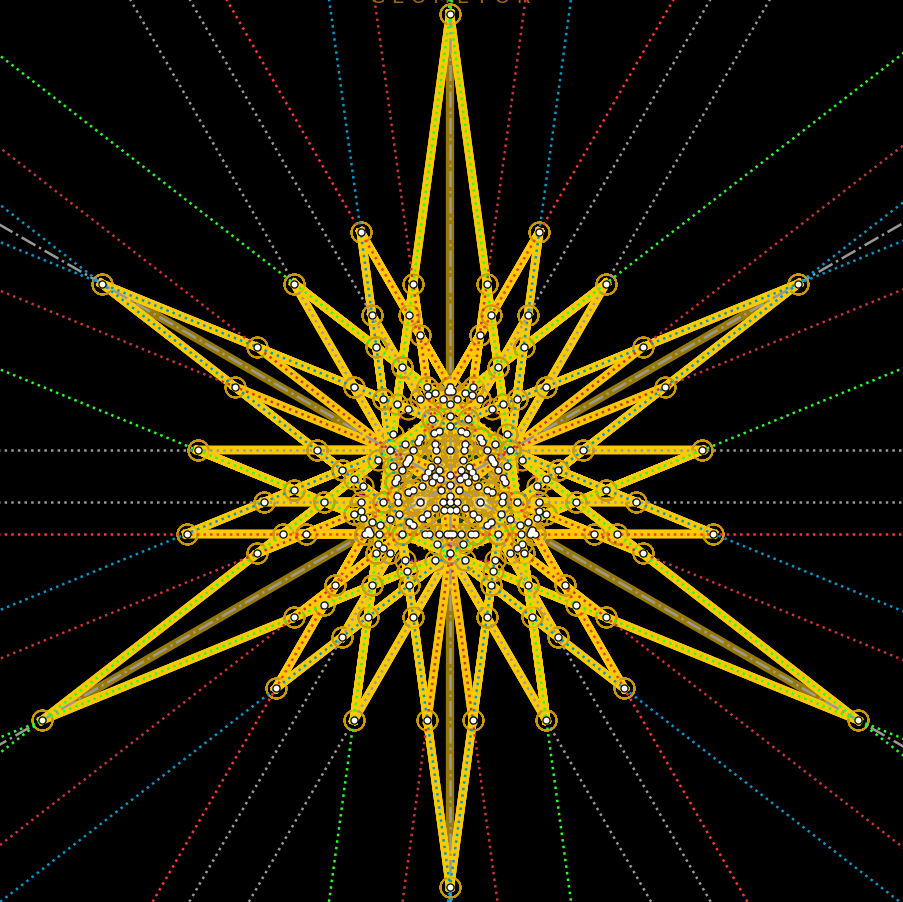
Commentary & Notes: Libro VII — August Adler and the Inversive Paradigm
How Circle Inversion Transformed Compass Completeness
1. From Mascheroni’s Exhaustive Cases to Adler’s Group Action
In 1797, Lorenzo Mascheroni had to divide Book VII into dozens of casework propositions: lines through the center, lines external to the circle, secant chords, parallel lines, intersecting lines at acute angles, and obtuse lines.
In 1890, the Czech-Austrian geometer August Adler (adler-1890) recognized that circular inversion acts as a conformal group involution on the extended plane:
Every straight line is simply a circle passing through the point at infinity \(\infty\).
Inverting through a point \(O\) maps \(\infty\) to \(O\), thus mapping every straight line not through \(O\) to a circle passing through \(O\).
Consequently, intersecting straight lines is mathematically identical to intersecting circles!
Adler’s paper eliminated the need for casework, proving the Mohr–Mascheroni theorem in less than three pages.
2. Relationship to Hilbert’s Field Criteria
In Grundlagen der Geometrie (1899, Chapter VII, hilbert-1899), David Hilbert showed that ruler-and-compass geometry constructs exactly those points whose coordinates lie in the field formed by successive square-root extensions of the rationals (\(\mathbb{Q} \subset K_1 \subset K_2 \dots\)).
Because the intersection of two circles \((x - a)^2 + (y - b)^2 = r_1^2\) and \((x - c)^2 + (y - d)^2 = r_2^2\) reduces algebraically to a linear equation (radical axis) and a quadratic equation, circle–circle intersections solve all quadratic equations. Mascheroni’s Book VII proves constructively that the compass alone accesses the full quadratic field closure.