Book III § 67: Repeated Binary Distance Subdivision¶
Lorenzo Mascheroni (The Geometry of the Compass, Pavia 1797, § 67, pp. 34–35)
Problem. To continue to subdivide into two equal parts with the simplest construction (fig. 18 and 19), \(AM\) into \(N\), \(AN\) into \(O\), and so on to infinity.
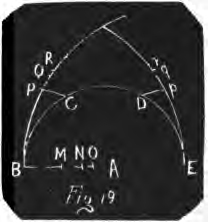
Solution. Semicircle \(BCDE\) having been described with radius \(AB\) (§ 64), and with the same radius and center \(B\) the indefinite arc \(P'CAp'\); with centers \(E\) and \(B\) and radius \(BE\) the two arcs \(R'Q'P'Bp'q'r'\), \(PQRERqp\); with center \(E\) and radius \(EC\) the arc \(PCp\); if with centers \(P'\) and \(p'\) and radius \(AB\) two arcs be described, they will intersect in \(M\) at the midpoint of \(AB\) (Sol. V, § 66).
Now set \(AP' = BQ' = Bq' = q'N = Q'N\) (§ 11). The point \(N\) will be at the midpoint of \(AM\).
Set \(AQ' = BR' = Br' = r'O = R'O\). The point \(O\) will be at the midpoint of \(AN\).
Continuing by the same method, one would divide \(AO\) into two equal parts, and so forth to infinity.
Demonstration. Imagine a line \(P'A\) bisecting the base \(BE\) of triangle \(\triangle P'BE\) (§ 12). By Apollonius’ median theorem (§ 26):
Substituting the known values \(BP' = AB\) and \(P'E = 2AB\), and subtracting \(2(AB)^2\), we obtain \(3(AB)^2 = 2(AP')^2\), whence:
Furthermore, point \(N\) lies on line \(BE\) (§ 13). The isosceles triangle \(\triangle Q'BN\) is similar to the isosceles triangle \(\triangle Q'BE\) by virtue of their common angle at \(B\) (Euclid I.5, I.32; VI.4). Comparing the two expressions for \((BQ')^2\):
Dividing by \(2 AB\) yields \(BN = \frac{3}{4} AB\), so that \(AN = \frac{1}{4} AB\). This proves that \(N\) is the exact midpoint of \(AM\).