Book III § 66: Distance Bisection Without Straightedge (Solution V)¶
Lorenzo Mascheroni (The Geometry of the Compass, Pavia 1797, § 66, pp. 33–34)
§ 66. Problem. To bisect a given distance \(AB\).
Solution V. With radius \(AB\) and center \(A\) (fig. 14), describe the semicircle \(BCDE\) (§ 64). With center \(E\) and radius \(EB\), describe the indefinite arc \(PBp\). With center \(B\) and radius \(BA\), cut this arc in \(P\) and \(p\). With these centers \(P\) and \(p\) and with the same radius \(BA\), describe two arcs intersecting in \(M\). The point \(M\) will be the sought point.
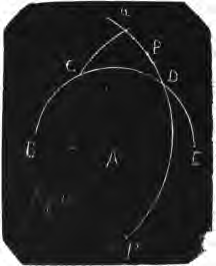
Demonstration. The point \(M\) will lie on line \(BE\) (§ 13). The two isosceles triangles \(\triangle PBM\) and \(\triangle PBE\) are similar on account of their common base angle at \(B\) (Euclid I.5, I.32; VI.4). Therefore:
whence (Euclid VI.17):
that is:
Dividing by \(AB\), we obtain:
or \(BM = \frac{1}{2}AB\). Consequently, the point \(M\) bisects the given distance \(AB\).