Book III § 64: Linear Distance Doubling¶
Lorenzo Mascheroni (The Geometry of the Compass, Pavia 1797, § 64, p. 31)
§ 64. Problem. To double the distance \(AB\) in a straight line.
Solution. With radius \(AB\) and center \(B\), describe the circle or arc \(BCDE\). With the same radius and center \(A\), cut the circumference at \(C\); with center \(C\), cut at \(D\); with center \(D\), cut at \(E\). I say that the distance \(AE\) is double \(AB\), and lies in a straight line with it.
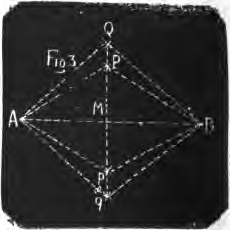
Demonstration. Since the radii \(BC, CD, DE\) and the chords \(BC, CD, DE\) are all equal to radius \(AB\), each of the three triangles \(\triangle ABC, \triangle BCD, \triangle BDE\) is equilateral. Each of the central angles \(\angle ABC, \angle CBD, \angle DBE\) is therefore equal to one-third of two right angles, or \(60^\circ\) (Euclid I.32).
The sum of the three angles is consequently equal to two right angles (\(180^\circ\)). Therefore the line \(ABE\) is a single continuous straight line (Euclid I.14).
Furthermore, since \(BE = AB\), the total distance \(AE = AB + BE = 2AB\). Which was to be constructed and demonstrated.