Book I: Notation and Fundamental Lemma (§§ 11–14)¶
Lorenzo Mascheroni (The Geometry of the Compass, Pavia 1797, pp. 14–15)
In like manner, three intervals \(AB, CD, EF\) being given, if I say: make :math:`EG = CD` and :math:`FG = AB`, it must be understood to mean: with radius \(CD\) and center \(E\), describe a circle on whose circumference lies point \(G\). Then with interval \(AB\) and center \(F\), describe another circle cutting the first in point \(G\).
At times in our demonstrations we shall mention certain straight lines that are not drawn in the figure, naming only the two endpoints between which they would be drawn—as if in § 11 I were to refer to line \(AB\) or \(CD\). This we shall do whenever there is no hazard of obscurity, in order to preserve the figure clean and allow the construction executed by the circle alone to stand forth clearly.
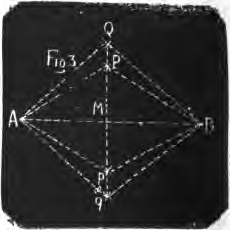
Lemma. If with two centers \(A\) and \(B\) and radii \(AP\) and \(AQ\) arcs are described intersecting in \(P\) and \(p\), and in \(Q\) and \(q\), the points \(Q, P, p, q\) will lie on the same straight line (fig. 3).
Demonstration. All sides of triangle \(APp\) are by construction equal respectively to those of triangle \(BPp\); hence angle \(APp\) equals angle \(BPp\) (Euclid I.8). By the same reasoning, \(\angle APQ = \angle BPQ\). Therefore the sum of angles \(\angle APp + \angle APQ\) equals the sum \(\angle BPp + \angle BPQ\). But the sum of all four angles is four right angles (Euclid I.13, Coroll.). Hence each pair of equal angles amounts to two right angles. Therefore \(QPp\) is a straight line (Euclid I.14). In the same manner \(Ppq\) is proved to be a straight line. Consequently, the points \(Q, P, p, q\) lie on the same straight line.
Under the same conditions as § 13, the lines \(AB\) and \(Pp\), as well as \(AB\) and \(Qq\), cut each other at right angles, and are bisected at their intersection point \(M\).