Book I: Definitions and Principles (§§ 1–10)¶
Lorenzo Mascheroni (The Geometry of the Compass, Pavia 1797, pp. 11–13)
I call Geometry of the Compass that which, by means of the compass alone without the straightedge, determines the position of points.
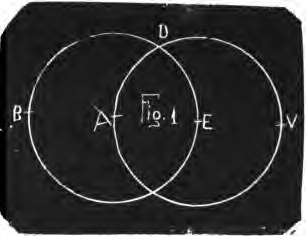
Given, for example, two points \(A\) and \(E\) (fig. 1); if a third point \(D\) be sought, which is as distant from each of them as they are from each other: describe with the interval, or radius \(AE\), and with centers \(A\) and \(E\), the two circles \(EDB\), \(ADV\), which intersect in the point \(D\). This point will be the sought point; for it will be distant from points \(A\) and \(E\) by an interval equal to \(AE\) (Prop. 1, Book I, Euclid). This point \(D\) has been found with the compass alone without the straightedge.
It may happen that the position of a point is found with the compass alone, yet to demonstrate the proposition it is necessary to construct the figure by means of the straightedge.
If, for example, two points \(A\) and \(B\) are given whose distance is taken as the unit (\(AB = 1\)), and a point \(D\) is sought such that \(BD = \sqrt{3}\), the solution is as follows:
With center \(A\) (fig. 2) and radius \(AB\), describe the circle \(BCD\). With the same radius and center \(B\), describe an arc cutting the circumference in \(C\). Again with the same radius and center \(C\), describe an arc cutting the circumference further along in \(D\). This point \(D\) will be the sought point, found without the straightedge.
Yet to demonstrate that \(BD = \sqrt{3}\), straight lines drawn with the straightedge are required. Let \(BE\) be the diameter of circle \(BCD\), and draw lines \(BD, DE\). Triangle \(BDE\) will be right-angled at \(D\) (Euclid III.31). Hence the square on \(BE\) is equal to the sum of the squares on \(BD\) and \(DE\) (Euclid I.47), so that the square on \(BD\) equals the difference of the squares on \(BE\) and \(DE\). Since \(BC = CD = AB\), we have \(DE = AB\) (Euclid IV.15), so \(DE = 1\). Also \(BE = 2\). Therefore \((BD)^2 = 4 - 1 = 3\), and \(BD = \sqrt{3}\). Which was to be demonstrated, and could not be done without the straightedge. (This proposition corresponds to Euclid XIII.12).
From the definition of this Geometry of the Compass (§ 1) it is clear that to it belong all problems solvable by the compass alone, even though they cannot be demonstrated without the straightedge, as in § 2.
The utility of this Geometry will be very great in practice for locating points with the greatest possible precision, and often far more expeditiously with the compass alone than by calling the straightedge to our aid.
It will therefore be our office to solve problems with the compass alone; it will then be permissible to employ demonstrations constructed with straightedge and compass, citing Euclid’s books and propositions.
We shall thus complete this treatise so that no element is lacking for determining with the compass alone all points of any problem whatsoever that were previously determined with ruler and compass.
Nevertheless, we shall not set down here all such problems; but having established the necessary and sufficient elements for all, we shall select a good number of the principal ones—those most useful or remarkable for elegance.
We add here in favor of artisans, for whose benefit this work was largely written, that knowing the trouble and risk of error that arise from opening and closing the compass to various precise spans, we shall endeavor to solve problems with the minimum possible number of compass openings. It will also be better for the artisan to keep ready as many faithful compasses, as they are called—those that securely maintain a given opening—as there are apertures required by the solution.
It being furthermore crucial to practical precision that the intersection of lines determining a point occur at right angles or near to a right angle, we shall always ensure that arcs cut each other at right angles, or at least at angles not far removed from a right angle.
For brevity without obscurity, we shall use concise notation: in fig. 2, instead of reciting full arc instructions, we shall simply say: set :math:`AB = BC = CD`, etc.