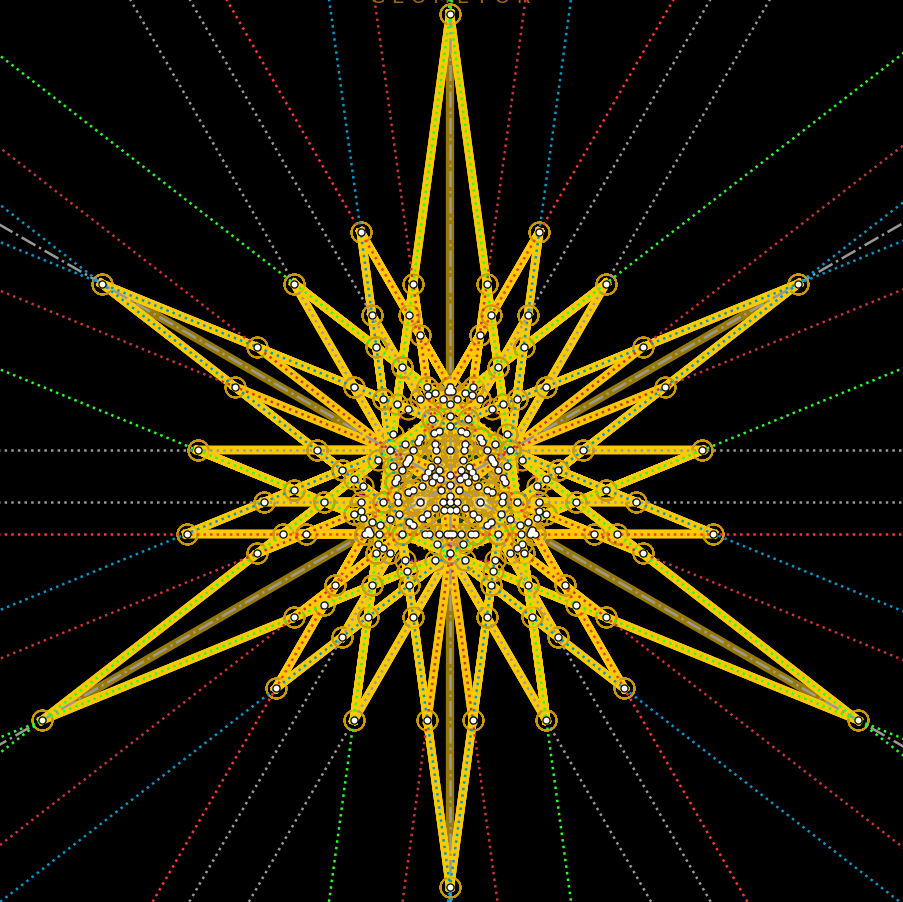
Book I: Preliminary Principles — Foundations of Compass-Only Construction¶
Lorenzo Mascheroni (La Geometria del Compasso, Pavia 1797, §§ 1–11, pp. 11–18)
f. 0040 · p. 11§ 1. Points, Virtual Lines & Compass Postulates (§§ 1–3)¶
In this geometry, no instrument other than the compass is admitted.
Because continuous straight lines cannot be drawn without a straightedge, Mascheroni establishes the principle of the virtual line: a straight line is regarded as completely determined whenever two distinct points \(A\) and \(B\) belonging to it are known:
Constructing a straight line means determining two points through which that line must pass.
Intersecting two straight lines, or a straight line and a circle, means finding purely by intersecting compass arcs the point or points where the loci would meet if traced with a ruler.
Every geometric figure—triangle, polygon, or conic locus—is resolved into a discrete network of constructible points.
§ 2. Operational Algebra: The Three Elementary Compass Operations (§§ 4–11)¶
Mascheroni’s procedures reduce to three primitive operations, codified in Lemoine’s Géométrographie Mascheronienne (lemoine-1902, pp. 66–74):
Operation C₁: Placing one leg of the compass on a previously determined point \(A\). Taking up distance \(AB\) requires placing both points: \(2C_1\).
Operation C₂: Placing one leg of the compass on an arbitrary point of an already traced arc.
Operation C₃: Describing a circle or circular arc once its center and radius are fixed.
When the straightedge is banished (\(l_1 = l_2 = 0\)), every construction ledger simplifies to:
§ 3. Distance Transfer and Orthogonal Symmetry (§ 11)¶
Given points \(A, B\) and an origin \(C\):
Describing circle \(C(AB)\) requires taking up radius \(AB\) (\(2C_1\)), placing the point at \(C\) (\(C_1\)), and drawing the arc (\(C_3\)), totaling \(3C_1 + C_3\) (\(S = 4, E = 3\)).
Two intersecting circles \(A(R_1)\) and \(B(R_2)\) yield two intersection points \(P, Q\). The segment \(PQ\) is perpendicularly bisected by the line of centers \(AB\), so that \(P\) and \(Q\) are mutual orthogonal reflections across \(AB\). This reflection lemma forms the fundamental engine of Books III, IV, and VII.