VIII.18
Between two similar plane numbers there is one mean proportional number; and the plane number has to the plane number the ratio duplicate of that which the corresponding side has to the corresponding side.
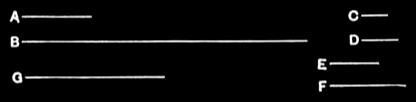
Let A, B be two similar plane numbers, and let the numbers C, D be the sides of A, and E, F of B.
Now, since similar plane numbers are those which have their sides proportional, [VII.def.21] therefore, as C is to D, so is E to F.
I say then that between A, B there is one mean proportional number, and A has to B the ratio duplicate of that which C has to E, or D to F, that is, of that which the corresponding side has to the corresponding side.
Now since, as C is to D, so is E to F, therefore, alternately, as C is to E, so is D to F. [VII.13]
And, since A is plane, and C, D are its sides, therefore D by multiplying C has made A.
For the same reason also E by multiplying F has made B.
Now let D by multiplying E make G.
Then, since D by multiplying C has made A, and by multiplying E has made G, therefore, as C is to E, so is A to G. [VII.17]
But, as C is to E, so is D to F; therefore also, as D is to F, so is A to G.
Again, since E by multiplying D has made G, and by multiplying F has made B, therefore, as D is to F, so is G to B. [VII.17]
But it was also proved that,
as D is to F, so is A to G;
therefore also, as A is to G, so is G to B.
Therefore A, G, B are in continued proportion.
Therefore between A, B there is one mean proportional number.
I say next that A also has to B the ratio duplicate of that which the corresponding side has to the corresponding side, that is, of that which C has to E or D to F.
For, since A, G, B are in continued proportion, A has to B the ratio duplicate of that which it has to G. [V.def.9]
And, as A is to G, so is C to E, and so is D to F.
Therefore A also has to B the ratio duplicate of that which C has to E or D to F. Q. E. D.