I.39
Equal triangles which are on the same base and on the same side are also in the same parallels.
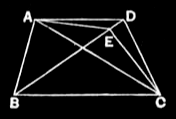
Let ABC, DBC be equal triangles which are on the same base BC and on the same side of it; [I say that they are also in the same parallels.]
And [For] let AD be joined; I say that AD is parallel to BC.
For, if not, let AE be drawn through the point A parallel to the straight line BC, [I.31] and let EC be joined.
Therefore the triangle ABC is equal to the triangle EBC; for it is on the same base BC with it and in the same parallels. [I.37]
But ABC is equal to DBC; therefore DBC is also equal to EBC, [I.cn.1] the greater to the less: which is impossible.
Therefore AE is not parallel to BC.
Similarly we can prove that neither is any other straight line except AD; therefore AD is parallel to BC.
Therefore etc.
Q. E. D.
Note
5
[I say that they are also in the same parallels.] Heiberg has proved (Hermes, XXXVIII., 1903, p. 50) from a recently discovered papyrus-fragment (Fayūm towns and their papyri, p. 96, No. IX.) that these words are an interpolation by some one who did not observe that the words And let AD be joined
are part of the
setting-out(ἔκθεσις), but took them as belonging to theconstruction(κατασκευή) and consequently thought that a διορισμός or definition(of the thing to be proved) should precede. The interpolator then altered And
into For
in the next sentence.