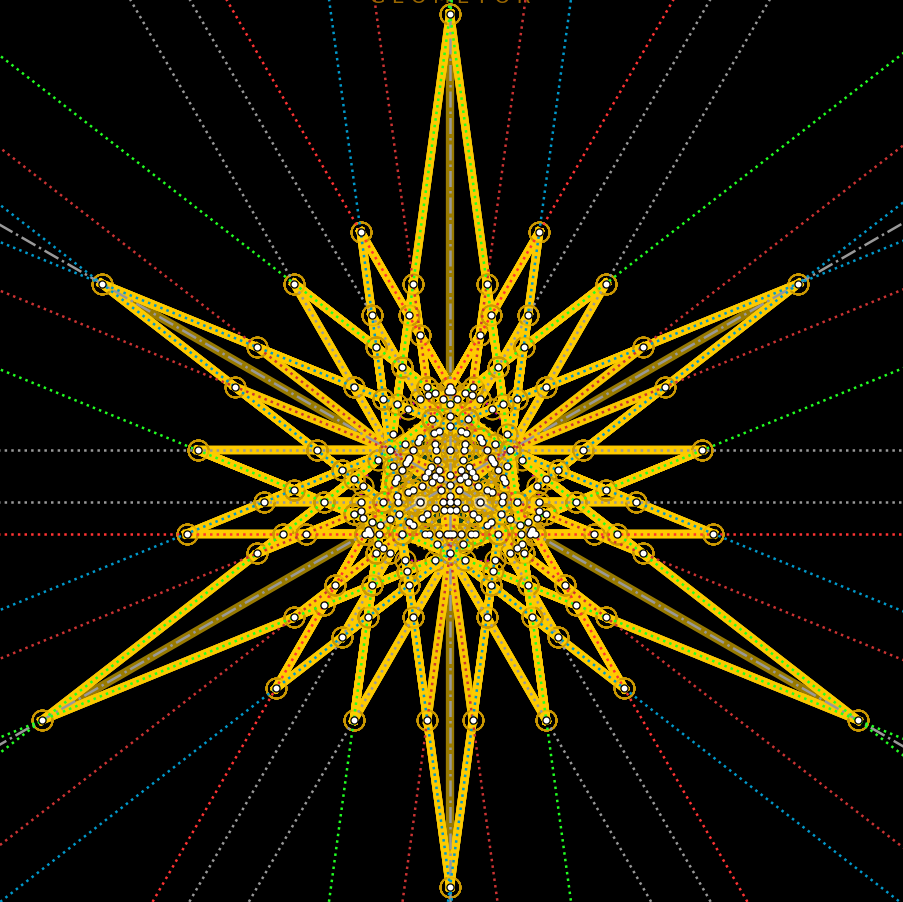
X3575

EULER LINE INTERCEPT OF THE LINE X64X_66

X3575 = reflection of X1885 in X4
< A B C >: Reference Triangle △ABC [ A B ]: Sideline AB (Base c = 1) [ B C ]: Sideline BC (Side a) [ C A ]: Sideline CA (Side b) { 1885, 4 }: Euler Line { 2, 3 }: Euler Line { 64, 66 }: Central Line L(64, 66) { 128, 135 }: Central Line L(128, 135) { 53, 571 }: Central Line L(53, 571) { 185, 1503 }: Central Line L(185, 1503) A = Vertex A (0.0000, 0.0000) B = Vertex B (1.0000, 0.0000) C = Vertex C (0.6122, 0.5999) X_1885 = ZOSMA TRANSFORM OF X(774) (0.5948, 0.3502) X_4 = ORTHOCENTER (0.6122, 0.3958) X_2 = CENTROID (0.5374, 0.2000) X_3 = CIRCUMCENTER (0.5000, 0.1021) X_64 = ISOGONAL CONJUGATE OF X(20) (0.5579, 1.5943) X_66 = ISOGONAL CONJUGATE OF X(22) (0.5912, 1.0593) X_128 = -OF-ORTHIC-TRIANGLE (0.3310, 0.3690) X_135 = INTERSECTION OF LINE X(4)X(131) AND X(25)X(114) (0.7014, 0.4587) X_53 = SYMMEDIAN POINT OF ORTHIC TRIANGLE (0.6164, 0.4390) X_571 = ORTHOHARMONIC OF X(52) (0.7141, 0.4556) X_185 = NAGEL POINT OF THE ORTHIC TRIANGLE (0.6033, 0.1643) X_1503 = POINT ARKAB (0.4818, -0.3843) X_3575 = EULER LINE INTERCEPT OF THE LINE X(64)X(66) (0.6297, 0.4413) A B C X1885 X4 X2 X3 X64 X66 X128 X135 X53 X571 X185 X1503 X3575 (a, b, c) = (5, 6, 7) | AB = 1

X3575 (EULER LINE INTERCEPT OF THE LINE X64X_66) constructed on acute reference triangle \((a, b, c) = (5, 6, 7)\) with unit baseline AB = \(1\).

Constructed Elements

Trilinears: \(f(a,b,c) : f(b,c,a) : f(c,a,b)\), where \(f(a,b,c) = bc[2a^{6} + b^{6} + c^{6} - 3a^{4}b^{2} - 3a^{4}c^{2} - b^{4}c^{2} - b^{2}c^{4}]/(b^{2} + c^{2} - a^{2})\)
Barycentrics: \(af(a,b,c) : bf(b,c,a) : cf(c,a,b)\)
Search Value (6, 9, 13): \(3.044799668126\)
▸ Incident Central Lines15 lines

{1, 1892}, {2, 3}, {53, 571}, {64, 66}, {128, 135}, {185, 1503}, {225, 1852}, {317, 1975}, {515, 1829}, {516, 1902}, {1179, 1300}, {1192, 1853}, {1452, 1837}, {1828, 2829}, {1862, 1872}

▸ Functional Relations11 relations

Notes

As a point on the Euler line, X3575 has Shinagawa coefficients \((F, -E - 3F)\).

Let KH denote the hyperbola discussed at X1112. As noted in the paper cited at X1112, KH is the X4-Ceva conjugate of the Euler line. Inversely, the Euler line is the X4-Ceva conjugate of KH. Since X3574 lies on KH, its X4-Ceva conjugate, which is X3575, lies on the Euler line. (Peter Moses, July 7, 2009)