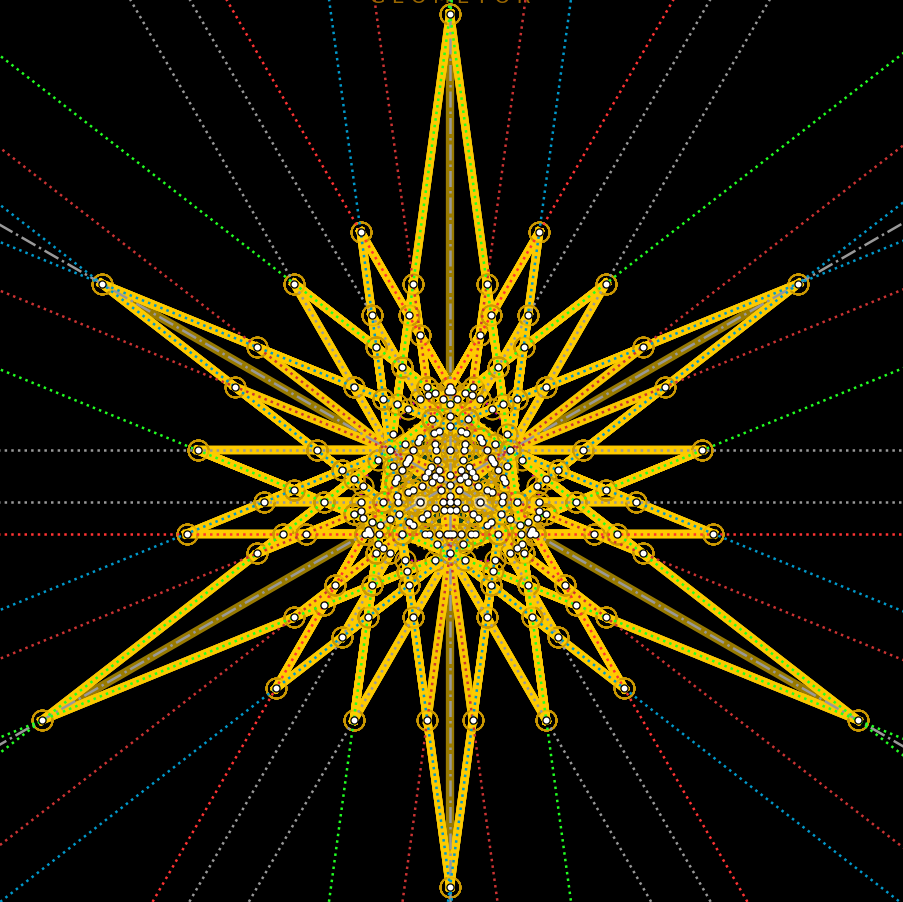
X3078
DANNEELS POINT OF X5
X3078 (DANNEELS POINT OF X5) constructed on acute reference triangle \((a, b, c) = (5, 6, 7)\) with unit baseline AB = \(1\).
Constructed Elements
Central Lines: {2, 3} (Euler line)
Related Centers: X5 (NINE-POINT CENTER), X233 (-CEVA CONJUGATE OF X140), X2 (CENTROID), X3 (CIRCUMCENTER)
Functional Relations2 relations
X3078 = X5-Ceva conjugate of X233
X3078 = X288-isoconjugate of X2167
Notes
\(ax^{2}(by + cz)\) : \(by^{2}(cz + ax)\) : \(cz^{2}(ax + by)\).
We denote this point by D(X) and call it the Danneels point of X. (Eric Danneels, Hyacinthos, Jan. 28, 2005). In addition to the discussion below, see the preamble to X8012 and the Danneels points beginning at X8012.
If X lies on the line at infinity, then D(X) = X2 of cevian triangle of X. (Randy Hutson, Jul 23, 2015)
The formula is simpler in barycentrics: if U =\(u : v : w\), then
D(U) = \(u^{2}(v + w)\) : \(v^{2}(w + u)\) : \(w^{2}(u + v)\).
If X is line the Euler line, then D(X) is on the Euler line. A proof follows. Let \(a_{1}\), \(b_{1}\), \(c_{1}\) be cos A, cos B, cos C, respectively, so that the Euler line is given parametrically as \(x(t) : y(t) : z\) (t) by
x = \(b_{1}\)\(c_{1}\) + \(ta_{1}\)
y = \(c_{1}\)\(a_{1}\) + \(tb_{1}\)
z = \(a_{1}\)\(b_{1}\) + \(tc_{1}\),
where t is an arbitrary function homogenous of degree 0 in a, b, c. Then D(X) is the point U =\(u : v : w\) given by
u = \(ax^{2}(by + cz)\)
v = \(by^{2}(cz + ax)\)
w = \(cz^{2}(ax + by)\).
A point P =\(p : q : r\) is on the Euler line if
\(a(b^{2}\) - \(c^{2})\)(\(b^{2}\) + \(c^{2}\) - \(a^{2})\)p
\(b(c^{2}\) - \(a^{2})\)(\(c^{2}\) + \(a^{2}\) - \(b^{2})\)q
\(c(a^{2}\) - \(b^{2})\)(\(a^{2}\) + \(b^{2}\) -\(c^{2})\)r = 0.
It is easy to check that the point U satisfies this equation. (This sort of algebraic proof is more inclusive than a geometric proof, because here, a,b,c are indeterminates or variables. They can, for example, take values that are not sidelengths of a triangle. Here, cos A is defined as (\(b^{2}\) + \(c^{2}\) - \(a^{2})\)/(2bc), so that no dependence on a geometric angle is necessary.)
The appearance of (i,j) in the following list means that D(Xi) = Xj:
(1,42) (2,2) (3,418) (4,25) 6,3051 (7,57) (8,200) (69,394) (75,321) (100,55) (110,84) (264,324) (366,367) (651,222) (653,196) (1113,25) (1114,25) (1370,455) For an extension of this list, see the preamble to X8012.