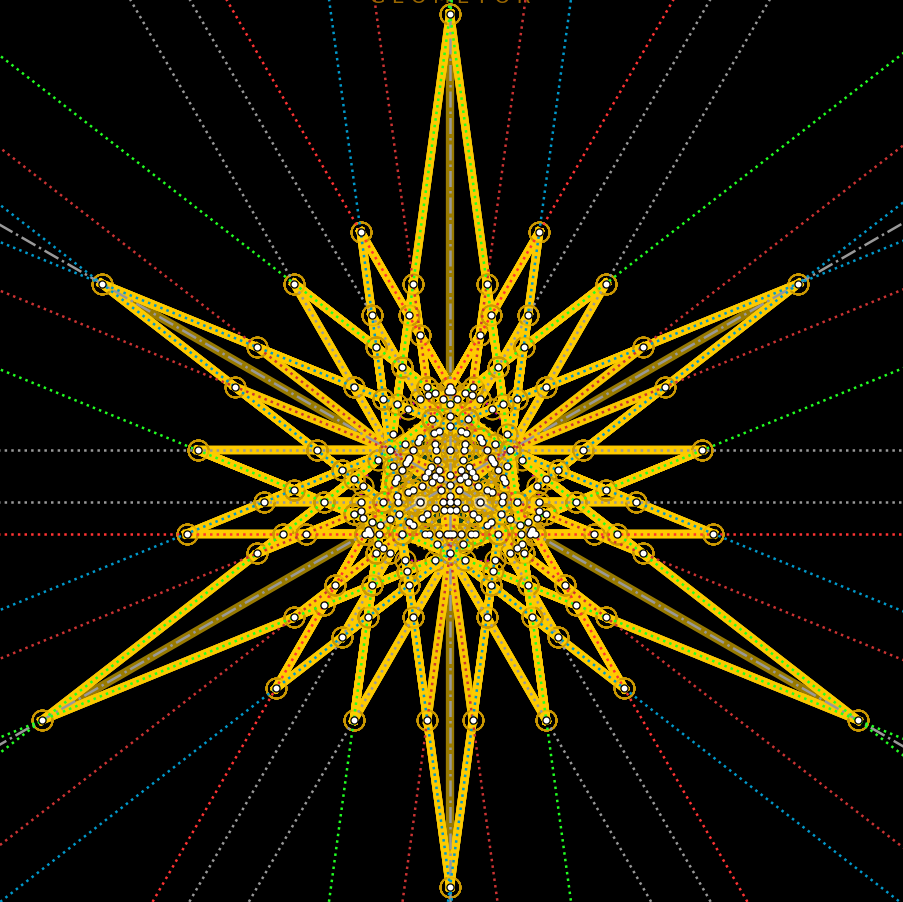
X3001–X3118
Central Line Intersections, Stevanović Points & T/G Mappings
X3001–X3118 (Central Line Intersections, Stevanović Points & T/G Mappings) — 16 representative centers (from 118 in collection) constructed on acute reference triangle \((a, b, c) = (5, 6, 7)\) with unit baseline AB = \(1\).
Group Preamble — Antipodal Pairs on Circles
In response to Stevanovic’s findings (X3000 to X3006), Peter Moses noted (Hyacinthos, 12/9/2004) a method for mapping a pair of antipodal points on one circle to an antipodal pair on another circle. The method depends on centers of similitude:
Suppose O1 and O2 are circles, that P is on O1 and that P' is the antipode of P on O1. Let U be the internal center of similitude (insimilicenter) of O1 and O2, and V the exsimilicenter. Define Q = PU ∩P' V and Q' = PV ∩P' U. Then on O2, point Q' is the antipode of Q. Moreover, the lines PP' and QQ' are parallel.
The method follows from introductory material on centers of similitude (e.g., H. S. M. Coxeter, Introduction to Geometry, 2nd edition, page 70, which cites Nathan Altshiller-Court, College Geometry, 2nd edition, page 184). If you have The Geometer’s Sketchpad, you can view Antipodal Pairs (AntipodalPairs.gsp).
In the following examples, suppose P =\(p : q : r\) (trilinears).
Example 1. O1 = circumcircle and O2 = incircle. In this case, insimilicenter(O1, O2) = X55, and exsimilicenter(O1, O2) = X56. The antipodal points on O2 given by the Moses mapping are
Q = ((b - c)2p + a(bq + cr))(b + c - a) : :
Q' = ((b + c)2p + a(bq + cr))/(b + c - a) : : .
Example 2. O1 = circumcircle and O2 = Apollonius circle, with center X970. Here, insimilicenter(O1, O2) = X573, and exsimilicenter(O1, O2) = X386. A point on O2 is
Q' = (a + b)(a + c)(b + c)2p - a(bc + ca + ab + \(b^{2}\) + \(c^{2})\)(bq + cr) : : .
Example 3. O1 = circumcircle and O2 = Spieker circle. In this case, insimilicenter(O1, O2) = X958, and exsimilicenter(O1, O2) = X1376.
Q = (a - b - c)[((b + c)(b - c)2 + \(a(b^{2}\) + \(c^{2})\))p + (ab + ac + 2bc + \(a^{2})\)(bq + cr)] : :
Q' = (\(b^{3}\) + \(c^{3}\) - \(ab^{2}\) - \(ac^{2}\) - \(bc^{2}\) - \(b^{2}\)c)p + (ab + ac - 2bc - \(a^{2})\)(bq + cr) : :
Example 4. O1 = incircle and O2 = Spieker circle. In this case, insimilicenter(O1, O2) = X2, and exsimilicenter(O1, O2) = X8.
Q = (bp + cq)/a : (cr + ap)/b : (ap + bq)/c = complement of P
Q' = 2abc(b + c)p - bc(a - b - c)(bq + cr) : :
Example 5. O1 = circumcircle and O2 = sine-triple-angle circle. In this case, insimilicenter(O1, O2) = X1147, and exsimilicenter(O1, O2) = X184. A point on O2 is
Q = a[\(a(a^{2}\) - \(b^{2})\)(\(a^{2}\) - \(c^{2})\)p - \(a^{2}(b^{2} -a^{2} + c^{2})\)(bq + cr)] : :
Group Preamble — T and G Mappings (Centers X3112-X3118)
This section presents points X3112 to X3118 as representative of points introduced by Quang Tuan Bui in Hyacinthos, August 5, 2006.
Suppose X is a point not on a sideline of ABC. Let
Then the points A, B, C, gX, tX, Tg, Gt are on a conic. As a circumconic, it is the image under the isogonal conjugate mapping of line X(gtX). It is also the image under the isotomic conjugate mapping of line X(tgX).
If X =\(x : y : z\) (trilinears), then
Gt = (\(b^{2}\) - \(c^{2})\)/(\(x(b^{2}\)\(y^{2}\) - \(c^{2}\)\(z^{2})\)) : (\(c^{2}\) - \(a^{2})\)/(\(y(c^{2}\)\(z^{2}\) - \(a^{2}\)\(x^{2})\)) : (\(a^{2}\) - \(b^{2})\)/(\(z(a^{2}\)\(x^{2}\) - \(b^{2}\)\(y^{2})\))
Tg = (\(b^{2}\) - \(c^{2})\)/(\(x(y^{2}\) - \(z^{2})\)) : (\(c^{2}\) - \(a^{2})\)/(\(y(z^{2}\) - \(x^{2})\)) : (\(a^{2}\) - \(b^{2})\)/(\(z(x^{2}\) - \(y^{2})\))

X3001(BROCARD AXIS)∩(DE LONGCHAMPS LINE)

X3002(BROCARD AXIS)∩(GERGONNE LINE)

X3003(BROCARD AXIS)∩(ORTHIC AXIS)

X3004(DE LONGCHAMPS LINE)∩(GERGONNE LINE)

X3005(DE LONGCHAMPS LINE)∩(LEMOINE AXIS)

X3006(DE LONGCHAMPS LINE)∩(NAGEL LINE)

X3007(DE LONGCHAMPS LINE)∩(SODDY LINE)

X3008(GERGONNE LINE)∩(NAGEL LINE)

X3009(LEMOINE AXIS)∩(NAGEL LINE)


X3011(NAGEL LINE)∩(ORTHIC AXIS)


X3013(ANTIORTHIC AXIS)∩(FERMAT AXIS)

X3014(DE LONGCHAMPS LINE)∩(FERMAT AXIS)


X3016(LEMOINE AXIS)∩(FERMAT AXIS)

X3017(NAGEL LINE)∩(FERMAT AXIS)

X3018(ORTHIC AXIS)∩(FERMAT AXIS)


X30204th STEVANOVIC POINT

X30215th STEVANOVIC POINT

X30226th STEVANOVIC POINT

X30237th STEVANOVIC POINT

X30248th STEVANOVIC POINT

X30259th STEVANOVIC POINT

X302610th STEVANOVIC POINT
X3026 lies on the incircle.

X3027INCIRCLE-ANTIPODE OF X3023

X3028INCIRCLE-ANTIPODE OF X3024

X3029INTERSECTION X10X_115∩X98X_573

X3030INTERSECTION X10X_11∩X43X_57

X3031INTERSECTION X10X_125∩X74X_573

X3032INTERSECTION X10X_11∩X100X_386

X3033INTERSECTION X10X_116∩X43X_57

X3034INTERSECTION X10X_116∩X105X_386

X3035COMPLEMENT OF X11

X3036COMPLEMENT OF X1317

X3037COMPLEMENT OF X1356

X3038COMPLEMENT OF X1357

X3039COMPLEMENT OF X1358

X3040COMPLEMENT OF X1361

X3041COMPLEMENT OF X1362

X3042COMPLEMENT OF X1364

X3043INTERSECTION X4X_110∩X74X_184

X3044INTERSECTION X54X_114∩X99X_184
X3044 lies on the sine-triple-angle circle.

X3045INTERSECTION X54X_119∩X100X_184
X3045 lies on the sine-triple-angle circle.

X3046INTERSECTION X54X_118∩X101X_184
X3046 lies on the sine-triple-angle circle.

X3047INTERSECTION X54X_113∩X2X_98

X3048INTERSECTION X110X_126∩X111X_184
X3048 lies on the sine-triple-angle circle.

X3049INTERSECTION X6X_523∩X520X_647

X3050INTERSECTION X6X_523∩X50X_647

X3051INTERSECTION X2X_6∩X32X_184

X3052INTERSECTION X31X_42∩X32X_220

X3053INTERSECTION X3X_6∩X4X_230

X3054CENTER OF EVANS CONIC

X3055{X2,X6}-HARMONIC CONJUGATE OF X3054

X3056INTERSECTION OF LINES X1X_256 AND X6X_31

X3057INTERSECTION OF LINES X1X_3 AND X10X_11

X3058INTERSECTION OF LINES X1X_30 AND X2X_11

X3059INTERSECTION OF LINES X7X_8 AND X9X_55

X3060INTERSECTION OF LINES X2X_51 AND X4X_52

X3061INTERSECTION OF LINES X1X_6 AND X2X_257

X3062ISOGONAL CONJUGATE OF X165

X3063CROSSDIFFERENCE OF X7 AND X8

X3064ISOGONAL CONJUGATE OF X1813

X3065ISOGONAL CONJUGATE OF X484

X30662nd LEMOINE HOMOTHETIC CENTER

X3067HOFSTADTER ELLIPSE INTERSECTION

X3068INTERSECTION OF X2X_6 AND X4X_371

X3069INTERSECTION OF X2X_6 AND X4X_372

X3070INTERSECTION OF X4X_6 AND X5X_372

X3071INTERSECTION OF X4X_6 AND X5X_371


X3074INTERSECTION OF X1X_6 AND X2X_255

X3075INTERSECTION OF X1X_3 AND X2X_255


X3078DANNEELS POINT OF X5

X3079DANNEELS POINT OF X20

X3080DANNEELS POINT OF X25

X3081DANNEELS POINT OF X30

X3082RADICAL CENTER OF EXTERNAL MALFATTI CIRCLES

X3083INTERSECTION OF LINES X1X_2 AND X37X_494

X3084INTERSECTION OF LINES X1X_2 AND X37X_493

X3085INTERSECTION OF LINES X1X_2 AND X4X_12

X3086INTERSECTION OF LINES X1X_2 AND X4X_11

X3087INTERSECTION OF LINES X2X_95 AND X4X_6

X3088INTERSECTION OF LINES X2X_3 AND X33X_3086

X3089INTERSECTION OF LINES X2X_3 AND X33X_3085

X3090INTERSECTION OF LINES X2X_3 AND X11X_1058

X3091INTERSECTION OF LINES X2X_3 AND X11X_153

X3092INTERSECTION OF LINES X2X_1579 AND X4X_6

X3093INTERSECTION OF LINES X2X_1578 AND X4X_6

X3094INTERSECTION OF LINES X2X_694 AND X3X_6

X3095INTERSECTION OF LINES X3X_6 AND X5X_76

X3096INTERSECTION OF LINES X2X_32 AND X76X_141

X3097INTERSECTION OF LINES X1X_39 AND X43X_63

X3098INTERSECTION OF LINES X3X_6 AND X69X_74


X3100INTERSECTION OF LINES X1X_7 AND X2X_33


X3102INNER VERTEX OF THE BROCARD SQUARE

X3103OUTER VERTEX OF THE BROCARD SQUARE

X3104INNER VERTEX OF 1st BROCARD EQUILATERAL TRIANGLE

X3105OUTER VERTEX OF 2nd BROCARD EQUILATERAL TRIANGLE

X3106CENTER OF 1st BROCARD EQUILATERAL TRIANGLE

X3107CENTER OF 2nd BROCARD EQUILATERAL TRIANGLE

X3108DC(X83)

X3109ORTHOGONAL PROJECTION OF X1 ON EULER LINE

X3110ORTHOGONAL PROJECTION OF X1 ON BROCARD AXIS

X3111ORTHOGONAL PROJECTION OF X2 ON BROCARD AXIS

X3112TgX(31)

X3113GtX(31)

X3114TgX(32)

X3115GtX(32)

X3116ISOGONAL CONJUGATE OF GtX(31)

X3117ISOGONAL CONJUGATE OF TgX(32)
