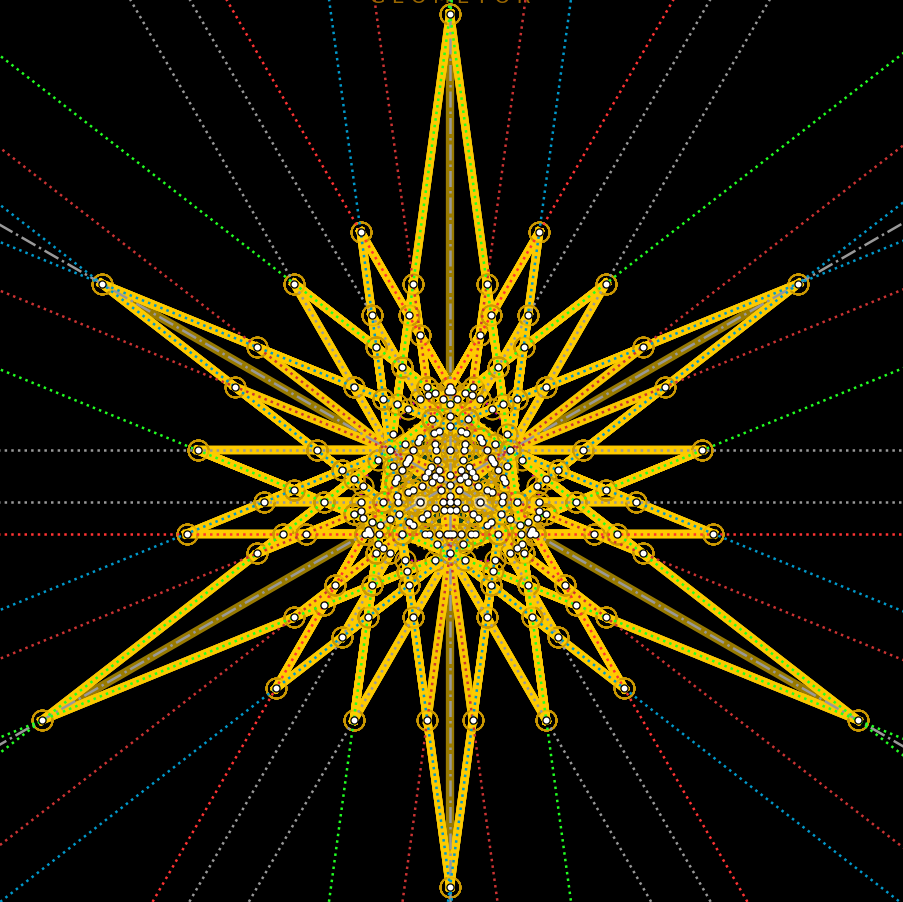
X768
ODD (- 4, - 3) INFINITY POINT
X768 (ODD (- 4, - 3) INFINITY POINT) constructed on acute reference triangle \((a, b, c) = (5, 6, 7)\) with unit baseline AB = \(1\).
Constructed Elements
Central Lines: {30, 511}
Related Centers: X30 (EULER INFINITY POINT), X511 (ISOGONAL CONJUGATE OF X98)
Functional Relations18 relations
X523 = odd (- 4, - 2) infinity point
X688 = odd (- 4, 0) infinity point
X689 = o-(- 4, 0) circumcircle point
X514 = odd (- 2, - 1) infinity point
X101 = o-(- 2, - 1) circumcircle point
X512 = odd (- 2, 0) infinity point
X99 = o-(- 2, 0) circumcircle point
X513 = odd (- 1, 0) infinity point
X100 = o-(- 1, 0) circumcircle point
X514 = odd (0, 1) infinity point
X101 = o-(0, 1) circumcircle point
X523 = odd (0, 2) infinity point
X110 = o-(0, 2) circumcircle point
X513 = odd (1, 2) infinity point
X100 = o-(1, 2) circumcircle point
X512 = odd (2, 4) infinity point
X99 = o-(2, 4) circumcircle point
Notes
\(a^{m-1}(b^{n} - c^{n})\) + \(a^{n-1}(b^{m} - c^{m})\),
corresponding to an odd polynomial center in case m and n are distinct integers. See the note accompanying X696, where even (m,n) infinity points and even (m,n) circumcircle points are introduced. [For nonzero n, “odd (m,n) circumcircle point” would be a misnomer (as the point is an even polynomial center); consequently, the prefix o- is used to distinguish this point from “even (m,n) circumcircle point” defined at X696.] Certain points of these classes occur prior to this section. They are as follows: