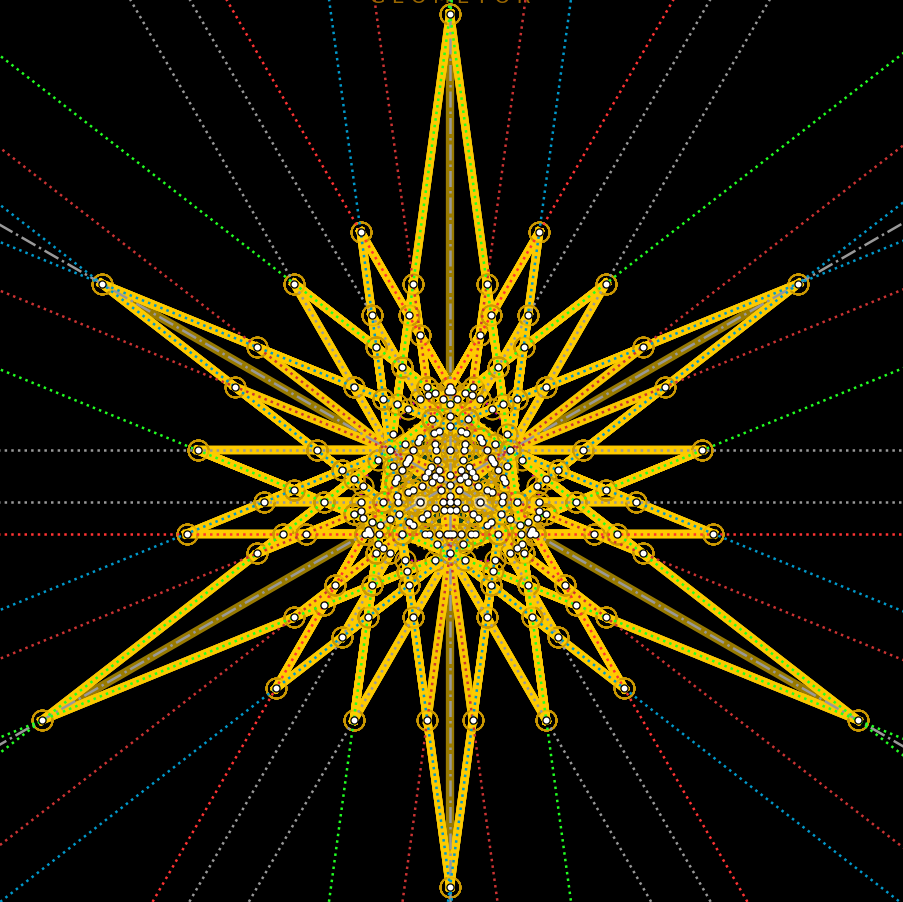
X566–X642

Brocard Axis Circles & Gibert Centers

Centers on the Brocard axis X3 X6 whose circles cut equal chords on the sidelines of ABC (X566–X584), congruent shrunk insquares points, and centers contributed by Bernard Gibert (X616–X642).
< A B C >: Reference Triangle △ABC [ A B ]: Sideline AB (Base c = 1) ( A R_b ): Euclid I.22 Guide Circle (A) ( B R_a ): Euclid I.22 Guide Circle (B) [ B C ]: Sideline BC (Side a) [ C A ]: Sideline CA (Side b) circumcircle: Circumcircle of △ABC incircle: Incircle of △ABC { 3, 6 }: Brocard Axis A = Vertex A (0.0000, 0.0000) B = Vertex B (1.0000, 0.0000) R_b = Radius Point R_b (0.8571, 0.0000) R_a = Radius Point R_a (0.2857, 0.0000) C = Vertex C (0.6122, 0.5999) X_3 = CIRCUMCENTER (0.5000, 0.1021) X_1 = INCENTER (0.5714, 0.2333) X_6 = SYMMEDIAN POINT (LEMOINE POINT, GREBE POINT) (0.6000, 0.2672) X_566 = HARMONIC OF X(50) (0.5516, 0.1872) X_568 = ORTHOHARMONIC OF X(50) (0.6437, 0.3393) X_571 = ORTHOHARMONIC OF X(52) (0.7141, 0.4556) X_573 = ORTHOHARMONIC OF X(58) (0.4583, 0.2009) X_577 = HARMONIC OF X(216) (0.4663, 0.0464) X_582 = HARMONIC OF X(500) (0.8750, 0.7214) X_586 = 2nd CONGRUENT SHRUNK INSQUARES POINT (-0.2506, -0.5117) X_602 = INTERSECTION OF LINES X(3)X(31) AND X(56)X(255) (0.8182, 0.6170) X_608 = ISOGONAL CONJUGATE OF X(345) (0.6361, 0.4975) X_610 = -CEVA CONJUGATE OF X(1) (0.4310, -0.2713) X_613 = INTERSECTION OF LINES X(1)X(6) AND X(56)X(511) (0.7698, 0.2310) X_617 = ANTICOMPLEMENT OF X(14) (-0.2146, 0.8285) X_619 = COMPLEMENT OF X(14) (0.3494, 0.3571) X_624 = COMPLEMENT OF X(16) (-0.1165, -0.8620) X_625 = MIDPOINT OF X(623) AND X(624) (0.2068, -0.3280) X_642 = COMPLEMENT OF X(486) (0.8466, 0.3084) A B C X3 X1 X6 X566 X568 X571 X573 X577 X582 X586 X602 X608 X610 X613 X617 X619 X624 X625 X642 (a, b, c) = (5, 6, 7) | AB = 1

X566–X642 (Brocard Axis Circles & Gibert Centers) — 16 representative centers (from 77 in collection) constructed on acute reference triangle \((a, b, c) = (5, 6, 7)\) with unit baseline AB = \(1\).

Group Preamble — Centers X566-X584

Centers X566-X584 lie on the Brocard axis, L(3,6). Each is the center X of a circle that meets the sides of triangle ABC with three equal angles at X.

Let AB, AC, BC, BA, CA, CB denote the meeting-points; e.g., AB and CB are on side CA. The equal angles are given by

D = angle(ABXAC) = angle(BCXBA) = angle(CAXCB)

Then trilinears for X are given by

X = sin A + cot D/2 cos A : sin B + cot D/2 cos B : sin C + cot D/2 cos C.

Definitions: Y is the orthogonal of X if D(X) + D(Y) = π/2;

Y is the harmonic of X if X and Y are harmonic conjugates with respect to X3 and X6;

Y is the orthoharmonic if Y is the harmonic of the orthogonal of X. The centers in this section were contributed by Edward Brisse, December, 2000.

Group Preamble — Centers X616-X642

Centers X616-X642 were contributed by Bernard Gibert, March 2, 2001. Notation:

\(S_{A}\) = (\(b^{2}\) + \(c^{2}\) - \(a^{2})\)/2 \(S_{B}\) = (\(c^{2}\) + \(a^{2}\) - \(b^{2})\)/2 \(S_{C}\) = (\(a^{2}\) + \(b^{2}\) - \(c^{2})\)/2

Joe Goggins (Oct. 19, 2005) found trilinears for points in this section, using the following notation. Let

\(F(13) = a \csc(A + \pi /3) + b \csc(B + \pi /3) + c \csc(C + \pi /3)\)
\(F(14) = a \csc(A - \pi /3) + b \csc(B - \pi /3) + c \csc(C - \pi /3)\)
These are based on trilinears for the isogonic centers, X13 and X14. In like manner, F(i) is defined for i = 15, 16, 17, 18, 61, 62.
Using this notation, we have, for example,
X616 = F(13)/a - 2 csc(A + π/3) : F(13)/b - 2 csc(B + π/3) : F(13)/c - 2 csc(C + π/3)
X617 = F(14)/a - 2 csc(A - π/3) : F(14)/b - 2 csc(B - π/3) : F(14)/c - 2 csc(C - π/3)

Trilinears of this sort are given below at Xi for these i: 616-619, 621-624, 627-630, and 633-636.

X_574 — HARMONIC OF X_187

X574HARMONIC OF X187

“Each one of the three circles of Apollonius of the reference triangle cuts the circumcircle in a second point. These three points form a triangle which is perspective with the base triangle through the symmedian point, the co-symmedian triangle. This triangle also possesses a Neuberg cubic, which has three points in common with the cubic of the first triangle in the circumcenter and the two isodynamic centers. Hence the remaining points of intersection must lie on a conic, which is necessarily a circle, since two of these six points are the circular points I and J.” Quoted from (T. W. Moore and J. H. Neelley). The center of the circle is X574. (Bernard Gibert, euclid 4332)
X_588 — 1st KENMOTU-VAN LAMOEN POINT

X5881st KENMOTU-VAN LAMOEN POINT

X588 is the perspector of triangles ABC and A'B'C', where A' is the circumcenter of X371 and the points where the squares in the Kenmotu configuration with center X371 meet sideline BC, and B' and C' are defined cyclically. See
X_589 — 2nd KENMOTU-VAN LAMOEN POINT

X5892nd KENMOTU-VAN LAMOEN POINT

X589 is the perspector of triangles ABC and A'B'C', where A' is the circumcenter of X372 and the points where the squares in the Kenmotu configuration with center X372 meet sideline BC, and B' and C' are defined cyclically. See the reference at X588.
X_591 — 1st VAN LAMOEN PERPENDICULAR BISECTORS POINT

X5911st VAN LAMOEN PERPENDICULAR BISECTORS POINT

Erect squares outwardly on the sides of triangle ABC. Two edges emanate from A; let P and Q be their endpoints. Let a’ be the perpendicular bisector of PQ, and define b’ and c’ cyclically. Then a’, b’, c’ concur in X591. See also X1991. (Floor van Lamoen, 1/4/2001, Hyacinthos #2123)
X_592 — VAN LAMOEN CIRCUMCENTERS POINT

X592VAN LAMOEN CIRCUMCENTERS POINT

Let P be the point where the line through X6 parallel to line CA meets line BC, and let Q be the point where the line through X6 parallel to line AB meets line BC. Let X = X182, and let A' be the circumcenter of the triangle PQX. Define B' and C' cyclically. The lines AA', BB', CC' concur in X592. (Floor van Lamoen, 1/4/01)
X_593 — 1st HATZIPOLAKIS-YIU POINT

X5931st HATZIPOLAKIS-YIU POINT

Let O(A) be the circle tangent to line BC and to the circumcircle of triangle ABC at vertex A. Let AB and AC be where O(A) meets lines AB and AC, respectively. Let L(A) be the line joining AB and AC, and define L(B) and L(C) cyclically. Let A' be where L(B) and L(C) meet, and define B' and C' cyclically. Then triangle A'B'C' is homothetic to triangle ABC, and the center of homothety is X593. See Antreas Hatzipolakis, Paul Yiu, Hyacinthos #2070.
X_595 — 2nd HATZIPOLAKIS-YIU POINT

X5952nd HATZIPOLAKIS-YIU POINT

Let O(A) be the circle tangent to line BC and to the circumcircle of triangle ABC at vertex A, and define O(B) and O(C) cyclically. X595 is the radical center of O(A), O(B), O(C).
X_600 — 3rd HATZIPOLAKIS-YIU POINT

X6003rd HATZIPOLAKIS-YIU POINT

Let OA be the circle with center A and radius R, the circumradius of triangle ABC. Let BA be the point where OA meets line AB farthest from B. Define CB and AC cyclically. Let CA be the point where OA meets line AC farthest from C. Define AB and BC cyclically. X600 is the radical center of the circles ABACA, BCBAB, CACBC. If “farthest from” is changed to “nearest to” in the construction, the resulting point is X5507. (Antreas Hatzipolakis, Paul Yiu, 1/5/01, Hyacinthos #2344, #2346-8; for a correction in coordinates, see Paul Yiu, Adgeom #202.)