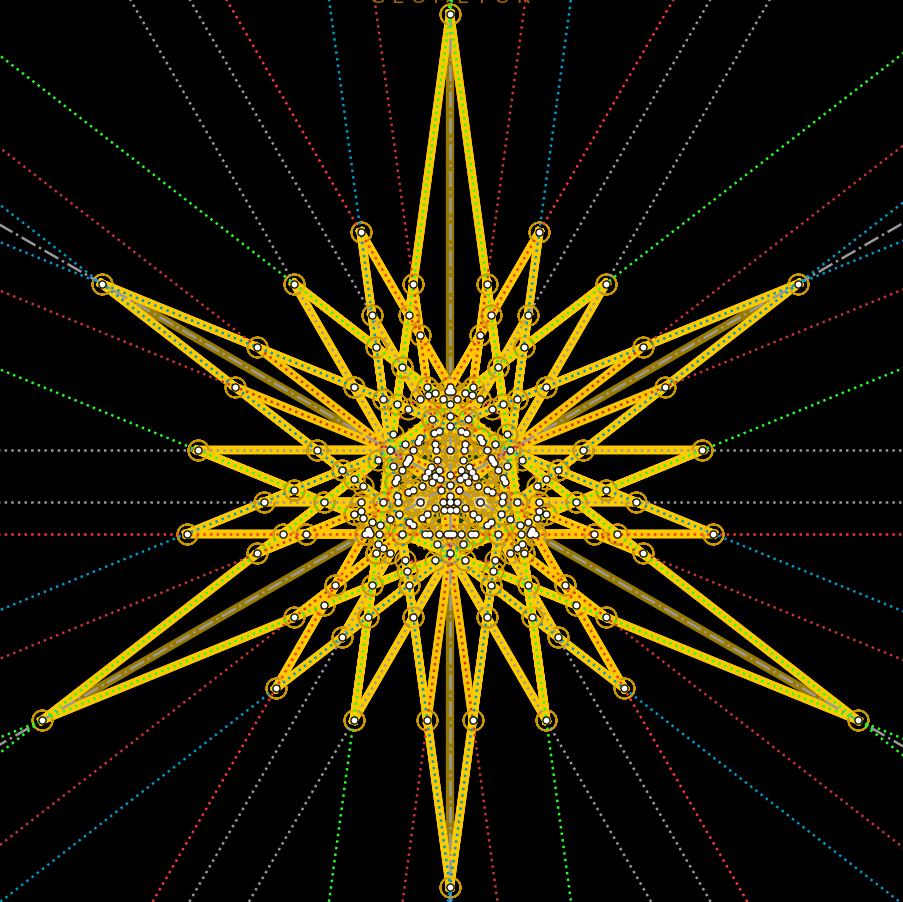
Cold-Boot Recovery Model
Every design decision in the Elementarium is evaluated against an explicit adversarial verification model: Cold-Boot Recovery at \(T + 10^5\text{ yr}\) under complete erasure of linguistic, digital, and institutional continuity.
Observer Assumptions
The recovery specification assumes an observer—either biological or an autonomous optical/machine system—possessing:
Sensitivity to electromagnetic radiation in or near the fused-silica transmission window (\(185\text{ nm} \le \lambda \le 2\,500\text{ nm}\)).
Spatial perception capable of distinguishing incidence, symmetry, and collinearity on a 2D projection plane or sensor array.
Zero prior shared symbols: no Latin/Greek alphabets, no Hindu-Arabic numerals, no ASCII/Unicode, no IEEE-754 floating-point conventions, and no SI unit definitions.
Verification Protocol on Mark I
To validate the Mark I Desktop Prototype prior to monolithic silica fabrication, recovery is tested across two independent tracks:
Track A (Zero-Instruction Human Trials): Test subjects receive only the unpowered Mark I optical assembly, unmounted fused-silica Brewster flats, and a broadband light source in a darkened room with zero verbal or written instructions. Success is measured by time-to-collimation (
T0 -> T1), discovery of crossed-Brewster polarization (T1 -> T2), and accurate decoding of proportional invariants.Track B (Autonomous Sensor Cold-Boot): An unprompted vision/symbolic agent inspects raw camera frames of the projected plates without external documentation, attempting to infer the formal equivalence syntax, bit-lattice ordering, and embedded
G.1–G.601constructive DAG engine (T1 -> T3).