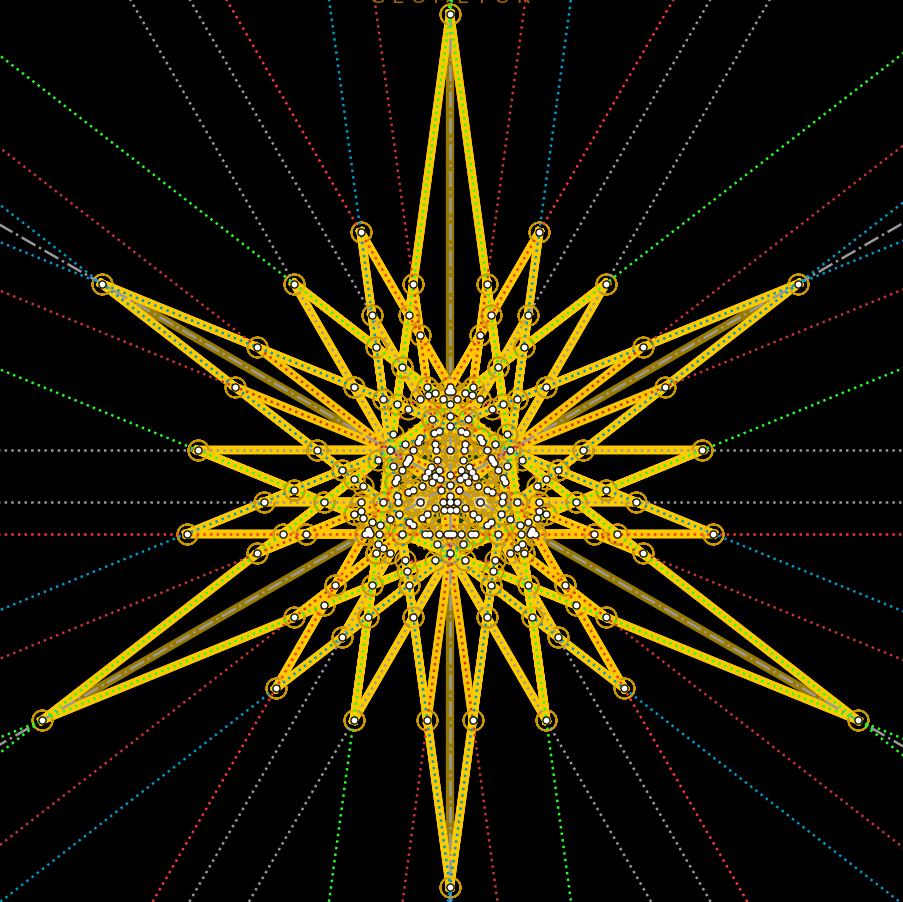
Optical Architecture
To guarantee readability across \(10^5\) years without surviving electronics or linguistic continuity, the Elementarium stratifies information across four passive optical regimes in fused silica (\(\text{SiO}_2\)).
Four-Tier Optical Stack
Tier |
Name |
Illumination Condition |
Epistemic & Optical Function |
|---|---|---|---|
|
Raw Light & Aperture Projection |
Uncollimated sunlight, starlight, or point source |
Casts |
|
Collimated Reticle & Diffractive Primer |
Collimated beam focused onto matte screen |
Projects micro-lithographic constructive proofs, rational quadrance/spread syntax, and the Brewster polarization diagram. |
|
Brewster-Angle Birefringent Library |
Crossed dielectric reflectors at \(\theta_B \approx 55.56^\circ\) |
Illuminates form-birefringent slow-axis azimuth and retardance voxels hidden invisibly inside clear quartz. |
|
Interferometric Logic & Cold-Boot Layer |
Vernier mask alignment or optical sensor array |
Performs passive optical nomography and exposes self-describing symbolic DAG frames ( |
Rational Brewster Spread Identity
Under Rational Trigonometry, Brewster’s law \(\tan\theta_B = n\) avoids transcendental functions entirely. The exact incidence spread \(s_B = \sin^2\theta_B\) for fused silica (\(n_D = \frac{2917}{2000}\)) is strictly rational:
Inclining two flat fused-silica plates at spread \(s_B\) with orthogonal planes of incidence creates an all-glass, degradation-free cross-polarizer analyzer capable of reading T2 birefringent strata indefinitely.