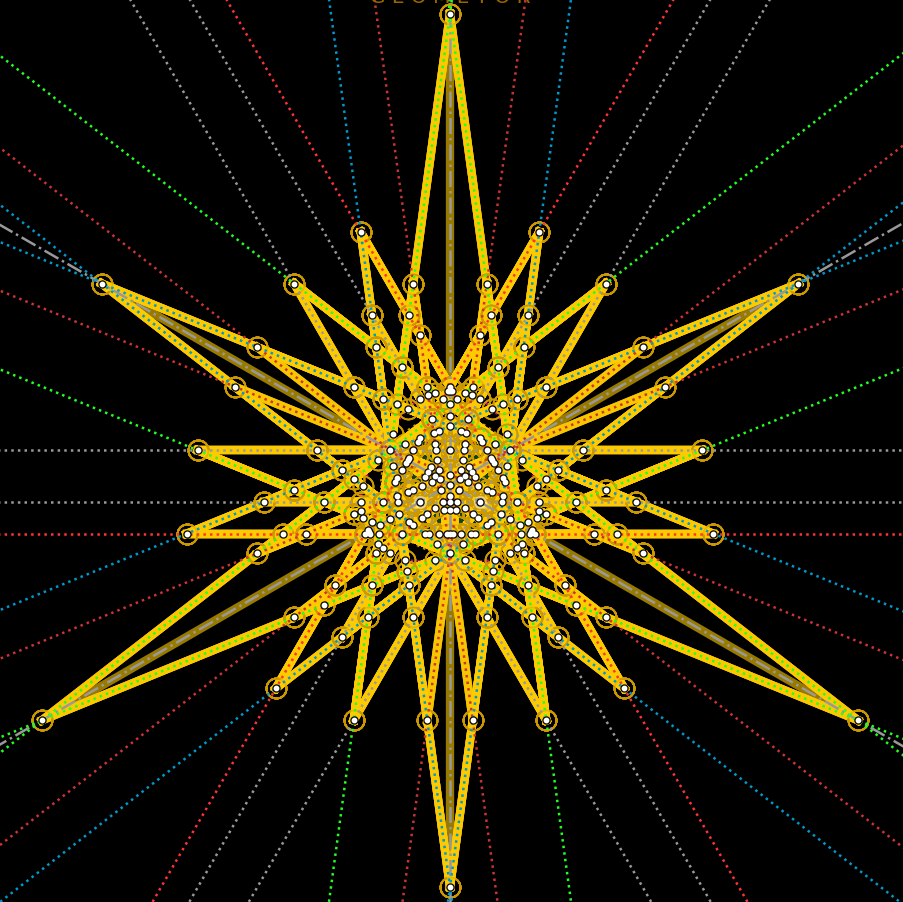
Point, Elementary Lines & Parallel Curves (Figs. 1–5)
The most acute-minded Euclid (der aller scharff sinnigst Euclides) has assembled the foundation of Geometry (euclid:elements). Whoever understands him well has no need whatever of the things written hereafter; for they are written solely for the young and for those who have no one else to instruct them faithfully.
At the outset, if one wishes to teach youths how to measure, they must know what is the ground out of which one measures and how measurement proceeds. Three kinds of things may be measured:
First, a length that has neither breadth nor thickness (Linien).
Second, a length that has breadth (Ebnen / Planum).
Third, a length that has both breadth and thickness (Corpora).
The beginning and end of all these things are points (Punct). A point is such a thing as has neither magnitude, length, breadth, nor thickness, and yet is the beginning and end of all corporeal things that one can make or conceive in our minds. Because a point fills no space, it is indivisible; yet in our thought we can cast a point high into the air or drop it into the depths whither our body cannot reach. To render youths intelligent in practical work, I mark the point visibly with a touch of the pen.
When this point is drawn from its first beginning to another end, it is called a line (Lini)—a length without any thickness or breadth. In particular there are three primary kinds of lines out of which much may be fashioned:
A straight line (gerade Lini), which may run upright, horizontally, or obliquely, and in thought may be extended infinitely.
A circular line (Cirkellini), which returns upon its own beginning; if made to rise or descend out of its plane, a spiral or serpentine curve arises.
A serpentine line (Schlangenlini), an inflected curve drawn to and fro either freehand or from point to point, capable of endless variation in length, width, height, or depth.
Furthermore, lines that run everywhere at equal separation—whether straight, circular, or serpentine—are called parallela in Latin, which in our German I shall call Barlinien. Note also that two adjacent plumb lines (bleyschnür) are not strictly parallel, because they converge at the center of the earth in an acute angle—though on account of the vast distance to the earth’s center, the convergence is imperceptible to our sight.