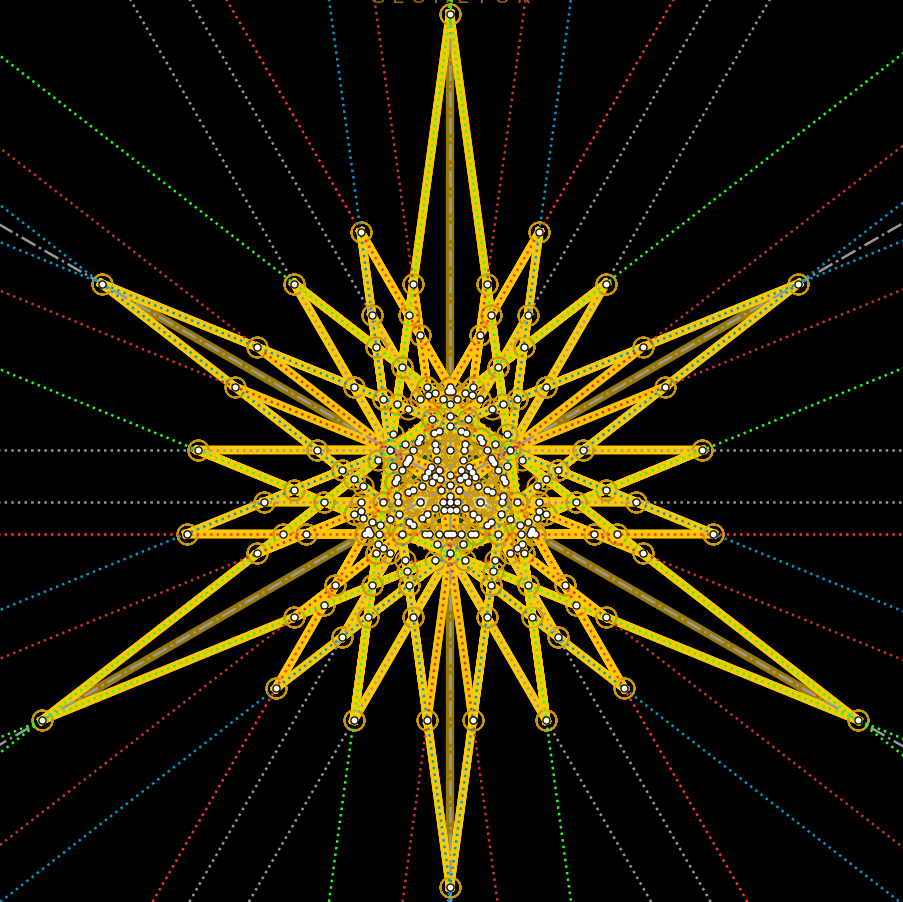
Liber Primus · Executive Geometric Summary
Core Theses & Theorems of Liber Primus (1678, pp. 1–44)
The Static Calculus of Intersecting Lines: Placing non-zero point masses $(u, v, w)$ at triangle vertices $(A, B, C)$ transforms geometric concurrency into associative barycentric grouping. By Archimedes’ Law of the Lever ($u \cdot \overline{AF} = v \cdot \overline{FB}$), composite fulcrums determine concurrent cevian lines at the global center of gravity $P = \frac{uA + vB + wC}{u + v + w}$.
Signed / Negative Weights (1678 $\to$ 1827): In Elementum III & p. 5 Scholium, Ceva extends the physical lever to exterior concurrency by writing subtractive weights “more analytico, seu algebrico” as $F - A$ (pondus negativum), directly anticipating August Ferdinand Möbius (1827).
3D Non-Planar Skew Quadrilateral Coplanarity: In Elementum V Corollarium (pp. 6–7), four spatial fulcrums along a non-planar 3D quadrilateral remain strictly coplanar because opposite-edge lever joins intersect at the spatial center of gravity $O$.
Ceva’s Theorem & Menelaus’s Transversal: Proposition VII establishes that cevians $AD, BE, CF$ concur if and only if $\frac{AF}{FB}\cdot\frac{BD}{DC}\cdot\frac{CE}{EA} = 1$. Dividing Ceva’s relation by Proposition VIII (Menelaus’s transversal $\frac{AF}{FB}\cdot\frac{BD'}{D'C}\cdot\frac{CE}{EA} = -1$) produces the projective harmonic range $(B, C; D, D') = -1$ constructible by straightedge alone.
Canonical Centers & Spread Ceva: Every classical Kimberling center possesses exact rational coordinates over $\mathbb{Q}$ on Heronian triangles ($X_1, X_2, X_4, X_6, X_7, X_8, J_A$). In Rational Trigonometry, Spread Ceva replaces transcendental sines with exact rational vertex spreads and quadrances: $\prod \frac{s(\angle BAD)}{s(\angle DAC)} = 1$.
Seven-Line 3D Tetrahedral Equilibrium (*Prop. XXIII*): Given non-coplanar vertices $A, B, C, D$ with weights $(m_A, m_B, m_C, m_D)$, the unique spatial center of gravity $O$ lies simultaneously on all 7 lines: 4 vertex-to-face cevians ($V G_V$, divided in ratio $\frac{M - m_V}{m_V}$) and 3 skew-edge bimedians ($E_{ij} E_{kl}$, divided in ratio $\frac{m_k + m_l}{m_i + m_j}$).
1678 Locus |
Vertex Weights |
Directed Side Ratios |
Geometric Regime |
|---|---|---|---|
Elementum II (Tab. 1, Fig. 5) |
$(+u, +v, +w)$, same sign |
$(+ , + , +)$, product $= +1$ |
Interior concurrency $P \in \operatorname{int}(\triangle ABC)$ |
Elementum III & p. 5 Scholium |
$(-u, +v, +w)$, $u \neq v, w$ |
$(- , + , -)$, product $= +1$ |
Exterior concurrency (e.g., excenter $J_A$) |
Limit $v + w = 0$ |
$(u, v, -v)$ |
Fulcrum $D \to \infty$ |
Cevian $AD \parallel BC$ (ideal projective point) |
Elementum V Corollarium |
$(m_A, m_B, m_C, m_D)$ in $\mathbb{R}^3$ |
$r_1 r_2 r_3 r_4 = +1$, $\det = 0$ |
Coplanar fulcrums & intersecting joins on 3D skew cycle |
Prop. XXIII (Tab. 3, Fig. 28) |
$(m_A, m_B, m_C, m_D)$ in $\mathbb{R}^3$ |
4 cevians + 3 bimedians |
7-line spatial concurrency “mira quadam concordia” at $O$ |