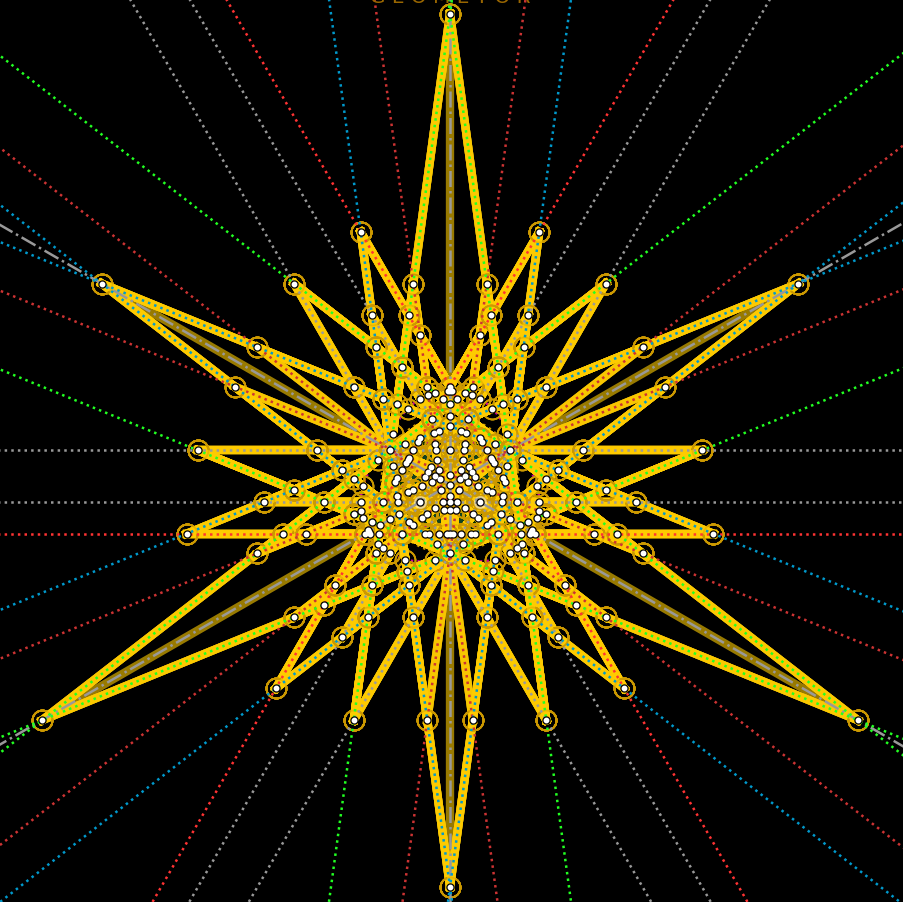
Book VI, Section V Summary: Coaxal Circles
Mathematical Synthesis of Casey’s Book VI, Section V (pp. 113–126)
1. Synthetic & Projective Foundations of Coaxal Systems
Section V investigates systems of circles having a common radical axis and their profound connections to inversion, projectivity, and closure theorems:
Classification of Coaxal Systems (Props. 1–2): Two circles $A, B$ determine an entire coaxial pencil. The system is intersecting (real common chord), touching (parabolic pencil), or non-intersecting (hyperbolic pencil) possessing two real limiting points $L, L'$ (Poncelet’s points limites), which are point-circles (zero radius) of the system.
Conjugate Orthogonal Pencils (Prop. 3): Every circle passing through the limiting points $L, L'$ cuts every circle of the coaxal system orthogonally. The coaxal system of intersecting circles through $L, L'$ is orthogonal and conjugate to the coaxal system of non-intersecting circles with limiting points $L, L'$.
Concurrency of Radical Axes (Prop. 4): The radical axes of any three systems of coaxal circles, taken in pairs, are concurrent at a radical centre.
Line of Centres & Radical Axis (Prop. 5): The line connecting the centres of two circles is perpendicular to their radical axis; the distance from the radical axis to the centre of any circle of the system is proportional to the difference of squares of its radius and tangent from the origin.
Inversion into Concentric Circles (Prop. 6): Inverting a non-intersecting coaxal pencil from either of its limiting points $L$ transforms the entire coaxal system into a family of concentric circles centered at $L'$ (the inverse of the other limiting point)! Orthogonal circles passing through $L, L'$ invert into concurrent straight lines through the concentric centre.
Envelope of Circles Touching Two Fixed Circles (Props. 7–8): A variable circle touching two fixed circles cuts their coaxal pencil at constant angles, and its chord of contact subtends a right angle at either limiting point.
Proportional Chord Division (Prop. 9): Any line cuts the circles of a coaxal pencil in segments whose chords are divided harmonically and proportionally.
Apollonius’ Problem of the Three Circles (Prop. 10): Casey provides a direct, synthetic solution to Apollonius’ ancient problem: the chords of contact of the tangent circles pass through the radical centres and poles of similitude, reducible by inversion or Newton’s 16th Lemma.
Bitangent Ratio Invariance (Prop. 11): The tangents $AA', BB'$ from variable points to two fixed circles of a coaxal system maintain a constant ratio depending only on their powers.
Poncelet’s Closure Theorem (Prop. 12): If a variable polygon of $n$ sides is inscribed in one circle of a coaxal system while $n-1$ of its sides touch other fixed circles of the system, its $n$-th side also touches a fixed circle of the system (proved via Jacobi’s elliptic functions and Hart’s celebrated elementary synthetic proof).
2. Verified Invariant Ledger (geometor.casey.coaxial)
Geometric Element |
Symbol / Formula |
Analytical Invariant |
|---|---|---|
Canonical Pencil Equation |
$x^2 + y^2 - 2\lambda x + \delta = 0$ |
Line of centres $y = 0$, Radical axis $x = 0$ |
Limiting Points ($\delta > 0$) |
$L_1, L_2 = (\mp \sqrt{\delta}, 0)$ |
Real point-circles ($r = 0$) |
Conjugate Orthogonal System |
$x^2 + y^2 - 2\mu y - \delta = 0$ |
Pass through $L_1, L_2$, centres on $x = 0$ |
Power Difference |
$\operatorname{pow}(P, C_\lambda) - \operatorname{pow}(P, C_\mu)$ |
$2(\mu - \lambda)x_P$ |
Inversion Centre |
$L_1$ |
Maps pencil to concentric circles at $L_2'$ |