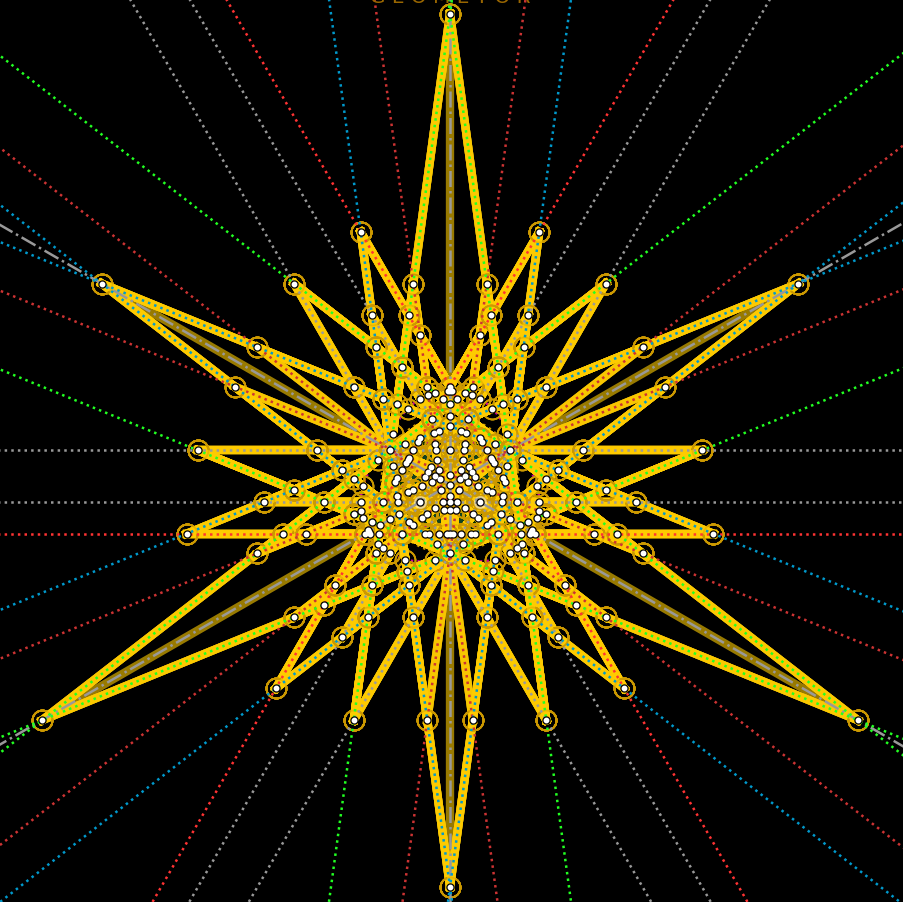
Book VI, Section IV Summary: Theory of Inversion
Mathematical Synthesis of Casey’s Book VI, Section IV (pp. 95–112)
1. Crown Jewels of Casey’s Theory of Inversion
Section IV contains the mathematical climax of Casey’s treatise:
Conformal Circle Inversion (Props. 1–3): $P \mapsto O + \frac{k^2}{|OP|^2}(P - O)$ linearizes circles through $O$, fixes orthogonal circles globally, preserves angles and cross-ratios, and transforms circles not through $O$ into circles with $O$ as a centre of similitude.
Invariant Bitangent Quadrances (Prop. 9): If two circles invert into two circles, their direct common tangents satisfy $\frac{t_{12}^2}{r_1 r_2} = \frac{t_{12}'^{\,2}}{r_1' r_2'}$.
Pappus’s Ancient Arbelos Chain (Prop. 9 Cor. 1): In the shoemaker’s knife, inverting from the common cusp straightens the boundary semicircles into parallel lines, proving that the height of the $n$-th inscribed circle equals $2n$ times its radius ($h_n = 2 n r_n$).
Casey’s Generalized Ptolemy Theorem (1866, Prop. 10): Four circles tangent to a fifth satisfy $\overline{12} \cdot \overline{34} + \overline{14} \cdot \overline{23} = \overline{13} \cdot \overline{24}$, proved in six lines by inverting from a contact point on the fifth circle into Euler’s collinear four-point identity!
Feuerbach’s Theorem at $F_e = X(11)$ (Prop. 10 Cor. 2): Proved both algebraically (as the point-circle midpoint specialization $\frac{1}{4}[a(c-b) + b(a-c) - c(a-b)] = 0$ of Casey’s Theorem) and synthetically (via Casey’s 1861 orthogonal circle $(M_a, \frac{1}{2}|b-c|)$ inverting the fourth common tangent $[C T_s]$ of $(I)$ and $(I_a)$ onto the Nine-Points Circle!).
Hart’s Extension (Prop. 11): Any circular triangle has four Apollonius circles touched by a fourth circle—Hart’s Circle.
Bicentric Quadrilateral Relation (Prop. 14): Inscribed in radius $R$ and circumscribed about $r$ with centre distance $\delta$, $\frac{1}{(R+\delta)^2} + \frac{1}{(R-\delta)^2} = \frac{1}{r^2}$ (Durège / R. F. Davis).
Four Mutually Orthogonal Circles (Props. 15–16): Successive inversions in four mutually orthogonal circles return any figure to itself, reducing bicircular quartics to elliptic integrals.
2. Verified Exact Symbolic Ledgers (geometor.casey.feuerbach)
Theorem / Element |
Symbol |
Exact Symbolic Value |
|---|---|---|
Incentre & Inradius on $(15, 13, 14)$ |
$I = X(1), \; r$ |
$I = (6, 4), \; r = 4$ |
Nine-Points Centre & Radius |
$N = X(5), \; R_9$ |
$N = \left(6, \frac{63}{16}\right), \; R_9 = \frac{65}{16}$ |
Internal Centre Distance |
$|N I| = R_9 - r$ |
$\frac{1}{16} = \frac{65}{16} - 4$ |
Feuerbach Point |
$F_e = X(11)$ |
$F_e = (6, 8)$ |
Three Excircle Feuerbach Touch Points |
$F_a, \; F_b, \; F_c$ |
$\left(\frac{2709}{289}, \frac{1792}{289}\right), \; \left(\frac{553}{233}, \frac{1344}{233}\right), \; \left(\frac{1672}{257}, -\frac{24}{257}\right)$ |
Casey Orthogonal Circle & Contact Inverse |
$(M_a, T_a), \; T_s \mapsto F_e$ |
Centre $\left(\frac{19}{2}, 6\right)$, radius $\frac{1}{2}$; $T_s = \left(\frac{614}{65}, \frac{392}{65}\right) \mapsto (6, 8)$ |