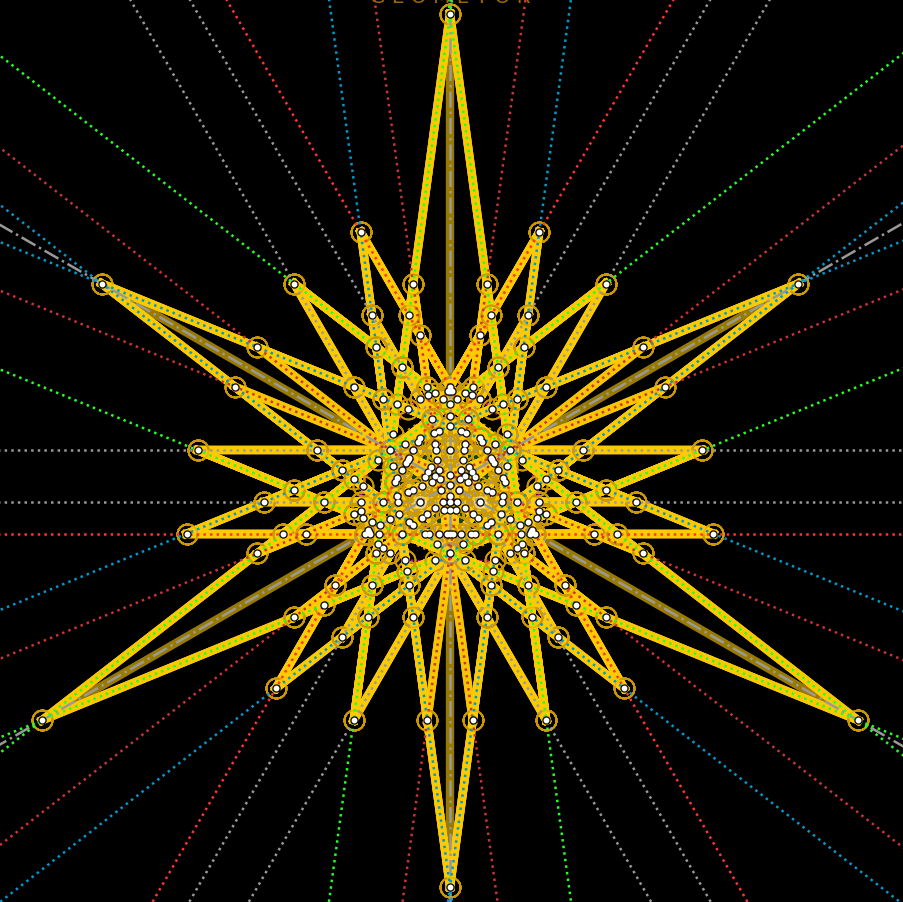
Pointer-Free Visual Pseudocode — 3-Way Rosetta Analysis
Side-by-Side Formalism Alignment: Heath (1908) · Byrne (1847) · GEOMETOR DAG
Side-by-side compiler and visual-register comparison across Heath's classical alphabetic Euclid (pass-by-reference vertex pointers), Oliver Byrne's 1847 colored glyph equations (pass-by-value visual literals with zero pointer dereferences), and exact geometor.model SymPy algebraic constructions.
1. Formal Grammar of Byrne’s 1847 Visual Pseudocode
In geometor.byrne.pseudocode, every proposition in Oliver Byrne's 1847 treatise is modeled as an abstract syntax tree (ByrneProgram) over typed pass-by-value geometric literals:
Program     ::= PhaseBlock+
        PhaseBlock  ::= ("GIVEN" | "SOUGHT" | "CONSTRUCTION" | "DEMONSTRATION" | "QED") Statement+
        Statement   ::= (VisualToken | Operator | Connector)+ ("[" Justification+ "]")?
        VisualToken ::= Sort "(" ColorExpr ("," StrokeMode)? ("," FillMode)? ")" ("²")?
        Sort        ::= line | angle | tri | sq | rect | arc | circle | mag
        ColorExpr   ::= red | blue | yellow | black | Color "+" Color | Color "/" Color "/" Color
        StrokeMode  ::= solid | dashed | dotted | solid-dotted
        Operator    ::= "=" | "+" | "-" | "⊏" | "⊐" | "∥" | "⊥" | "∷" | "×" | "∟" | "2∟" | "∴" | "∵"
2. Rosetta Case I: I.1 (Equilateral Triangle, G.84)
Heath / Classical Alphabetic Prose (179 words, 31 vertex-pointer lookups): “With centre A and distance AB let the circle BCD be described; again, with centre B and distance BA let the circle ACE be described; and from the point C, in which the circles cut one another, to the points A, B let the straight lines CA, CB be joined…”
Byrne 1847 Visual Pseudocode (22 words, 0 pointers, 6 registers): Describe and ; draw and ([I.post.3], [I.post.1]). Then = ([I.def.15]) and = ([I.def.15]), ∴ = = ([C.N.1]).
GEOMETOR Formal Pseudocode (``elements`` / ``model``):
c_ab = model.construct_circle(A, B, by="I.post.3")
        c_ba = model.construct_circle(B, A, by="I.post.3")
        C = model.intersect(c_ab, c_ba, side_of=(A, B, +1), ID="C")
        assert quadrance(A, C) == quadrance(A, B) == quadrance(B, C)
3. Rosetta Case II: I.5 (Pons Asinorum, G.91)
Heath (329 words, 62 vertex-pointer lookups): Requires tracking overlapping triangles
AFC,AGB,BFC,CGBand three-letter anglesABG,ACF,CBG,BCF,ABC,ACB.Byrne 1847 (32 words, 0 pointers, 4 :term:`congruence-twin <congruence-twin>` pairs): + = + around common ([C.N.2]) $\implies$ = and = ([I.4]) $\implies$ remaining base angles = ([C.N.3]).
GEOMETOR Formal Pseudocode:
G = model.intersect(line_AC, circle(A, F), beyond=(A, C), ID="G")
        assert spread(B, A, B, C) == spread(C, A, C, B)
4. Rosetta Case III: I.47 (Pythagorean Theorem, G.140)
Heath (314 words, 64 vertex-pointer lookups): Refers repeatedly to four-letter squares
BDEC,ABFG,ACKHand parallelogramsBLMD,CLME.Byrne 1847 (25 words, 0 pointers, 8.0% verbal load): = 2 × windmill triangle = ([I.4], [I.41]), and = 2 × symmetric windmill triangle = , ∴ + = + ([C.N.2]).
GEOMETOR Formal Pseudocode:
assert spread(A, B, A, C) == 1
        assert quadrance(B, C) == quadrance(A, B) + quadrance(A, C)
5. Rosetta Cases IV–VI: II.11, IV.10–IV.11 & Book V V.16
Golden Section & Pentagon (``II.11`` → ``IV.10`` → ``IV.11``): Byrne links colored area subtraction ( = in
II.11) to tangent-secant power (2 inIV.10) and five-chord cyclotomic symmetry (, , , , inIV.11), mirrored in SymPy by the algebraic tower $\mathbb{Q} \subset \mathbb{Q}(\phi) \subset \mathbb{Q}(\phi, \sqrt{10 - 2\sqrt{5}})$.Book V Colored Ratio Calculus (``V.16`` *Alternando*, ``G.276``): : ∷ : $\implies$ : ∷ : (7.1% verbal load, connecting directly to
geometor/codes).