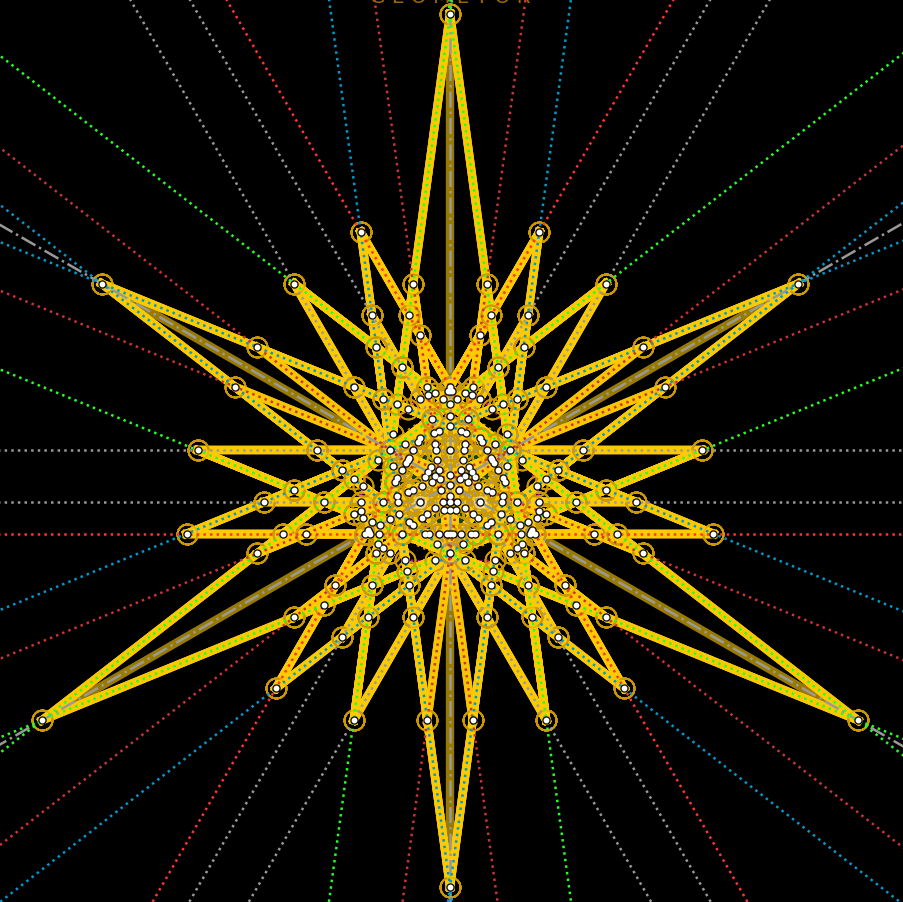
Book IV — Inscribed Circles, The Golden Triangle & Regular Pentagon

Incircles, Cyclotomic Symmetry & Chromatic Register Mastery (Pickering pp. 125–151, Leaves 159–185)

Book IV unites the triangle congruence of Book I, the golden-section area algebra of Book II (II.11), and the tangent-chord circle theorems of Book III (III.36–III.37) to construct inscribed circles (IV.4), the $36^\circ\text{–}72^\circ\text{–}72^\circ$ Golden Triangle (IV.10), and the regular pentagon (IV.11).

Book IV, Prop. XI — Regular Pentagon Inscribed in a Circle < A C D > < A B C D E > ( O A ) < C A D ) < E C A ) < D C E ) < B D C ) / A B / / B C / / C D / / D E / / E A / / C E / / D B / A = (0, 1) B = (-sqrt(2)*sqrt(sqrt(5) + 5)/4, -1/4 + sqrt(5)/4) C = (-sqrt(2)*sqrt(5 - sqrt(5))/4, -sqrt(5)/4 - 1/4) D = (sqrt(2)*sqrt(5 - sqrt(5))/4, -sqrt(5)/4 - 1/4) E = (sqrt(2)*sqrt(sqrt(5) + 5)/4, -1/4 + sqrt(5)/4)
**Book IV Climax — Proposition IV.11 (p. 137 · G.224).** Inscribing an equilateral and equiangular pentagon in a given circle via the Golden Triangle (:ref:`IV.10 `) and stroke-modulated chromatic registers.

Propositions in Book IV

Book IV, Prop. IV — Incircle of a Triangle < A B C > ( I E ) / A B / / A C / / B C / / B I / / C I / / I E / / I F / / I G / B = (0, 0) C = (14, 0) A = (5, 12) I = (6, 4) E = (6, 0) F = (30/13, 72/13) G = (46/5, 32/5)

Proposition IV.4 — Incircle of a Triangle

In a given triangle () to inscribe a circle.

Book IV, Prop. X — The 36°–72°–72° Golden Triangle < A B D > ( A B ) ( P A ) < B A D ) < C D B ) < D B A ) / A C / / C B / / A D / / B D / / C D / A = (0, 0) B = (1, 0) C = (-1/2 + sqrt(5)/2, 0) D = (1/4 + sqrt(5)/4, sqrt(2)*sqrt(5 - sqrt(5))/4)

Proposition IV.10 — Isosceles Golden Triangle

To construct an isosceles triangle, in which each of the angles at the base shall be double of the vertical angle.

Book IV, Prop. XI — Regular Pentagon Inscribed in a Circle < A C D > < A B C D E > ( O A ) < C A D ) < E C A ) < D C E ) < B D C ) / A B / / B C / / C D / / D E / / E A / / C E / / D B / A = (0, 1) B = (-sqrt(2)*sqrt(sqrt(5) + 5)/4, -1/4 + sqrt(5)/4) C = (-sqrt(2)*sqrt(5 - sqrt(5))/4, -sqrt(5)/4 - 1/4) D = (sqrt(2)*sqrt(5 - sqrt(5))/4, -sqrt(5)/4 - 1/4) E = (sqrt(2)*sqrt(sqrt(5) + 5)/4, -1/4 + sqrt(5)/4)

Proposition IV.11 — Regular Pentagon Inscribed in a Circle

In a given circle () to inscribe an equilateral and equiangular pentagon.