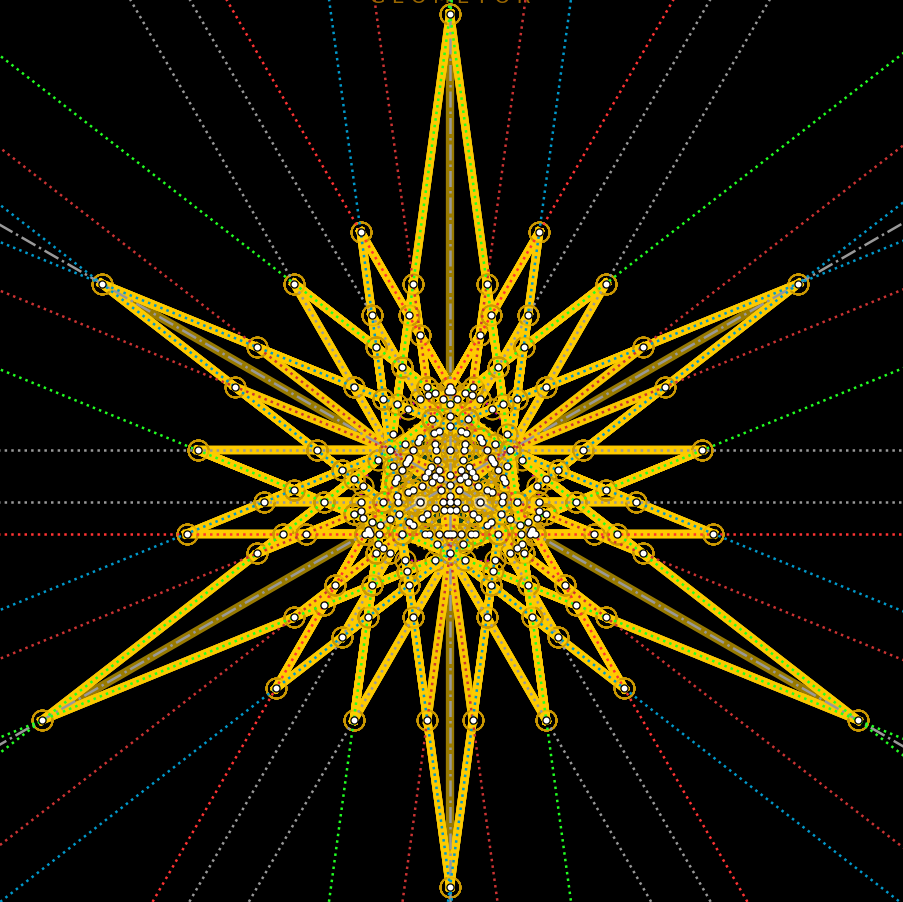
Liber II.B — Intelligible Priority in Definitions & Antanairesis
Liber II — Organon Geometricum: Quantity, Syllogism & Definitions · Bekker 141a23–142b19, 158a31–159a14
«τὴν αὐτὴν ἀνταναίρεσιν ἔχει τὰ χωρία καὶ αἱ βάσεις.»
“The areas and the bases have the same reciprocal subtraction (antanairesis).” — Topica VIII.3, 158b33–34
Topics VI.4 — Prior by Nature vs. Prior to Us: Defining Point, Line, Plane & Solid (141a23–142b19)
Oxford Translation by W. A. Pickard-Cambridge · Bekker 141a23–142b19
Whether, then, a man defines a thing correctly or incorrectly you should proceed to examine on these and similar lines. But whether he has mentioned and defined its essence or no, should be examined as follows: First of all, see if he has failed to make the definition through terms that are prior and more intelligible. For the reason why the definition is rendered is to make known the term stated, and we make things known by taking not any random terms, but such as are prior and more intelligible, as is done in demonstrations (for so it is with all teaching and learning); accordingly, it is clear that a man who does not define through terms of this kind has not defined at all. Otherwise, there will be more than one definition of the same thing: for clearly he who defines through terms that are prior and more intelligible has also framed a definition, and a better one, so that both would then be definitions of the same object. This sort of view, however, does not generally find acceptance: for of each real object the essence is single: if, then, there are to be a number of definitions of the same thing, the essence of the object will be the same as it is represented to be in each of the definitions, and these representations are not the same, inasmuch as the definitions are different. Clearly, then, any one who has not defined a thing through terms that are prior and more intelligible has not defined it at all.
The statement that a definition has not been made through more intelligible terms may be understood in two senses, either supposing that its terms are absolutely less intelligible, or supposing that they are less intelligible to us: for either sense is possible. Thus absolutely the prior is more intelligible than the posterior, a point, for instance, than a line, a line than a plane, and a plane than a solid; just as also a unit is more intelligible than a number; for it is the prius and starting-point of all number. Likewise, also, a letter is more intelligible than a syllable. Whereas to us it sometimes happens that the converse is the case: for the solid falls under perception most of all-more than a plane-and a plane more than a line, and a line more than a point; for most people learn things like the former earlier than the latter; for any ordinary intelligence can grasp them, whereas the others require an exact and exceptional understanding.
Absolutely, then, it is better to try to make what is posterior known through what is prior, inasmuch as such a way of procedure is more scientific. Of course, in dealing with persons who cannot recognize things through terms of that kind, it may perhaps be necessary to frame the expression through terms that are intelligible to them. Among definitions of this kind are those of a point, a line, and a plane, all of which explain the prior by the posterior; for they say that a point is the limit of a line, a line of a plane, a plane of a solid. One must, however, not fail to observe that those who define in this way cannot show the essential nature of the term they define, unless it so happens that the same thing is more intelligible both to us and also absolutely, since a correct definition must define a thing through its genus and its differentiae, and these belong to the order of things which are absolutely more intelligible than, and prior to, the species. For annul the genus and differentia, and the species too is annulled, so that these are prior to the species. They are also more intelligible; for if the species be known, the genus and differentia must of necessity be known as well (for any one who knows what a man is knows also what ‘animal’ and ‘walking’ are), whereas if the genus or the differentia be known it does not follow of necessity that the species is known as well: thus the species is less intelligible. Moreover, those who say that such definitions, viz. those which proceed from what is intelligible to this, that, or the other man, are really and truly definitions, will have to say that there are several definitions of one and the same thing. For, as it happens, different things are more intelligible to different people, not the same things to all; and so a different definition would have to be rendered to each several person, if the definition is to be constructed from what is more intelligible to particular individuals. Moreover, to the same people different things are more intelligible at different times; first of all the objects of sense; then, as they become more sharpwitted, the converse; so that those who hold that a definition ought to be rendered through what is more intelligible to particular individuals would not have to render the same definition at all times even to the same person. It is clear, then, that the right way to define is not through terms of that kind, but through what is absolutely more intelligible: for only in this way could the definition come always to be one and the same. Perhaps, also, what is absolutely intelligible is what is intelligible, not to all, but to those who are in a sound state of understanding, just as what is absolutely healthy is what is healthy to those in a sound state of body. All such points as this ought to be made very precise, and made use of in the course of discussion as occasion requires. The demolition of a definition will most surely win a general approval if the definer happens to have framed his expression neither from what is absolutely more intelligible nor yet from what is so to us.
One form, then, of the failure to work through more intelligible terms is the exhibition of the prior through the posterior, as we remarked before.’ Another form occurs if we find that the definition has been rendered of what is at rest and definite through what is indefinite and in motion: for what is still and definite is prior to what is indefinite and in motion.
Of the failure to use terms that are prior there are three forms:
The first is when an opposite has been defined through its opposite, e.g.i. good through evil: for opposites are always simultaneous by nature. Some people think, also, that both are objects of the same science, so that the one is not even more intelligible than the other. One must, however, observe that it is perhaps not possible to define some things in any other way, e.g. the double without the half, and all the terms that are essentially relative: for in all such cases the essential being is the same as a certain relation to something, so that it is impossible to understand the one term without the other, and accordingly in the definition of the one the other too must be embraced. One ought to learn up all such points as these, and use them as occasion may seem to require.
Another is-if he has used the term defined itself. This passes unobserved when the actual name of the object is not used, e.g. supposing any one had defined the sun as a star that appears by day’. For in bringing in ‘day’ he brings in the sun. To detect errors of this sort, exchange the word for its definition, e.g. the definition of ‘day’ as the ‘passage of the sun over the earth’. Clearly, whoever has said ‘the passage of the sun over the earth’ has said ‘the sun’, so that in bringing in the ‘day’ he has brought in the sun.
Again, see if he has defined one coordinate member of a division by another, e.g. ‘an odd number’ as ‘that which is greater by one than an even number’. For the co-ordinate members of a division that are derived from the same genus are simultaneous by nature and ‘odd’ and ‘even’ are such terms: for both are differentiae of number.
Likewise also, see if he has defined a superior through a subordinate term, e.g. ‘An “even number” is “a number divisible into halves”’, or ‘“the good” is a “state of virtue” ‘. For ‘half’ is derived from ‘two’, and ‘two’ is an even number: virtue also is a kind of good, so that the latter terms are subordinate to the former. Moreover, in using the subordinate term one is bound to use the other as well: for whoever employs the term ‘virtue’ employs the term ‘good’, seeing that virtue is a certain kind of good: likewise, also, whoever employs the term ‘half’ employs the term ‘even’, for to be ‘divided in half’ means to be divided into two, and two is even.
Topics VIII.3 — Primary Hypotheses & Pre-Eudoxian Proportion by Antanairesis (158b29–35) (158a31–159a14)
Oxford Translation by W. A. Pickard-Cambridge · Bekker 158a31–159a14
There are certain hypotheses upon which it is at once difficult to bring, and easy to stand up to, an argument. Such (e.g.) are those things which stand first and those which stand last in the order of nature. For the former require definition, while the latter have to be arrived at through many steps if one wishes to secure a continuous proof from first principles, or else all discussion about them wears the air of mere sophistry: for to prove anything is impossible unless one begins with the appropriate principles, and connects inference with inference till the last are reached. Now to define first principles is just what answerers do not care to do, nor do they pay any attention if the questioner makes a definition: and yet until it is clear what it is that is proposed, it is not easy to discuss it. This sort of thing happens particularly in the case of the first principles: for while the other propositions are shown through these, these cannot be shown through anything else: we are obliged to understand every item of that sort by a definition. The inferences, too, that lie too close to the first principle are hard to treat in argument: for it is not possible to bring many arguments in regard to them, because of the small number of those steps, between the conclusion and the principle, whereby the succeeding propositions have to be shown. The hardest, however, of all definitions to treat in argument are those that employ terms about which, in the first place, it is uncertain whether they are used in one sense or several, and, further, whether they are used literally or metaphorically by the definer. For because of their obscurity, it is impossible to argue upon such terms; and because of the impossibility of saying whether this obscurity is due to their being used metaphorically, it is impossible to refute them.
In general, it is safe to suppose that, whenever any problem proves intractable, it either needs definition or else bears either several senses, or a metaphorical sense, or it is not far removed from the first principles; or else the reason is that we have yet to discover in the first place just this-in which of the aforesaid directions the source of our difficulty lies: when we have made this clear, then obviously our business must be either to define or to distinguish, or to supply the intermediate premisses: for it is through these that the final conclusions are shown.
It often happens that a difficulty is found in discussing or arguing a given position because the definition has not been correctly rendered: e.g. ‘Has one thing one contrary or many?’: here when the term ‘contraries’ has been properly defined, it is easy to bring people to see whether it is possible for the same thing to have several contraries or not: in the same way also with other terms requiring definition. It appears also in mathematics that the difficulty in using a figure is sometimes due to a defect in definition; e.g. in proving that the line which cuts the plane parallel to one side divides similarly both the line which it cuts and the area; whereas if the definition be given, the fact asserted becomes immediately clear: for the areas have the same fraction subtracted from them as have the sides: and this is the definition of ‘the same ratio’. The most primary of the elementary principles are without exception very easy to show, if the definitions involved, e.g. the nature of a line or of a circle, be laid down; only the arguments that can be brought in regard to each of them are not many, because there are not many intermediate steps. If, on the other hand, the definition of the starting-points be not laid down, to show them is difficult and may even prove quite impossible. The case of the significance of verbal expressions is like that of these mathematical conceptions.
One may be sure then, whenever a position is hard to discuss, that one or other of the aforesaid things has happened to it. Whenever, on the other hand, it is a harder task to argue to the point claimed, i.e. the premiss, than to the resulting position, a doubt may arise whether such claims should be admitted or not: for if a man is going to refuse to admit it and claim that you shall argue to it as well, he will be giving the signal for a harder undertaking than was originally proposed: if, on the other hand, he grants it, he will be giving the original thesis credence on the strength of what is less credible than itself. If, then, it is essential not to enhance the difficulty of the problem, he had better grant it; if, on the other hand, it be essential to reason through premisses that are better assured, he had better refuse. In other words, in serious inquiry he ought not to grant it, unless he be more sure about it than about the conclusion; whereas in a dialectical exercise he may do so if he is merely satisfied of its truth. Clearly, then, the circumstances under which such admissions should be claimed are different for a mere questioner and for a serious teacher.