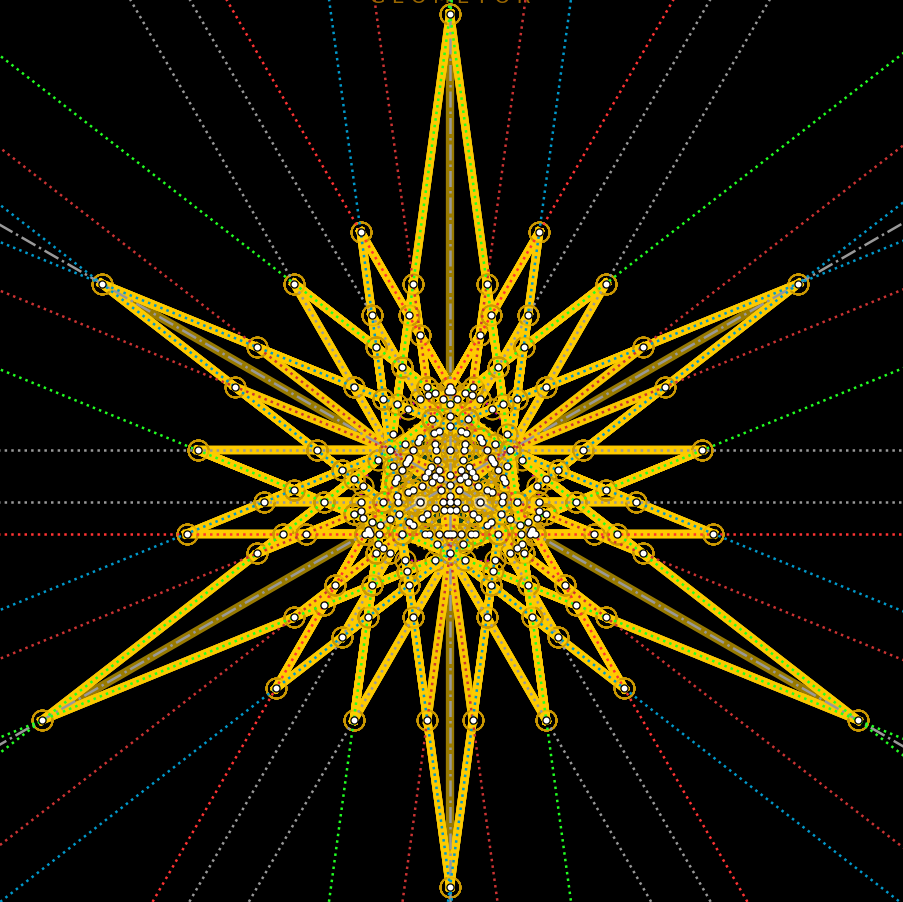
Liber II.A — Discrete & Continuous Quantity and Geometric Syllogism — Structural Synopsis
Argumentative Architecture & Bekker Conspectus (Bekker 4b20–6a35, 25b–26a, 40b–41b, 64b–65a)
Architectural Thesis
Liber II.A gathers Aristotle's foundational logical-ontological texts on quantity and geometric deduction from the Organon: Categories 6 (4b20–6a35) establishing the irreducible bifurcation between discrete and continuous quantity, and Prior Analytics I.4, I.23–24, and II.16 (25b, 40b–41b, 64b–65a) exhibiting syllogistic necessity, the reductio proof of the incommensurability of the diagonal, the pre-Euclidean proof of Elements I.5, and the circularity lurking in pre-Euclidean parallel-line theories.
Logical & Noetic Progression
Categories 6 (4b20–6a35) — Discrete vs. Continuous Quantity
Divides quantity into discrete (number, spoken speech—parts share no common boundary) and continuous (line, surface, solid body, time, place—parts join at a common boundary: point for line, line for plane, plane for body). Establishes equality and inequality (ἴσον τε καὶ ἄνισον, 6a26) as the distinctive proprietary mark of all quantity.
Prior Analytics I.4 (25b26–26b33) — First-Figure Syllogism (Barbara)
Formulates the canonical universal syllogism (25b37–39): ‘If A is predicated of all B, and B of all C, A must be predicated of all C’—introducing schematic letter-variables into formal logic on the model of Greek geometric lettering.
Prior Analytics I.23 (40b17–41b5) — Syllogism per Impossibile & the Diagonal (41a23–30)
Shows that ostensive and reductio proofs alike reduce to the three syllogistic figures, citing the famous Pythagorean proof that if the diagonal of a square is assumed commensurable with its side, odd numbers turn out equal to even (περισσὰ ἴσα γίνεσθαι τοῖς ἀρτίοις, 41a26–27).
Prior Analytics I.24 (41b6–41b35) — Pre-Euclidean Proof of Isosceles Base Angles (41b13–22)
Illustrates why every demonstration requires at least one universal premiss through a remarkable pre-Euclidean proof of Elements I.5 utilizing mixed (rectilinear-curvilinear) angles of a circle!
Prior Analytics II.16 (64b28–65a37) — Petitio Principii in Parallel Lines (65a4–9)
Diagnoses begging the question (to en archēi aiteisthai) in contemporary fourth-century geometers who ‘think they draw parallel lines’ (οἱ τὰς παραλλήλους οἰόμενοι γράφειν, 65a4) while unconsciously assuming facts logically equivalent to the Parallel Postulate itself.
Chapter & Bekker Span Conspectus
Treatise & Chapter |
Bekker Span |
Thematic Scope |
Tracks |
|---|---|---|---|
Categoriae Ch. 6 |
|
Discrete vs. Continuous Quantity: Number, Line, Surface, Body, Time & Place |
|
Analytica Priora I.4 |
|
First-Figure Syllogism (Barbara) & Universal Necessity (25b37–39) |
|
Analytica Priora I.23 |
|
Syllogistic Reduction & Proof of Incommensurability of the Diagonal (41a23–30) |
|
Analytica Priora I.24 |
|
Universal Premiss in Proof & Pre-Euclidean Proof of Isosceles Base Angles (41b13–22) |
|
Analytica Priora II.16 |
|
Petitio Principii & Circularity in Pre-Euclidean Parallel-Line Proofs (65a4–9) |
Reception Snapshot in the GEOMETOR Canon
This unit encompasses 5 distinct Bekker loci cited across geometor/euclid, geometor/hoenen, and geometor/pacioli. See the companion Critical Notes & Dual Commentary and the master Bekker Concordance for full folio and page back-references.