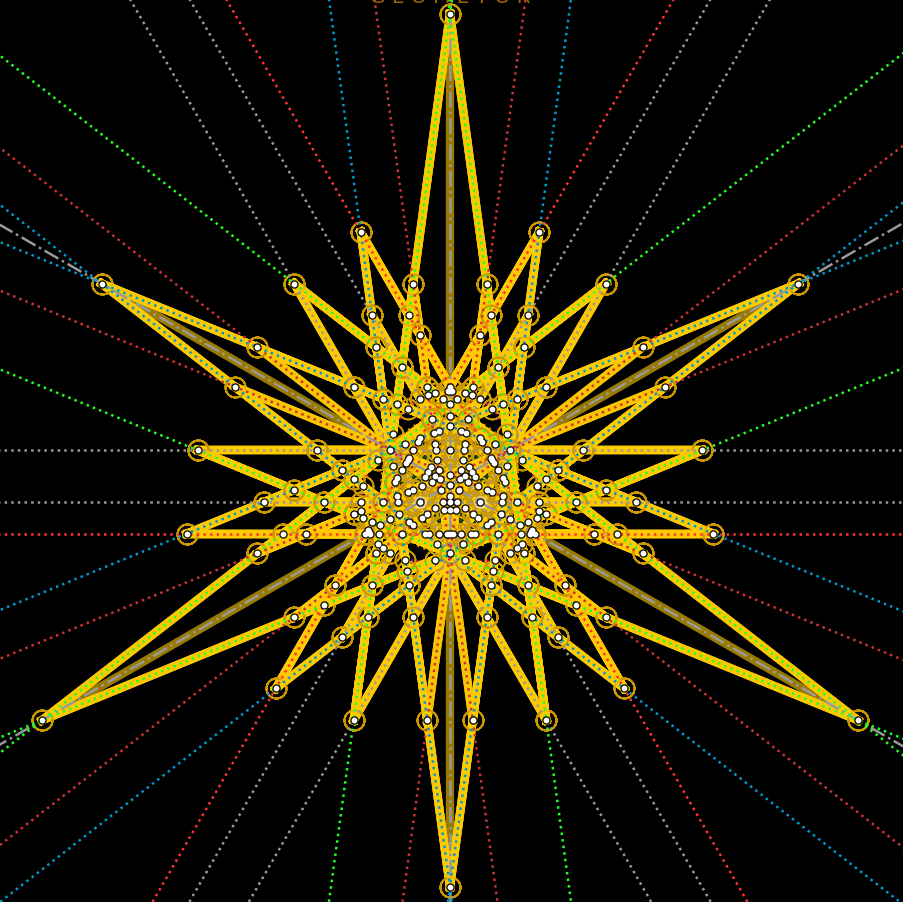
Principles of Rational Trigonometry

Principles of Rational Trigonometry & Universal Geometry — Norman J. Wildberger

Primary Treatises: Divine Proportions: Rational Trigonometry to Universal Geometry (2005) & Universal Hyperbolic Geometry (2008).
Executable Formalization: 28 executable principles (W.01–W.28) formalized in SymPy by the GEOMETOR Project.
Digital Edition: 2-track codex (Synthesis · Code) with interactive SVG diagrams and exact symbolic proofs.

Table of Contents

The GEOMETOR Wildberger Codex gathers 28 foundational principles (\(\text{W.01}\) through \(\text{W.28}\)) of Rational Trigonometry and Universal Geometry (Wildberger2005, Wildberger2008), demonstrating each theorem through 100% exact SymPy symbolic proofs, runnable geometor.model constructions, and interactive SVG diagrams.

  • Part I (W.01 – W.05): Planar proportions, reflections, quadrance, spread, and spread polynomials \(S_n(s)\) (including Pentagonal Golden Spreads).

  • Part II (W.06 – W.11): The Five Fundamental Laws (Pythagoras, Triple Quad, Spread Law, Cross Law, Triple Spread) and Kepler’s Golden Right Triangle.

  • Part III (W.12 – W.23): Triangle centers, Euler line & Nine-Point Circle over \(\mathbb{Q}\) and \(\mathbb{F}_p\), circles, cyclic quadrilaterals, golden pentagons, metrical conics, Taylor tangents, projective cross-ratio, and Chromogeometry (Blue, Red, Green metrics).

  • Part IV (W.24 – W.28): Polynomial triangle solvers, Snellius–Pothenot resection, Hansen’s surveying benchmark, algebraic physics, exact rational dihedral spreads of all five Platonic solids, rational polar curves, and the Ellipson.

l_3 p_3 n_3 A_1 = [0, 1] A_2 = [6, 4] A_3 = [2, 6] F_3 = [18/5, 14/5] A = [4, 7] l_3 = <-3:6:-6> F_3 = [18/5, 14/5] A1A1 A2A2 A3A3 F3F3 + − ⟲ Lbl Gde

W.01 Planar Points, Line Proportions & Incidence Determinants

Over any field F of characteristic not equal to 2, a planar point is an ordered pair A = [x, y] and a planar line is a homogeneous 3-proportion l = <a : b : c> with (a, b) != (0, 0) representing a*x + b*y + c = 0; three points are collinear and three lines are concurrent if and only if their respective 3x3 coordinate determinants vanish.
l / A A_r / (Q = 196/5) m m_r P_1 = [0, 0] P_2 = [2, 1] A = [1, 4] B = [5, 4] F = [12/5, 6/5] A_r = [19/5, -8/5] C = [31/5, 8/5] D = [8, 4] A_r = [19/5, -8/5] s(l,m) = s(l,m_r) = 1/5 P1P1 P2P2 AA BB FF ArAr + − ⟲ Lbl Gde

W.02 Lineations, Central Rotations & Reflections in Lines

For any non-null line l = <a : b : c> over a field F (char F != 2), the reflection sigma_l maps every point A = [x, y] and every line m = <a_2 : b_2 : c_2> to exact rational images whose denominators depend only on the quadratic norm a^2 + b^2, without radicals or angles.
l b_12 / A_0 F_0 / (Q = 98/5) A_1 = [1, 1] A_2 = [7, 3] A_0 = [2, 6] M = [4, 2] F_0 = [17/5, 9/5] A = [6, -4] Q(A_1,A_2) = 40, Q(A_1,M) = 10 Q(A_0, l) = 98/5 A1A1 A2A2 A0A0 MM F0F0 + − ⟲ Lbl Gde

W.03 Quadrance, Midpoints & Point-to-Line Separation

The quadrance between A_1 = [x_1, y_1] and A_2 = [x_2, y_2] is the quadratic form Q(A_1, A_2) = (x_2 - x_1)^2 + (y_2 - y_1)^2; midpoint M divides the quadrance by 4, the locus Q(X, A_1) = Q(X, A_2) is the linear perpendicular bisector, and the quadrance from A_0 to a non-null line l = <a : b : c> is (a*x_0 + b*y_0 + c)^2 / (a^2 + b^2).
l_1 l_2 n_bc (Q = 10) A = [0, 0] B = [5, 5] C = [6, 2] s(l_1,l_2) = 1/5 c = 4/5, t = 1/4 AA BB CC + − ⟲ Lbl Gde

W.04 Spread, Cross, Twist & Line Separation Ratios

For two non-null lines l_1 = <a_1 : b_1 : c_1> and l_2 = <a_2 : b_2 : c_2>, the spread s(l_1, l_2) = (a_1*b_2 - a_2*b_1)^2 / ((a_1^2 + b_1^2)*(a_2^2 + b_2^2)) depends only on the unoriented lines, vanishes iff l_1 || l_2, equals 1 iff l_1 perp l_2, and equals Q(B, C) / Q(A, B) for any altitude BC dropped from B on l_1 to C on l_2.
l_0 l_1 l_2 l_3 l_4 O = [0, 0] V_0 = [5, 0] V_1 = [4, 2] A = [2, 8/3] B = [2, 11] C = [2, -48/7] s_1 = 1/5, S_2 = 16/25, S_3 = 121/125 S_5(s)=0 => (3-phi)/4, (2+phi)/4 OO V0V0 V1V1 + − ⟲ Lbl Gde

W.05 Spread Polynomials S_n(s) & Pentagonal Golden Spreads

The integer-coefficient spread polynomials S_0(s) = 0, S_1(s) = s, S_n(s) = 2(1 - 2s)S_{n-1}(s) - S_{n-2}(s) + 2s satisfy the semigroup composition law S_n(S_m(s)) = S_{nm}(s) over every commutative ring, and the fivefold polynomial S_5(s) = s(16s^2 - 20s + 5)^2 vanishes precisely at the Pentagonal Golden Spreads s = (5 -/+ sqrt(5))/8 = (3 - phi)/4 and (2 + phi)/4.
t c (Q = 25/4) / A_3 F_3 / (Q = 144/25) A_1 = [0, 3] A_2 = [4, 0] A_3 = [0, 0] M_3 = [2, 3/2] F_3 = [36/25, 48/25] Q_1=16 + Q_2=9 = Q_3=25 s_3 = 1 A1A1 A2A2 A3A3 M3M3 F3F3 + − ⟲ Lbl Gde

W.06 Law I: Pythagoras’ Theorem & Right Triangle Invariants

For any three non-collinear points A_1, A_2, A_3 over a field F (char F != 2) with non-null lines A_1 A_3 and A_2 A_3, the lines A_1 A_3 and A_2 A_3 are perpendicular (s_3 = 1) if and only if Q(A_2, A_3) + Q(A_1, A_3) = Q(A_1, A_2), in which case the hypotenuse midpoint M_3 is equidistant in quadrance (Q_3 / 4) from all three vertices.
t l_base h_3 (Q = 144) A_1 = [0, 0] A_2 = [14, 0] A_3 = [5, 12] P_col = [9, 0] A = [5, 0] Quadrea A = 112896 = 16 * 84^2 Collinear P_col: A(81, 25, 196) = 0 A1A1 A2A2 A3A3 PcolPcol + − ⟲ Lbl Gde

W.07 Law II: Triple Quad Formula, Archimedes’ Function & Quadrea

Three planar points A_1, A_2, A_3 with pairwise quadrances Q_1, Q_2, Q_3 are collinear if and only if Archimedes’ symmetric quadratic form A(Q_1, Q_2, Q_3) = (Q_1 + Q_2 + Q_3)^2 - 2(Q_1^2 + Q_2^2 + Q_3^2) vanishes; for any triangle, A(Q_1, Q_2, Q_3) equals 4 times the squared coordinate determinant (16 * Delta^2), defining the triangle’s quadrea.
t c (Q = 4225/64) / A_1 F_1 / (Q = 3136/25) / A_2 F_2 / (Q = 28224/169) A_1 = [0, 0] A_2 = [14, 0] A_3 = [5, 12] F_1 = [224/25, 168/25] F_2 = [350/169, 840/169] C = [7, 33/8] s_i / Q_i = 16/4225 = 1/(4K) K = 4225/64 A1A1 A2A2 A3A3 F1F1 F2F2 CC + − ⟲ Lbl Gde

W.08 Law III: The Spread Law & Extended Circumquadrance Law

In any non-null triangle A_1 A_2 A_3 with side quadrances Q_1, Q_2, Q_3, vertex spreads s_1, s_2, s_3, quadrea A, and circumquadrance K, the ratios of spread to opposite quadrance are equal: s_1 / Q_1 = s_2 / Q_2 = s_3 / Q_3 = A / (4 * Q_1 * Q_2 * Q_3) = 1 / (4 * K).
t l_1 alt_1 (Q = 784/41) A_1 = [0, 0] A_2 = [7, 0] A_3 = [2, 4] F_1 = [112/41, 140/41] (Q_1+Q_2-Q_3)^2 = 144 = 4*Q_1*Q_2*c_3 s_3 = 196/205, c_3 = 9/205 A1A1 A2A2 A3A3 F1F1 + − ⟲ Lbl Gde

W.09 Law IV: The Cross Law & Quadrea-Spread Identity

In any triangle A_1 A_2 A_3 with non-null sides Q_1, Q_2 meeting with spread s_3 and cross c_3 = 1 - s_3 at vertex A_3, the quadrances satisfy (Q_1 + Q_2 - Q_3)^2 = 4 * Q_1 * Q_2 * (1 - s_3) = 4 * Q_1 * Q_2 * c_3, equivalently A(Q_1, Q_2, Q_3) = 4 * Q_1 * Q_2 * s_3.
t l_1 l_2 l_3 A_1 = [0, 0] A_2 = [8, 1] A_3 = [3, 6] s = (9/13, 81/130, 9/10) (s_1+s_2+s_3)^2 = 2*sum(s_i^2) + 4*s_1*s_2*s_3 A1A1 A2A2 A3A3 + − ⟲ Lbl Gde

W.10 Law V: Triple Spread, Triple Cross & Quadruple Spread Formulas

For any three coplanar non-null lines l_1, l_2, l_3 with pairwise spreads s_1, s_2, s_3 and crosses c_i = 1 - s_i, the spreads satisfy the cubic Triple Spread Formula (s_1 + s_2 + s_3)^2 = 2(s_1^2 + s_2^2 + s_3^2) + 4*s_1*s_2*s_3 and the crosses satisfy (c_1 + c_2 + c_3 - 1)^2 = 4*c_1*c_2*c_3; for four lines, the Quadruple Spread polynomial R(s_12, s_23, s_34, s_14) = 0 is identically invariant under s_ij <-> 1 - s_ij.
t_kepler alt (Q = -1/2 + sqrt(5)/2) A_1 = [-1/2 + sqrt(5)/2, -sqrt(1/2 + sqrt(5)/2)/2 + sqrt(5)*sqrt(1/2 + sqrt(5)/2)/2] A_2 = [0, 0] A_3 = [GoldenRatio, 0] F_1 = [-1/2 + sqrt(5)/2, 0] Q = (1, phi, phi^2), F_1 splits phi : 1 s = (2 - phi, phi - 1, 1) = (1/phi^2, 1/phi, 1) A1A1 A2A2 A3A3 F1F1 + − ⟲ Lbl Gde

W.11 Isosceles, Equilateral & Kepler’s Golden Right Triangle

In a non-null triangle, Q_1 = Q_2 iff s_1 = s_2 (with apex spread s_3 = (Q_3/Q_1)(1 - Q_3/(4*Q_1))), and Q_1 = Q_2 = Q_3 iff s_1 = s_2 = s_3 = 3/4; in Kepler’s Golden Right Triangle with side lengths (1, sqrt(phi), phi), the nested radical vanishes in quadrance to give Q = (1, phi, phi^2) and exact golden spreads (s_1, s_2, s_3) = (2 - phi, phi - 1, 1) = (1/phi^2, 1/phi, 1).
t c_in (Q = 16) b_1 b_2 b_3 A_1 = [0, 0] A_2 = [14, 0] A_3 = [5, 12] I_0 = [6, 4] A = [6, 0] B = [6 - 12*sqrt(13)/13, 4 - 8*sqrt(13)/13] C = [12*sqrt(13)/13 + 6, 8*sqrt(13)/13 + 4] D = [6 - 8*sqrt(5)/5, 4*sqrt(5)/5 + 4] E = [8*sqrt(5)/5 + 6, 4 - 4*sqrt(5)/5] F = [6 - 4*sqrt(65)/65, 32*sqrt(65)/65 + 4] G = [4*sqrt(65)/65 + 6, 4 - 32*sqrt(65)/65] I_0 = [6, 4], Inquadrance R_0 = 16 s(I_0 A_1, I_0 A_2) = 49/65 A1A1 A2A2 A3A3 I0I0 + − ⟲ Lbl Gde

W.12 Vertex Bisectors, Square Vertices & The Four Incenters

The locus of points X having equal quadrance Q(X, l_1) = Q(X, l_2) to two intersecting non-null lines l_1, l_2 splits into two orthogonal vertex bisectors over F if and only if (a_1^2 + b_1^2)(a_2^2 + b_2^2) is a square in F; when two vertices of a triangle have bisectors in F, so does the third, producing four symmetric incenters I_0, I_1, I_2, I_3.
t t_med / A_1 M_1 / (Q = 153/2) / A_2 M_2 / (Q = 261/2) / A_3 M_3 / (Q = 90) A_1 = [0, 0] A_2 = [12, 0] A_3 = [3, 9] M_1 = [15/2, 9/2] M_2 = [3/2, 9/2] M_3 = [6, 0] G = [5, 3] 4*Q(A_3,M_3) = 360 = 2*Q_1 + 2*Q_2 - Q_3 G = [5, 3], Q(A,G)=4*Q(G,M) A1A1 A2A2 A3A3 M1M1 M2M2 M3M3 GG + − ⟲ Lbl Gde

W.13 Stewart’s Theorem, Median Quadrances & The Centroid

For any affine point D = (1 - lambda)*A_1 + lambda*A_2 on side A_1 A_2 of triangle A_1 A_2 A_3, the cevian quadrance satisfies Q(A_3, D) = (1 - lambda)*Q_2 + lambda*Q_1 - lambda*(1 - lambda)*Q_3; at lambda = 1/2, the median quadrance satisfies 4*Q(A_3, M_3) = 2*Q_1 + 2*Q_2 - Q_3, and the three medians concur at G = (A_1 + A_2 + A_3)/3.
t / A_1 B_1 / (Q = 44064/529) / A_2 B_2 / (Q = 75168/625) / A_3 B_3 / (Q = 333/4) A_1 = [0, 0] A_2 = [12, 0] A_3 = [4, 9] A_0 = [5, 3] B_1 = [180/23, 108/23] B_2 = [48/25, 108/25] B_3 = [11/2, 0] Ceva Q-product = 2070829332/66125 Alt Spreads r_1*r_2*r_3 = 14907321/1026238660 A1A1 A2A2 A3A3 A0A0 B1B1 B2B2 B3B3 + − ⟲ Lbl Gde

W.14 Menelaus, Ceva & The Alternate Spreads Theorem

If either a transversal line l cuts the sidelines A_2 A_3, A_3 A_1, A_1 A_2 of a non-null triangle at B_1, B_2, B_3 (Menelaus) or three cevians through a point A_0 meet the opposite sidelines at B_1, B_2, B_3 (Ceva), then the six segment quadrances satisfy Q(A_2, B_1) * Q(A_3, B_2) * Q(A_1, B_3) = Q(B_1, A_3) * Q(B_2, A_1) * Q(B_3, A_2).
t t_orth c_circ (Q = 4225/64) / A_1 F_1 / (Q = 3136/25) / A_2 F_2 / (Q = 28224/169) / A_3 F_3 / (Q = 144) A_1 = [0, 0] A_2 = [14, 0] A_3 = [5, 12] C = [7, 33/8] O = [5, 15/4] F_1 = [224/25, 168/25] F_2 = [350/169, 840/169] F_3 = [5, 0] C = [7, 33/8] O = [5, 15/4] A1A1 A2A2 A3A3 CC OO F1F1 F2F2 F3F3 + − ⟲ Lbl Gde

W.15 Circumcenter, Orthocenter & Universal Affine Barycentrics

Every non-null triangle A_1 A_2 A_3 over a field F (char F != 2) has a unique circumcenter C at the intersection of its side perpendicular bisectors and a unique orthocenter O at the intersection of its altitudes, with affine barycentric weights beta_i = Q_i*(Q_j + Q_k - Q_i)/(2*A) for C and gamma_i = (Q_i + Q_j - Q_k)*(Q_k + Q_i - Q_j)/(2*A) for O.
t c_circ (Q = 610/9) c_nine (Q = 305/18) l_euler A_1 = [0, 0] A_2 = [14, 0] A_3 = [4, 12] C = [7, 13/3] G = [6, 4] N = [11/2, 23/6] O = [4, 10/3] M_1 = [9, 6] M_2 = [2, 6] M_3 = [7, 0] F_1 = [504/61, 420/61] F_2 = [7/5, 21/5] F_3 = [4, 0] E_1 = [2, 5/3] E_2 = [9, 5/3] E_3 = [4, 23/3] A = [7 - sqrt(61), 13/3 - sqrt(61)/3] B = [7 + sqrt(61), sqrt(61)/3 + 13/3] D = [11/2 - sqrt(61)/2, 23/6 - sqrt(61)/6] E = [sqrt(61)/2 + 11/2, sqrt(61)/6 + 23/6] K_9 = K/4 = 305/18 Euler Line: 3*G = 2*C + O, 2*N = C + O A1A1 A2A2 A3A3 CC GG NN OO M1M1 M2M2 M3M3 F1F1 F2F2 F3F3 E1E1 E2E2 E3E3 + − ⟲ Lbl Gde

W.16 The Euler Line & Nine-Point Circle Over Arbitrary Fields

In any non-null triangle A_1 A_2 A_3 over a field F (char F != 2), the nine-point center N = (C + O)/2 satisfies 2*N - C = O (and 3*G = 2*C + O when char F != 3), placing C, G, N, O on the Euler line with quadrance proportions Q(C, G) : Q(C, N) : Q(C, O) = 4 : 9 : 36; the three side midpoints M_i, three altitude feet F_i, and three Euler midpoints E_i = (A_i + O)/2 all have exact quadrance K / 4 from N.
c (Q = 25) / P_1 P_2 / (Q = 50) / B P_1 / (Q = 90) / B P_2 / (Q = 80) l_sec1 l_sec2 O_c = [0, 0] P_1 = [-3, 4] P_2 = [4, 3] B = [0, -5] Q_1 = [5, 0] Q_2 = [4, -3] A_0 = [15/2, -5/4] s(BP_1,BP_2) = 1/2, central = S_2(s) = 1 Secant Q-prod = 275625/256 OcOc P1P1 P2P2 BB Q1Q1 Q2Q2 A0A0 + − ⟲ Lbl Gde

W.17 Circle Geometry: Subtended Spreads, Secant Products & Rational Points

On a circle Q(X, O_c) = K over F, a diameter subtends spread 1 at every other circle point (Thales), any chord P_1 P_2 subtends constant spread s_3 at the circumference with Q(P_1, P_2) = 4*K*s_3 and central spread s(O_c P_1, O_c P_2) = S_2(s_3) = 4*s_3*(1 - s_3), and any external or internal point A_0 has invariant secant quadrance product Q(A_0, P_1)*Q(A_0, P_2) = (Q(A_0, O_c) - K)^2.
q_cyc c (Q = 25) d_13 (Q = 90) d_24 (Q = 100) O_c = [0, 0] A_1 = [-5, 0] A_2 = [-3, 4] A_3 = [4, 3] A_4 = [3, -4] P_x = [-1, 4/3] Opposite spreads: s_1 = s_3 = 1, s_2 = s_4 = 9/10 Ptolemy: A(1000, 4000, 9000) = 0 OcOc A1A1 A2A2 A3A3 A4A4 PxPx + − ⟲ Lbl Gde

W.18 Cyclic Quadrilaterals, Ptolemy & Euler’s Four-Point Relation

Four non-collinear points A_1, A_2, A_3, A_4 on a circle c satisfy equal opposite spreads s(A_1 A_2, A_1 A_4) = s(A_3 A_2, A_3 A_4), Ptolemy’s Triple-Quad Law A(Q_12*Q_34, Q_23*Q_14, Q_13*Q_24) = 0 among product quadrances, and the cyclic quadrea / circumquadrance formulas, while four collinear points satisfy Q(Q_12, Q_23, Q_34, Q_14) = 0.
pent star c (Q = 1) O = [0, 0] P_0 = [0, 1] P_1 = [sqrt(2)*sqrt(sqrt(5) + 5)/4, -1/4 + sqrt(5)/4] P_2 = [sqrt(2)*sqrt(5 - sqrt(5))/4, -sqrt(5)/4 - 1/4] P_3 = [-sqrt(2)*sqrt(5 - sqrt(5))/4, -sqrt(5)/4 - 1/4] P_4 = [-sqrt(2)*sqrt(sqrt(5) + 5)/4, -1/4 + sqrt(5)/4] Q_diag / Q_side = phi^2 = phi + 1 s_diag = (3-phi)/4, s_side = (2+phi)/4 OO P0P0 P1P1 P2P2 P3P3 P4P4 + − ⟲ Lbl Gde

W.19 Regular Stars, Golden Pentagons & Finite-Field Polygons

A regular n-star of lines has consecutive spread s satisfying S_n(s) = 0; for n = 5, a regular pentagon P_0..P_4 has side-to-diagonal spread alpha = (5 - sqrt(5))/8 = (3 - phi)/4, exterior/star spread beta = (5 + sqrt(5))/8 = (2 + phi)/4, and exact golden quadrance ratio Q_diag / Q_side = beta / alpha = phi^2 = phi + 1, existing rationally in F_p^2 whenever 5 and -1/5-dependent discriminants split (e.g. regular 5-stars in F_19).
parabola quadrola grammola l_dir / F_0 D_1 / (Q = 29) F_0 = [0, 2] D_1 = [-5, 0] D_2 = [5, 0] V_p = [0, 1] F_1 = [7, 2] F_2 = [13, 2] C_q = [10, 2] Parabola: Q(X, F_0) = Q(X, l_dir) Quadrola: A(Q_1, Q_2, 100) = 0 F0F0 D1D1 D2D2 VpVp F1F1 F2F2 CqCq + − ⟲ Lbl Gde

W.20 Metrical Conics: Circles, Ribbons, Parabolas, Quadrolas & Grammolas

A conic is the zero locus of a quadratic polynomial proportion C = <a:b:c:d:e:f>; metrically, Q(X, l) = R defines a ribbon, Q(X, F_0) = Q(X, l_dir) defines a parabola, the squared-sum/difference bifocal locus A(Q(X, F_1), Q(X, F_2), S) = 0 defines a quadrola (unifying ellipses and hyperbolas into one irreducible algebraic curve), and Q(X, l_1) +/- Q(X, l_2) = R defines a grammola.
parabola quadrola l_dir t_tan l_in l_out t_q / F_1 P_q / (Q = 1156/25) / F_2 P_q / (Q = 256/25) F_0 = [0, 2] D_1 = [-4, 0] D_2 = [6, 0] A = [4, 5] D_0 = [4, 0] F_1 = [10, 2] F_2 = [16, 2] P_q = [16, 26/5] B = [6, 9] C = [3/2, 0] D = [-8/3, 0] E = [18, 4] F = [74/3, 0] G = [89/13, 139/13] H = [256/27, 82/9] I = [4, 62/5] Parabola: s_in = s_out = 1/5 Quadrola: s_1 = s_2 = 25/34 F0F0 D1D1 D2D2 AA D0D0 F1F1 F2F2 PqPq + − ⟲ Lbl Gde

W.21 Taylor Conics, Algebraic Tangents & Optical Reflection Laws

Translating any conic f(x, y) = 0 to a point A = [x_0, y_0] on the conic isolates a unique linear term l_1(x - x_0, y - y_0) = 0 defining its algebraic tangent t_tan without limits; for a parabola, t_tan is the perpendicular bisector of focus F_0 and directrix foot D_0 (giving equal spreads with F_0 A and the axis), and for a quadrola, t_tan makes equal spreads with both focal lines F_1 P_q and F_2 P_q.
l_a l_b r_1 r_2 r_3 r_4 O_p = [4, 8] A_1 = [0, 0] A_2 = [4, 0] A_3 = [3, 0] A_4 = [6, 0] B_1 = [12/7, 24/7] B_2 = [4, 4] B_3 = [108/31, 120/31] B_4 = [84/17, 72/17] A = [-12, 0] Harmonic Range [0,4; 3,6]: CR_Q = 1 Pencil Spread CR_s = CR_Q(B) = 1 OpOp A1A1 A2A2 A3A3 A4A4 B1B1 B2B2 B3B3 B4B4 + − ⟲ Lbl Gde

W.22 Projective Cross-Ratio, Harmonic Pencils & The Pappus Bridge

If four concurrent lines r_1, r_2, r_3, r_4 through O_p meet a transversal l_a at collinear points A_1, A_2, A_3, A_4 and another transversal l_b at B_1, B_2, B_3, B_4, then the squared cross-ratio in quadrances (Q(A_1, A_3)*Q(A_2, A_4)) / (Q(A_1, A_4)*Q(A_2, A_3)) equals the pencil spread cross-ratio (s_13 * s_24) / (s_14 * s_23) and is invariant across all transversals.
t p_chromo e_B e_R e_G A_1 = [0, 0] A_2 = [8, 2] A_3 = [2, 6] G = [10/3, 8/3] C_B = [41/11, 23/11] O_B = [28/11, 42/11] N_B = [69/22, 65/22] C_R = [53/11, 47/11] O_R = [4/11, -6/11] C_G = [16/11, 18/11] O_G = [78/11, 52/11] Q_B^2 = Q_R^2 + Q_G^2: 68^2 = 60^2 + 32^2 N_B = (C_R + C_G)/2, Euler lines concur at G A1A1 A2A2 A3A3 GG CBCB OBOB NBNB CRCR OROR CGCG OGOG + − ⟲ Lbl Gde

W.23 Chromogeometry & Universal Symmetric Bilinear Forms

Replacing the Euclidean quadratic form with any non-degenerate symmetric bilinear form M on F^2 preserves all Five Laws of Rational Trigonometry; in Chromogeometry—pairing Blue (dx^2 + dy^2), Red (dx^2 - dy^2), and Green (2*dx*dy) metrics on the same triangle—the three Euler lines concur at the centroid G, C_B C_R O_B C_G is a parallelogram, and N_B = (C_R + C_G)/2.
t_surv l_ground seg_tower (Q = 36) A = [0, 0] B = [5, 0] D_foot = [9, 0] C_top = [9, 6] P_obs = [3, 0] s_A=4/13, s_B=9/13 => H = 36 Regiomontanus (4,9): X_opt=36, s_max=25/169 AA BB DfootDfoot CtopCtop PobsPobs + − ⟲ Lbl Gde

W.24 Exact Triangle Solvers & Surveying Triangulation

Every classical triangle specification (QQQ, QQS, QSS, SQQ, and SSS up to scaling) reduces to linear or quadratic equations in quadrances and spreads with exact discriminant branching; applied to surveying, inaccessible heights and Regiomontanus’ maximum-spread viewing problem resolve by pure rational algebra without trigonometric tables.
q_hansen d_ac (Q = 41) d_bd (Q = 25) A = [0, 0] B = [1, 5] C = [5, 4] D = [4, 1] Baseline Q(A,B) = 26 Recovered Q_AD=17, Q_BC=17, Q_AC=41 AA BB CC DD + − ⟲ Lbl Gde

W.25 Snellius–Pothenot Resection & Hansen’s Surveying Problem

In Snellius-Pothenot resection, an observer P measuring spreads to three known beacons A, B, C lies on the algebraic intersection of two subtended-spread conics; in Hansen’s problem, knowing one baseline quadrance Q(A, B) and four sighting spreads at unobserved stations C, D determines every side and diagonal quadrance exactly via Triple Spread Systems and Alternate Spreads.
traj l_dir l_iface l_norm / I_inc P_ref / (Q = 25) / P_ref T_trans / (Q = 25) O = [0, 0] V_apex = [4, 2] R_range = [8, 0] F_traj = [4, 0] A = [0, 4] B = [8, 4] P_ref = [12, 0] I_inc = [8, 3] T_trans = [15, -4] C = [12, 3] D = [16, 0] Projectile s=1/2: Q_range = (v^4/g^2)*S_2(s) = 64 Snell (n=3->4): 3^2*(16/25) = 4^2*(9/25) = 144/25 OO VapexVapex RrangeRrange FtrajFtraj PrefPref IincIinc TtransTtrans + − ⟲ Lbl Gde

W.26 Algebraic Physics: Projectile Parabolas, Snell’s Law & Relativity

A Galilean projectile launched from O with initial speed-squared v^2 and elevation spread s traces a parabola whose apex height h = v^2*s/(2*g), horizontal range quadrance Q_range = 16*(v^4/(4*g^2))*s*(1 - s) = (v^4/g^2)*S_2(s), and focus-directrix geometry depend rationally on s; Snell’s refraction law becomes n_1^2 * s_1 = n_2^2 * s_2 in spreads.
t_base / V_0 V_1 / (Q = 25/9) / V_0 V_2 / (Q = 8) / V_0 V_3 / (Q = 13/9) s_ap1 (Q = 109/36) s_ap2 (Q = 205/36) V_0 = [1/2, 2/3] V_1 = [3/2, -2/3] V_2 = [-3/2, -4/3] V_3 = [-1/2, 4/3] M_edge = [0, -1] Platonic Dihedral Spreads: 8/9, 1, 8/9, 4/9, 4/5 De Gua Quadreas: 2016 = 144 + 1296 + 576 V0V0 V1V1 V2V2 V3V3 MedgeMedge + − ⟲ Lbl Gde

W.27 3D Planes, De Gua’s Quadrea Law & Platonic Dihedral Spreads

In 3D space over F, quadrance is Q(A_1, A_2) = dx^2 + dy^2 + dz^2, a right-corner tetrahedron satisfies De Gua’s Quadrea Theorem A_base = A_xy + A_yz + A_zx, and the dihedral (face) spreads of ALL FIVE regular Platonic solids—Tetrahedron (8/9), Cube (1), Octahedron (8/9), Icosahedron (4/9), and Dodecahedron (4/5)—are exact rational numbers in Q!
lemniscate cardioid folium ellipson_slice ellipson_c_half l_ref O = [0, 0] A_ref = [0, 4] Lemniscate: Q = 16*(2*s - 1) Ellipson: S(u,u,4u(1-u))=0 & s_3=1/2 circle OO ArefAref + − ⟲ Lbl Gde

W.28 Rational Polar Coordinates, Classical Curves & The Ellipson

Replacing polar coordinates (r, theta) with rational polar coordinates [s, Q] where s = x^2 / (x^2 + y^2) (spread to the y-axis) and Q = x^2 + y^2 converts classical polar curves into exact polynomial relations—Bernoulli’s lemniscate s = (Q + 2)/4 (or Q = a*(2*s - 1)), Descartes’ folium (2*s - 1)^2*(s^2 - s + 1)^2*Q^2 - 18*s*(1 - s)*(1 - 3*s + 3*s^2)*Q + 81*s^2*(1 - s)^2 = 0, and the deltoid/ellipson S_3(s) law—while (s_1 + s_2 + s_3)^2 = 2(s_1^2 + s_2^2 + s_3^2) + 4*s_1*s_2*s_3 cuts out the tetrahedral Ellipson.

Master Index of Principles (W.01 – W.28)

Code

Principle

Category

Thematic Division

W.01

Planar Points, Line Proportions & Incidence Determinants

Affine & Projective Incidence

Part I: Preliminaries & Foundational Invariants

W.02

Lineations, Central Rotations & Reflections in Lines

Isometries & Lineations

Part I: Preliminaries & Foundational Invariants

W.03

Quadrance, Midpoints & Point-to-Line Separation

Foundational Quadratic Invariants

Part I: Preliminaries & Foundational Invariants

W.04

Spread, Cross, Twist & Line Separation Ratios

Foundational Quadratic Invariants

Part I: Preliminaries & Foundational Invariants

W.05

Spread Polynomials S_n(s) & Pentagonal Golden Spreads

Polynomial Families & Golden Proportion

Part I: Preliminaries & Foundational Invariants

W.06

Law I: Pythagoras’ Theorem & Right Triangle Invariants

The Five Fundamental Laws

Part II: The Five Fundamental Laws

W.07

Law II: Triple Quad Formula, Archimedes’ Function & Quadrea

The Five Fundamental Laws

Part II: The Five Fundamental Laws

W.08

Law III: The Spread Law & Extended Circumquadrance Law

The Five Fundamental Laws

Part II: The Five Fundamental Laws

W.09

Law IV: The Cross Law & Quadrea-Spread Identity

The Five Fundamental Laws

Part II: The Five Fundamental Laws

W.10

Law V: Triple Spread, Triple Cross & Quadruple Spread Formulas

The Five Fundamental Laws

Part II: The Five Fundamental Laws

W.11

Isosceles, Equilateral & Kepler’s Golden Right Triangle

Special & Golden Triangles

Part II: The Five Fundamental Laws

W.12

Vertex Bisectors, Square Vertices & The Four Incenters

Triangle Centers & Number Theory

Part III: Universal Triangle, Conic & Chromogeometry

W.13

Stewart’s Theorem, Median Quadrances & The Centroid

Proportions, Cevians & Medians

Part III: Universal Triangle, Conic & Chromogeometry

W.14

Menelaus, Ceva & The Alternate Spreads Theorem

Projective & Cevian Proportions

Part III: Universal Triangle, Conic & Chromogeometry

W.15

Circumcenter, Orthocenter & Universal Affine Barycentrics

Triangle Centers & Classical Lines

Part III: Universal Triangle, Conic & Chromogeometry

W.16

The Euler Line & Nine-Point Circle Over Arbitrary Fields

Triangle Centers & Classical Circles

Part III: Universal Triangle, Conic & Chromogeometry

W.17

Circle Geometry: Subtended Spreads, Secant Products & Rational Points

Circle Geometry & Rational Parametrization

Part III: Universal Triangle, Conic & Chromogeometry

W.18

Cyclic Quadrilaterals, Ptolemy & Euler’s Four-Point Relation

Cyclic Polygons & Four-Point Invariants

Part III: Universal Triangle, Conic & Chromogeometry

W.19

Regular Stars, Golden Pentagons & Finite-Field Polygons

Regular Polygons, Golden Stars & Finite Fields

Part III: Universal Triangle, Conic & Chromogeometry

W.20

Metrical Conics: Circles, Ribbons, Parabolas, Quadrolas & Grammolas

Metrical Conics & Quadratic Loci

Part III: Universal Triangle, Conic & Chromogeometry

W.21

Taylor Conics, Algebraic Tangents & Optical Reflection Laws

Algebraic Tangents & Optical Reflection

Part III: Universal Triangle, Conic & Chromogeometry

W.22

Projective Cross-Ratio, Harmonic Pencils & The Pappus Bridge

Projective Geometry & Harmonic Ranges

Part III: Universal Triangle, Conic & Chromogeometry

W.23

Chromogeometry & Universal Symmetric Bilinear Forms

Universal Bilinear Forms & Chromogeometry

Part III: Universal Triangle, Conic & Chromogeometry

W.24

Exact Triangle Solvers & Surveying Triangulation

Practical Triangle Solvers & Surveying

Part IV: Practical Solvers, 3D Platonic Geometry & Polar Curves

W.25

Snellius–Pothenot Resection & Hansen’s Surveying Problem

Geodetic Resection & Two-Station Surveying

Part IV: Practical Solvers, 3D Platonic Geometry & Polar Curves

W.26

Algebraic Physics: Projectile Parabolas, Snell’s Law & Relativity

Algebraic Mechanics, Optics & Relativity

Part IV: Practical Solvers, 3D Platonic Geometry & Polar Curves

W.27

3D Planes, De Gua’s Quadrea Law & Platonic Dihedral Spreads

3D Solid Geometry & The Five Platonic Solids

Part IV: Practical Solvers, 3D Platonic Geometry & Polar Curves

W.28

Rational Polar Coordinates, Classical Curves & The Ellipson

Rational Polar Coordinates & Algebraic Surfaces

Part IV: Practical Solvers, 3D Platonic Geometry & Polar Curves


Scholarly Apparatus