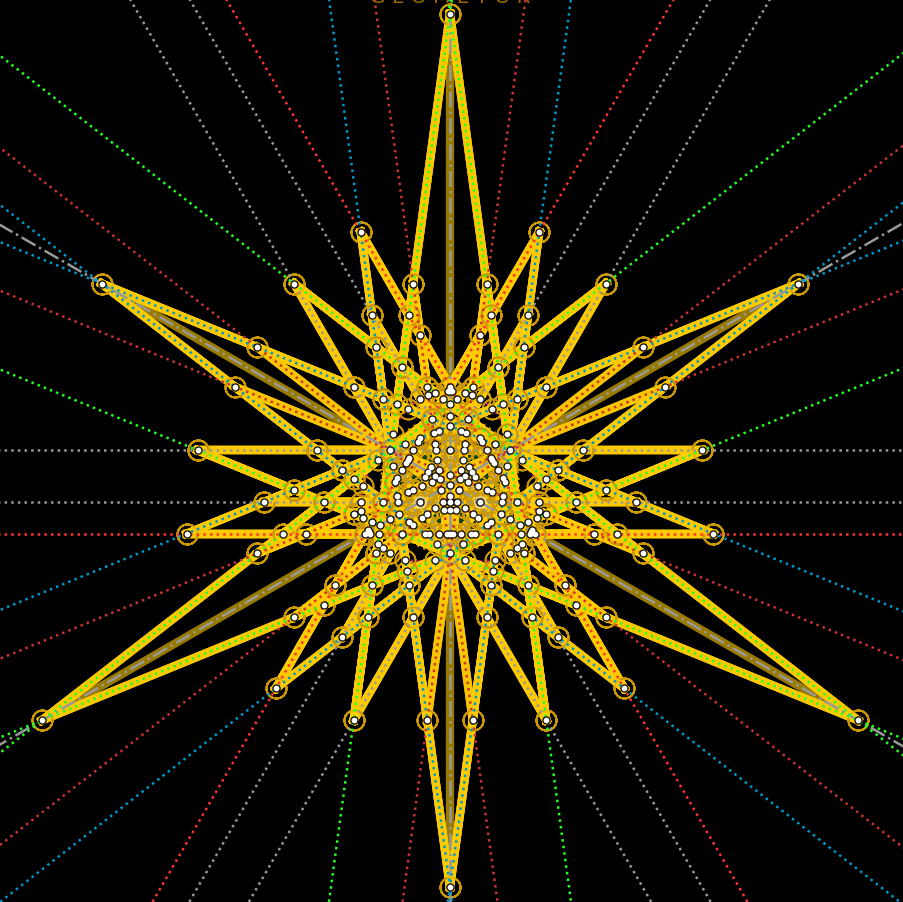
Unit III: The Logarithmic Spiral, Hero’s Gnomon, Foraminifera, and Horns — Notes & Concordance
Critical Apparatus & GEOMETOR Cross-References — III. Equiangular Spiral & Gnomons
Scholarly Commentary & GEOMETOR Concordance (Unit III)
Gnomonic Self-Similarity Across aristotle, euclid, divine, and Hambidge
1917 Folio Verification (pp. 509–512): Direct 300 DPI scan inspection of pp. 510–511 (thompson_gnomon-530.png, 531.png) confirms Thompson’s Greek citation (σχηματογραφεῖν) of Pythagorean figurate numbers alongside Figs. 251–254:
Fig. 251: Halving a $1 : \sqrt{2}$ rectangle yields a $1/\sqrt{2}$ gnomon (the exact principle of ISO paper sizes and Hambidge's root-two reciprocal!).
Fig. 252: Removing nested unit squares from the golden rectangle $1 : \phi$ ($\phi = \frac{1 + \sqrt{5}}{2}$, Euclid II.11 & VI.30 in geometor/euclid and geometor/divine) leaves self-similar golden rectangles rotated by $90^\circ$ (“whirling squares”), whose homologous vertices lie on an equiangular spiral around the intersection pole $O$ of perpendicular diagonals.
Fig. 254: Bisecting the $72^\circ$ base angle of Euclid’s IV.10 sublime triangle ($36^\circ\text{–}72^\circ\text{–}72^\circ$) detaches an obtuse $108^\circ\text{–}36^\circ\text{–}36^\circ$ gnomon while leaving a smaller $36^\circ\text{–}72^\circ\text{–}72^\circ$ golden triangle.
Chronological Bridge to Jay Hambidge (1917 → 1919): Thompson published Chapter XI’s “whirling squares” analysis in 1917 (drawing also on Sir Theodore Cook’s Curves of Life, 1914); two years later, Jay Hambidge systematized the whirling-square rectangle and its parent $\sqrt{5}$ rectangle in The Diagonal (hambidge:1920-diagonal, Nov. 1919) as the cornerstone of Greek Dynamic Symmetry (Unit VII).
Time-Invariance of Accretionary Shells
Why *Nautilus* Is Not Golden: Thompson carefully cautions against mystical claims that every mollusc shell has the golden ratio $\phi$ as its whorl-expansion factor! Rather, any constant ratio of tangential to radial growth produces a genuine equiangular spiral $r = a e^{\theta \cot\alpha}$: in Nautilus pompilius $\alpha \approx 80^\circ$ ($e^{2\pi\cot\alpha} \approx 3.0\text{–}3.2$), in Planorbis $\alpha \approx 85^\circ$, and in flat opercula or Haliotis $\alpha$ drops to $30^\circ\text{–}45^\circ$. The invariant law is Hero’s gnomon itself, of which $\phi$ is the canonical discrete quadratic exemplar.
Structured Concordance Loci in This Unit
- Spira Mirabilis, Hero’s Theory of the Gnomon, Golden Triangles, and Turbinated Shells (Chs. XI–XIII (The Logarithmic Spiral, Foraminifera & Horns), pp. 493–634)
Reveals why Nautilus, ammonites, gastropods, foraminifera, claws, and horns all obey the equiangular spiral: accretion of dead shell or horn at a growing margin without changing shape is mathematically equivalent to gnomonic self-similarity. Algebraic Invariants:
r = a e^(θ cot α)·φ² = φ + 1·φ = (1 + √5)/2geometor/euclid (Book II, Def. 2 & Prop. 11; Book IV, Prop. 10; Book VI, Prop. 30): Generalizes Euclid’s parallelogrammic gnomon (II Def. 2) via Hero Def. 58 to the whirling-square golden rectangle (II.11, VI.30) and the 36°–72°–72° golden triangle (IV.10).
geometor/aristotle (Categories 15a29–33): Recovers Aristotle’s law that gnomonic accretion increases magnitude without altering form (αὐξάνεται μὲν, ἀλλοιοῦται δ’ οὔ).
geometor/divine (Golden Ratio φ = (1 + √5)/2 & Gnomonic Chains): Thompson’s Figs. 252 and 254 provide the classical morphological realization of recursive φ gnomons.
Dynamic Symmetry Parallel: The Diagonal (1919–1920), Lesson I & Whirling Squares — direct citation of logarithmic shell growth and square gnomons of the φ rectangle