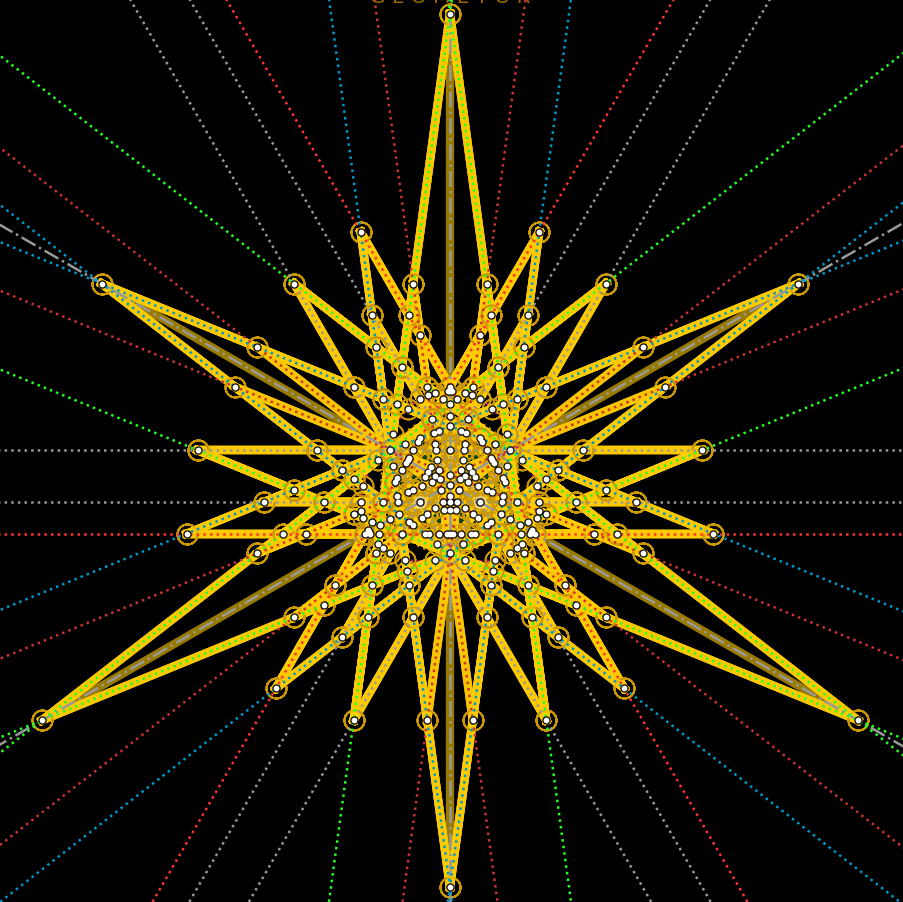
Chapter IX: On Concretions, Spicules, and Spicular Skeletons — Notes & Concordance
Scholarly Apparatus & GEOMETOR Cross-References — Ch. IX
Scholarly Commentary & GEOMETOR Concordance (Chapter IX)
Euler’s Polyhedral Law & Radiolarian Topology (geometor/euclid & geometor/pacioli)
Topological Proof against Pure Hexagon Spheres: For any 3-valent spherical mesh ($3V = 2E$) with Euler characteristic $\chi = 2$, $\sum_{k \ge 3} (6 - k) F_k = 12$. Because $(6 - 6) = 0$, hexagons contribute nothing to curvature defect: every closed hexagonal mesh must contain at least 12 pentagons.
Link to `geometor/euclid` Book XIII: Bridges Platonic regular solids directly to siliceous protozoan skeletons (pacioli:1509).
Structured Concordance Loci in This Chapter
- Sponge Spicules, Haeckel’s Polyhedral Radiolaria, Euler’s Formula, and Cell Geodetics (Ch. IX (On Concretions, Spicules, and Spicular Skeletons), pp. 411–487)
Proves via Euler’s theorem that no spherical radiolarian mesh can consist solely of hexagons, and explains tetrahedral/octahedral/icosahedral baskets via symmetrical soap-film partitions. Algebraic Invariants:
V - E + F = 2·∑ (6 - k) F_k = 12 (3-valent spherical net)geometor/euclid (Book XIII, Props. 13–18 (Construction & Exhaustion of the Five Regular Solids)): Critiques Haeckel’s claim of true hexagonal/octagonal regular lattices on spheres via Euler’s polyhedral theorem (12 pentagons mandatory in hexagonal fullerene/radiolarian cages, e.g. Aulonia hexagona).
geometor/pacioli (De Divina Proportione, Skeletal Polyhedra Plates): Callimitra and Challenger radiolarian frames physically instantiate skeletal wire-frame polyhedra via adsorbed siliceous deposition along Plateau film edges.
Dynamic Symmetry Parallel: Dynamic Symmetry: The Greek Vase (1920) — icosahedral/dodecahedral √5 proportions in nature