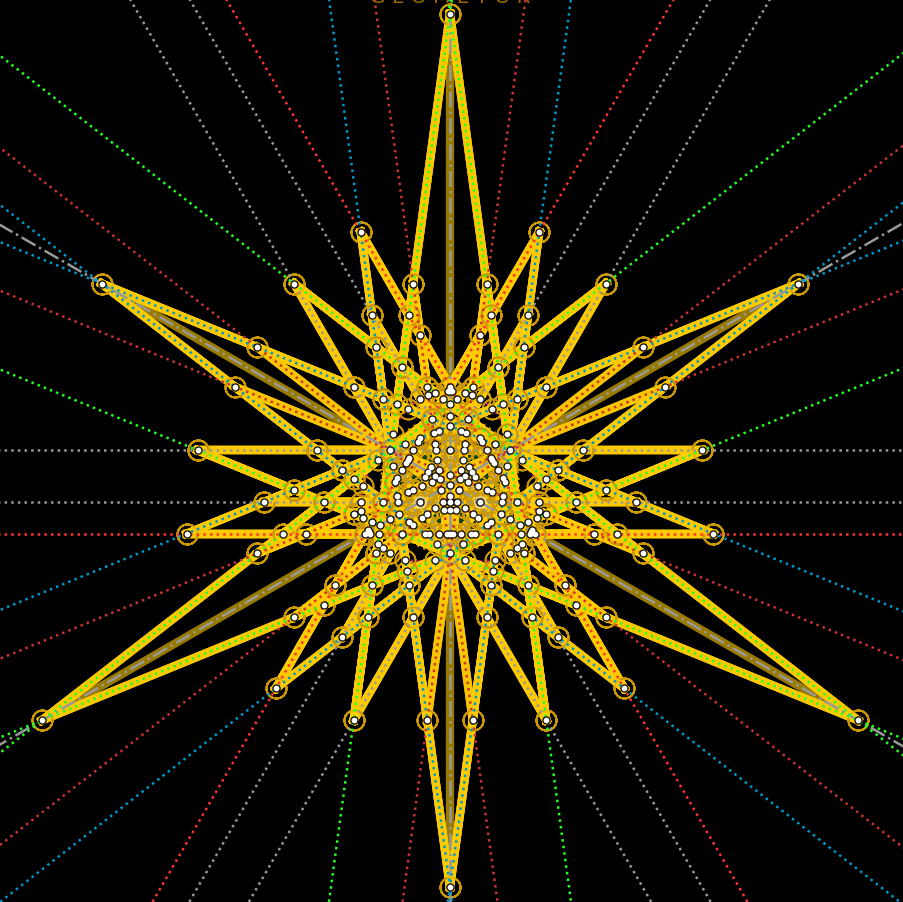
Chapter VII: The Forms of Tissues, or Cell-Aggregates — Notes & Concordance
Scholarly Apparatus & GEOMETOR Cross-References — Ch. VII
Scholarly Commentary & GEOMETOR Concordance (Chapter VII)
Rational Trigonometry of Soap Films (geometor/etc & geometor/wildberger)
2D Triple Junctions (`X(13)` & Spread $s = 3/4$): Three co-planar soap films meet at the Fermat–Torricelli point X(13). In Rational Trigonometry, the $120^\circ$ angle has exact rational spread $s = \sin^2(120^\circ) = 3/4 \in \mathbb{Q}$.
3D Maraldi Angle (Spread $s = 8/9$): Four liquid edges meeting at a spatial foam vertex subtend $\theta = \arccos(-1/3) \approx 109^\circ 28' 16''$. Since $\cos^2\theta = 1/9$, the Maraldi angle has exact rational spread $s = 8/9$.
Connection to `geometor/pacioli`: Kepler’s rhombic dodecahedron has face diagonal ratio $1 : \sqrt{2}$, linking soap froth directly to classical polyhedra and Hambidge’s root-two rectangle.
Structured Concordance Loci in This Chapter
- Plateau’s 120° Triple Junction, Steiner Networks, and Hexagonal Epithelia (Ch. VII (Forms of Tissues, or Cell-Aggregates), pp. 293–326)
Shows that hexagonal cellular pavements, segmentation cleavage planes (Sachs’s & Errera’s laws), and epithelial mosaics arise directly from liquid surface-tension equilibrium. Algebraic Invariants:
∠APB = ∠BPC = ∠CPA = 120°·s(120°) = 3/4·Euler V - E + F = χgeometor/etc (X(13) (1st Isogonic / Fermat–Torricelli–Steiner Point)): Three soap-film laminae spanning three pins converge physically at X(13), subtending 120° between every pair of segments.
geometor/wildberger (Rational Spread s = 3/4): The 120° soap-film equilibrium angle corresponds to exact rational spread sin²(120°) = 3/4 over Q.
geometor/pappus (Synagoge Book V, Preface (On the Sagacity of Bees)): Pappus’s proof that the regular hexagon encloses maximum area per unit perimeter among plane-tiling polygons becomes physical capillary minimization in Thompson.
Dynamic Symmetry Parallel: Dynamic Symmetry: The Greek Vase (1920), Ch. I — hexagonal crystal/honeycomb tiling as the archetype of √3 Static Symmetry
- Maraldi’s Tetrahedral Angle (109° 28′ 16″), Rhombic Dodecahedron, and Kelvin’s Tetrakaidecahedron (Ch. VII (The Bee’s Cell & Parenchyma), pp. 327–345)
Unifies Kepler, Maraldi, Réaumur, König, Maclaurin, Boscovich, Plateau, and Kelvin: both the bee’s pyramidal cell cap and three-dimensional soap froth obey the tetrahedral spread s = 8/9. Algebraic Invariants:
cos θ = -1/3·tan(θ/2) = √2·s = 8/9·14-hedron: F = 14, V = 24, E = 36geometor/wildberger (Tetrahedral Rational Spread s = 8/9): The Maraldi angle arccos(-1/3) ≈ 109° 28′ 16″ has cos²θ = 1/9 and exact rational spread s = 1 - 1/9 = 8/9, with rhombus diagonal quadrance ratio 1 : 2.
geometor/pacioli (De Divina Proportione (1509) & Kepler Strena (1611)): Connects semi-regular/space-filling polyhedra—Kepler’s rhombic dodecahedron and Kelvin’s truncated octahedron (8 hexagons + 6 squares)—to physical foam packing.
Dynamic Symmetry Parallel: The Diagonal (1919–1920), p. 18 — 1 : √2 diagonal ratio of the Maraldi rhombus matches the root-two rectangle