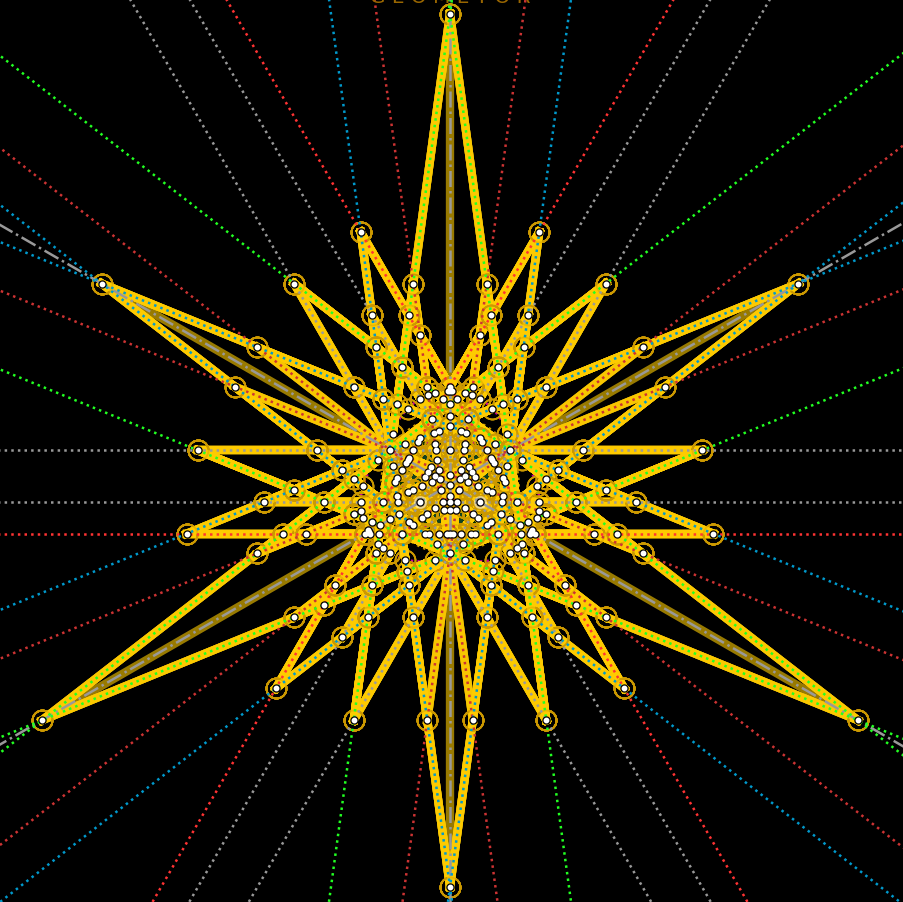
Chapter III: The First Five Fundamental Problems — Linear & Angular Constructions (§ 18, [68]–[76])¶
Jakob Steiner — Die geometrischen Constructionen, ausgeführt mittelst der geraden Linie und Eines festen Kreises (Berlin, 1833, pp. 50–56 / [68]–[76])
First Problem ([68]–[71]): Drawing a Parallel Through Any Given Point¶
« Through any given point, to draw a straight line parallel to any given straight line. »
- Case a: When the given line passes through the center :math:`M` of the fixed circle.
The given line cuts the fixed circle \(\Omega\) in a diameter \(ab\) bisected at \(M\). Let \(P\) be the given external point. 1. Choose an arbitrary vertex \(S\) off the diameter line. 2. Draw the three reference rays \(Sa, SM, Sb\). 3. Through \(P\), draw any transversal line meeting these rays in \(a', M', b'\). 4. Cross-join the points: draw \(ab'\) and \(ba'\) meeting at \(O\). 5. Ray \(SO\) meets the transversal at the harmonic center \(K\). 6. The complete quadrangle diagonals produce the exact parallel \(PQ \parallel ab\) in 6 straight lines:
\[\mathrm{Op.}_{\text{Parallel}} : 11R_1 + 6R_2, \qquad S = 17, \quad E = 11, \quad N_{\text{circles}} = 0.\]- Case b: When the given line does not pass through :math:`M`.
Draw two secants through \(M\) parallel to the line, or transfer the line to a parallel diameter through \(M\), reducing the construction to Case a.
Second Problem ([71]): Segment Multiplication and Rational Division¶
- « Given a bounded segment on a straight line:
a) To find another segment that is any given integer multiple of the first; b) To divide the given segment into any given number of equal parts; c) To construct a segment having any given rational ratio to the first. »
By Problem 1, draw a parallel line at arbitrary distance. Stepping equal segments along the parallel and projecting rays through a perspective center divides or multiplies the original segment by pure straightedge incidence (Euclid VI.9–10).
f. 0056 · p. 52Third Problem ([71]–[75]): Dropping a Perpendicular to a Straight Line¶
« Through any given point, to draw a straight line perpendicular to a given straight line. »
- Solution A (Via Thales’ Theorem):
Draw diameter \(ab\) of \(\Omega\) parallel to the given line. For any point \(c\) on the circumference of \(\Omega\), Thales' theorem guarantees that \(\angle acb = 90^\circ\). Drawing a line through the given point parallel to \(bc\) (by Problem 1) yields the required perpendicular.
- Solution B (Via the Orthocenter of a Triangle on Diameter :math:`ab`):
Choose vertex \(S\) off diameter \(ab\). Rays \(Sa, Sb\) cut \(\Omega\) at \(c, d\). Since \(\angle acb = \angle adb = 90^\circ\), chords \(ad\) and \(bc\) are the exact altitudes of \(\triangle abS\). Their intersection \(H\) is the orthocenter. Line \(SH\) is therefore perpendicular to diameter \(ab\) in just 5 straight lines:
\[\mathrm{Op.}_{\text{Perpendicular}} : 10R_1 + 5R_2, \qquad S = 15, \quad E = 10, \quad N_{\text{circles}} = 0.\]
Fourth & Fifth Problems ([75]–[76]): Laying Off and Bisecting Angles¶
« Fourth Problem: Through a given point, to draw a straight line making with a given straight line an angle equal to a given angle. »
« Fifth Problem: To bisect a given angle, or to multiply it by any integer. »
Draw diameters \(ab, cd\) of the fixed circle \(\Omega\) parallel to the arms of the given angle, transporting the angle directly to center \(M\) as central angle \(\angle aMc\).
To bisect the angle (Problem 5), draw chord \(ad\). In isosceles \(\triangle aMd\), the altitude from \(M\) perpendicular to chord \(ad\) bisects \(\angle aMc\). By Problem 1, drawing a parallel to chord \(ad\) through \(M\) immediately bisects the angle using only the straightedge!