Notes & Commentary: Historical Genesis of Projective Geometry
From Pappus Book VII to Steiner’s Organic Systematic Development
1. The Complete Quadrangle in Antiquity and the Renaissance
The harmonic division generated by the complete quadrilateral was first documented by Pappus of Alexandria in Synagoge Book VII (pappus-synagoge, Lemma to Euclid’s Porisms). In the nineteenth century, Brianchon (brianchon-1817), Poncelet (poncelet-1822), and Steiner (steiner-1832, steiner-1833) transformed this isolated antique proposition into an all-encompassing constructive engine.
2. Steiner’s Projective Architecture
In his 1832 masterwork Systematische Entwickelung (steiner-1832), Steiner proposed to liberate geometry from algebraic coordinate calculations (“reine synthetische Geometrie”). In the 1833 Geometrischen Constructionen, Steiner demonstrates that harmonic ranges and circular polars are not merely theoretical curiosities: they provide the exact linear machinery that enables the straightedge to emulate the metric properties of compass arcs.
3. The Hexagrammum Mysticum & Steiner Points
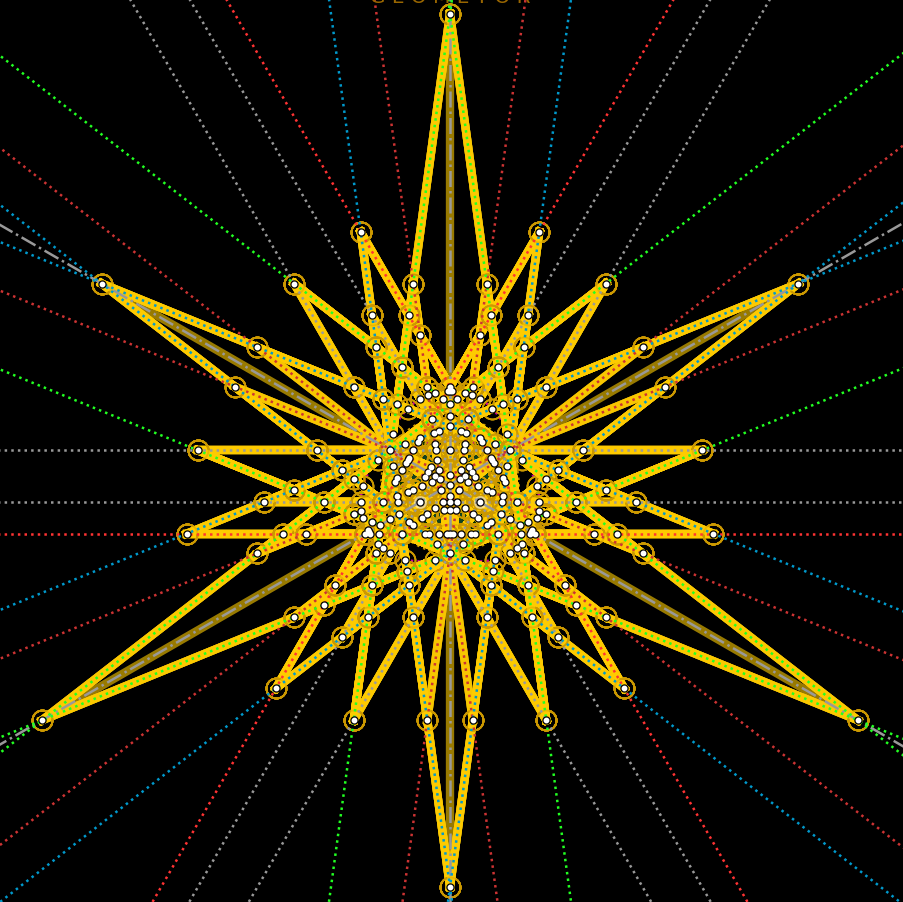
Dually connected to harmonic pencils and circular polars is Blaise Pascal’s 1640 Mystic Hexagram theorem. For any six points on a conic, opposite sides meet in three collinear points (the Pascal line). When the 60 Pascal lines of a complete hexagram are generated, Steiner discovered that they concur three by three in 20 Steiner points—mirroring the two star points \(S_+, S_-\) formed by the six-permutation Pappus configuration in Synagoge Book VII.