Chapter V: Gyroscopic Precession & The Evolution of Atomic and Stellar Systems
Why True Spheres Only Exist at $90^\circ$ Wave Amplitude (Lessons 42–43, Figs. 95–104)
Both atomic systems and stellar/planetary systems evolve along the same gyroscopic wave path from stillness (0) to wave amplitude (4±) and back to stillness (0):
Centripetal Winding (`1+ -> 2+ -> 3+`): Beginning as an expanded inert-gas ring in space (0), centripetal compression winds the ring through prolate (polar-elongated, $c/a > 1$) spheroids whose spin axes precess ($22.5^\circ, 45^\circ, 67.5^\circ$) toward the wave amplitude perpendicular.
The True Sphere at Wave Amplitude (`4+ / 0 / 4-`): Only when a system locks squarely upon the $90^\circ$ wave amplitude crest does its central nucleus become a true incandescent sphere ($c/a = 1$, such as Carbon in the elements or a mature Sun in a solar system), with its planets revolving in its equatorial plane (Fig. 103).
Centrifugal Unwinding (`3- -> 2- -> 1- -> 0`): Past the amplitude crest ($112.5^\circ, 135^\circ, 157.5^\circ$), centrifugal radiation flattens the sphere at its poles ($c/a < 1$) and bulges its equator into oblate spheroids, ringed planets (like Saturn), and ring nebulae (like the Ring Nebula in Lyra), unwinding back into the inert gases of space.
Interactive 3D Gyroscopic Precession & Spheroid Morphing
Drag the Octave Precession slider below from 0° (0 Inert Gas) to `90°` (`4±` True Sphere) and 180° (0 Rebirth) to watch the 3D wireframe system precess and morph from prolate winding to true sphere to oblate Saturnian ring ejection:
Parametric 3D Geometry Exports:
Wavefront OBJ (gyroscopic_octave.obj)
·
Scene JSON (gyroscopic_octave.json)
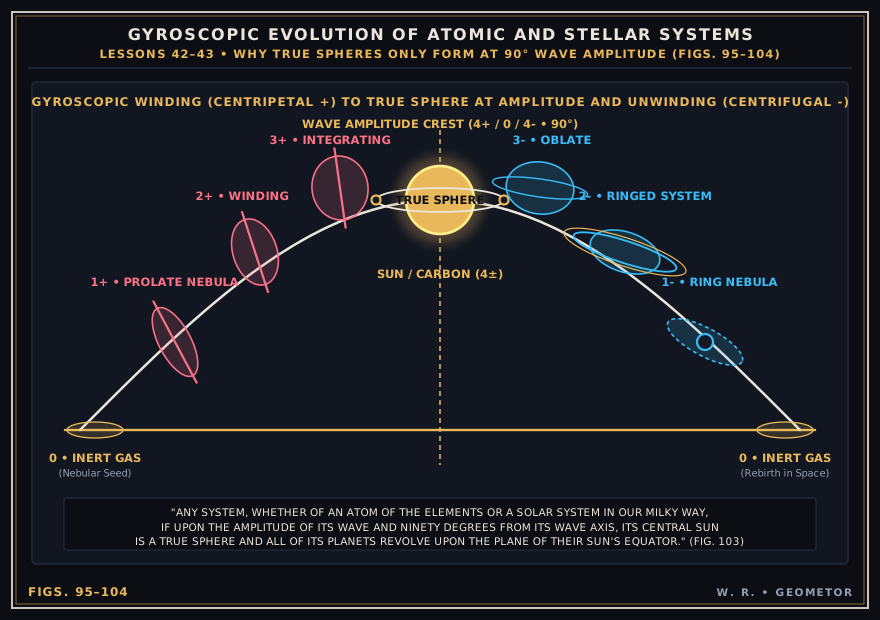
Plate VI (Figs. 95–104): Gyroscopic evolution from prolate winding (1+, 2+, 3+) to the True Sphere at $90^\circ$ Wave Amplitude (4±) and oblate/ringed unwinding (3-, 2-, 1-).