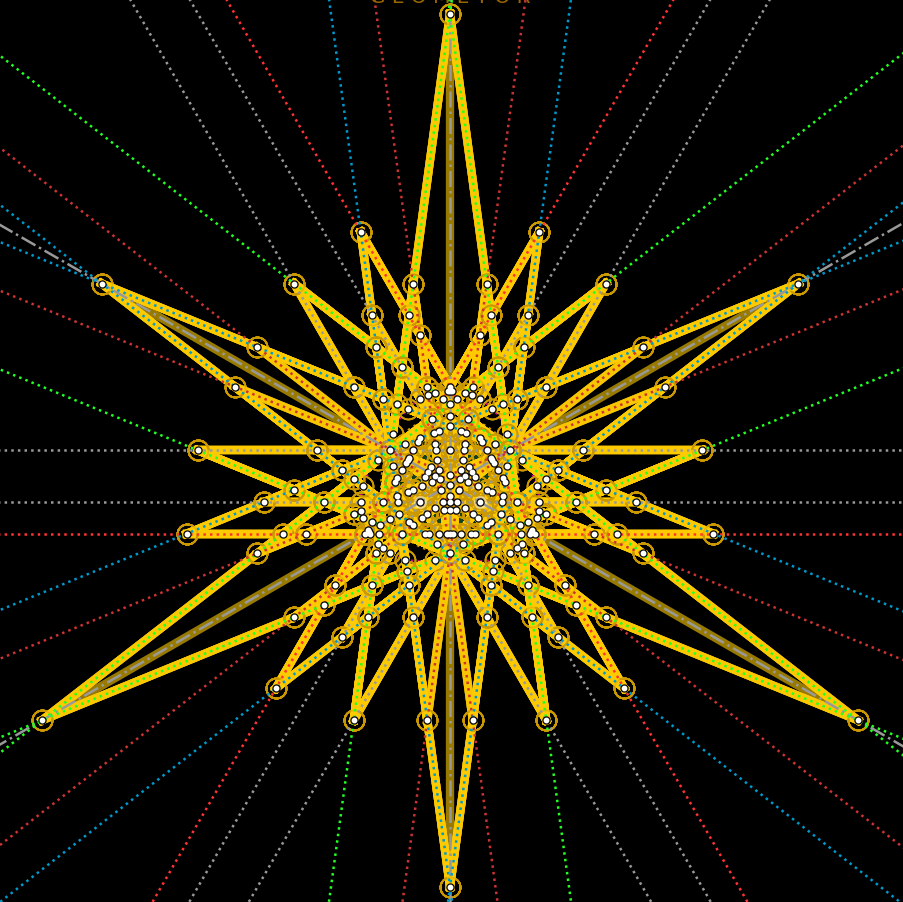
Prologue Part II: Philosophy & History of Geometry — GEOMETOR Commentary & Concordance Notes¶
GEOMETOR Philosophical & Mathematical Commentary¶
*Phantasia*, *Probole*, and *Materia Intelligibilis* (`Friedlein 48–57, 78–79`): Proclus’s identification of mathematical imagination with Aristotle's intelligible matter (ὕλη νοητή, Friedlein 49–53) is one of the central pillars of Hoenen's De Noetica Geometriae (Caput I §1; Caput III, p. 67, citing Friedlein 49, 12–17 and 49, 17 sqq.; Caput IV passim). Where pure dianoia holds the unextended universal logos of the circle, probole projects that logos onto the spatial continuum of phantasia, generating plural, intersecting circles and segments—the exact cognitive counterpart of a constructive geometric graph!
The Eudemian Summary (`Friedlein 64–70`) & The Divine Proportion: Notice at Friedlein 67, 6 (cited twice in geometor/euclid, Vol. I p. 137 & Vol. II p. 99 on [IV.10]) Proclus’s report from Eudemus that Eudoxus of Cnidus “multiplied the number of theorems concerning **the section* (περὶ τὴν τομήν) which had their origin in Plato, applying the analytical method to them.”* Following Bretschneider, Tannery, and Heath, “the section” par excellence is the golden section (extreme and mean ratio, $\phi$), linking the Academy’s analytical inquiries directly to Books II ([II.11]), IV ([IV.10]–[IV.11]), VI ([VI.30]), and XIII (icosahedron & dodecahedron)—the guiding thread of GEOMETOR (geometor/divine).
Cross-Reference to the Six Parts of a Proposition: While Chaps. V–IX of Prologue II (Friedlein 70–84) establish the architecture of stoicheiosis, problems, and theorems, Proclus places his detailed analysis of the Six Canonical Parts of a Geometric Proposition (Protasis, Ekthesis, Diorismos, Kataskeue, Apodeixis, Symperasma) immediately after the Common Notions at Friedlein 203–207 (see Problems vs. Theorems & The Six Canonical Parts of a Proposition in Hypotheses, Postulates, Axioms & Propositional Form).
Friedlein Loci Cited in GEOMETOR (27 Loci in pp. 48–84)¶
Friedlein 49, 12–17 (text) — Inexactitude of sensible figures versus the unvarying precision of universal forms projected in mathematical imagination (phantasia). -
hoenen(proclus:in-euclid:12.14-22): De Noetica Geometriae Caput III (cf. Caput I §1), p. 67Friedlein 49, 17 (text) — Mathematical being requires a receptacle (phantasia / intelligible matter) where universal logoi are unfolded with indivisible exactitude. -
hoenen(proclus:in-euclid:12.14): De Noetica Geometriae Caput III, p. 67Friedlein 60, 7–9 (text) — Distinction between leading principles and derivative consequences in universal mathematical reasoning. -
euclid(proclus:in-euclid:60.7-9): Heath Vol. I, p. 137 [folio0151]Friedlein 64–70 (text) — The Eudemian Summary: Proclus’s preservation of Eudemus of Rhodes’s History of Geometry from Thales and Pythagoras to Plato’s Academy and Euclid. -
euclid(proclus:in-euclid:64-70): Heath Vol. I, p. 37 [folio0051]Friedlein 64, 8 (text) — Transition from cosmic geometry to the historical origin of geometry among the Egyptians and Phoenicians. -
euclid(proclus:in-euclid:64.8): Heath Vol. I, p. 38 [folio0052]Friedlein 64, 19 (text) — Origin of geometry in Egyptian land-measurement after the Nile floods and arithmetic among the Phoenicians through commerce. -
euclid(proclus:in-euclid:64.19): Heath Vol. I, p. 37 [folio0051]Friedlein 65, 19 (text) — Pythagoras transforms geometry into a liberal philosophical education and investigates its principles from above (anothen). -
euclid(proclus:in-euclid:65.19): Heath Vol. I, p. 412 [folio0426]Friedlein 65, 20 (text) — Pythagorean discovery of cosmic figures and golden-section pentagon constructions preserved in the Eudemian Summary. -
euclid(proclus:in-euclid:65-20): Heath Vol. II, p. 97 [folio0103] -euclid(proclus:in-euclid:65.20): Heath Vol. I, p. 413 [folio0427]Friedlein 66, 20 (text) — Leon (pupil of Neoclides) composes improved Elements and invents diorismoi determining when a problem is possible or impossible. -
euclid(proclus:in-euclid:66.20): Heath Vol. I, p. 116 [folio0130]Friedlein 67, 6 (text) — Eudoxus’s investigation of ‘the section’ (tome) begun by Plato, applying geometric analysis to golden-ratio division. -
euclid(proclus:in-euclid:67-6): Heath Vol. II, p. 99 [folio0105] -euclid(proclus:in-euclid:67.6): Heath Vol. I, p. 137 [folio0151]Friedlein 67, 14 (text) — Theudius of Magnesia arranges the Elements admirably and renders many partial propositions more universal. -
euclid(proclus:in-euclid:67.14): Heath Vol. I, p. 117 [folio0131]Friedlein 67, 22 (text) — Hermotimus of Colophon advances Eudoxus’s and Theaetetus’s discoveries, discovers many Elements, and composes treatises on Loci. -
euclid(proclus:in-euclid:67.22): Heath Vol. I, p. 117 [folio0131]Friedlein 68, 4–7 (text) — Close of Eudemus’s chronicle with Philippus of Medma, disciple of Plato who directed geometric research toward Platonic philosophy. -
euclid(proclus:in-euclid:68.4-7): Heath Vol. I, p. 35 [folio0049]Friedlein 68, 20 (text) — Euclid’s famous reply to King Ptolemy I Soter: ‘There is no royal road to geometry.’ -
euclid(proclus:in-euclid:68.20): Heath Vol. I, p. 2 [folio0016]Friedlein 69, 3 (text) — Survey of Euclid’s other mathematical, optical, astronomical, and musical works alongside the Elements. -
euclid(proclus:in-euclid:69.3): Heath Vol. I, p. 17 [folio0031]Friedlein 69, 4 (text) — Characterization of Euclid’s Data, Phenomena, Optics, Catoptrics, and Divisions of Figures. -
euclid(proclus:in-euclid:69.4): Heath Vol. I, p. 8 [folio0022]Friedlein 70, 1–18 (text) — Euclid’s Pseudaria (Book of Fallacies): pedagogical treatise training beginners to detect paralogisms alongside true demonstrations. -
euclid(proclus:in-euclid:70.1-18): Heath Vol. I, p. 7 [folio0021]Friedlein 70, 19–71, 21 (text) — Aim (skopos) of Euclid’s Elements both as a whole (construction of the five Platonic cosmic figures) and relative to the learner. -
euclid(proclus:in-euclid:70.19-71.21): Heath Vol. I, p. 116 [folio0130]Friedlein 73, 4 (text) — Menaechmus’s two senses of ‘element’ (stoicheion): that which proves vs. the simplest constituent into which compounds resolve, contrasted with ‘lemma’. -
euclid(proclus:in-euclid:73.4): Heath Vol. I, p. 133 [folio0147]Friedlein 74, 23 (text) — Euclid’s strict economy in the Elements: excluding whatever is alien to elementary stoicheiosis while furnishing irrefragable foundations. -
euclid(proclus:in-euclid:74.23): Heath Vol. III, p. 10 [folio0014]Friedlein 75, 10–77, 2 (text) — Why every demonstrative science must proceed from unhypothetical common principles, definitions, postulates, and axioms. -
euclid(proclus:in-euclid:75.10-77.2): Heath Vol. I, p. 122 [folio0136]Friedlein 77, 7–12 (text) — First division of the things following from first principles into Problems (constructions/generations) and Theorems (essential attributes). -
euclid(proclus:in-euclid:77.7-12): Heath Vol. I, p. 125 [folio0139]Friedlein 79, 11–80, 5 (text) — Distinction of theoretical demonstration vs. problematic construction in Book I of the Elements. -
euclid(proclus:in-euclid:79.11-80.5): Heath Vol. I, p. 126 [folio0140]Friedlein 80, 15–81, 4 (text) — Internal architecture of Euclid’s Book I: triangles, parallels, and the theory of parallelogrammic equality of areas. -
euclid(proclus:in-euclid:80.15-81.4): Heath Vol. I, p. 126 [folio0140]Friedlein 81, 5–22 (text) — How Book I ascends from elementary triangle constructions through congruence and parallels to the equality of areas and the square on the hypotenuse. -
euclid(proclus:in-euclid:81.5-22): Heath Vol. I, p. 127 [folio0141]Friedlein 84, 8 (text) — Mention of Aegaeas (or Aenaeas) of Hierapolis and earlier commentators/epitomators on the Elements. -
euclid(proclus:in-euclid:84.8): Heath Vol. I, p. 19 [folio0033]Friedlein 84, 13 (text) — Proclus’s methodological remark at the close of Prologue II introducing his selective philosophical and mathematical commentary on the Definitions. -
euclid(proclus:in-euclid:84.13): Heath Vol. I, p. 30 [folio0044] -euclid(proclus:in-euclid:84.13): Heath Vol. I, p. 45 [folio0059]