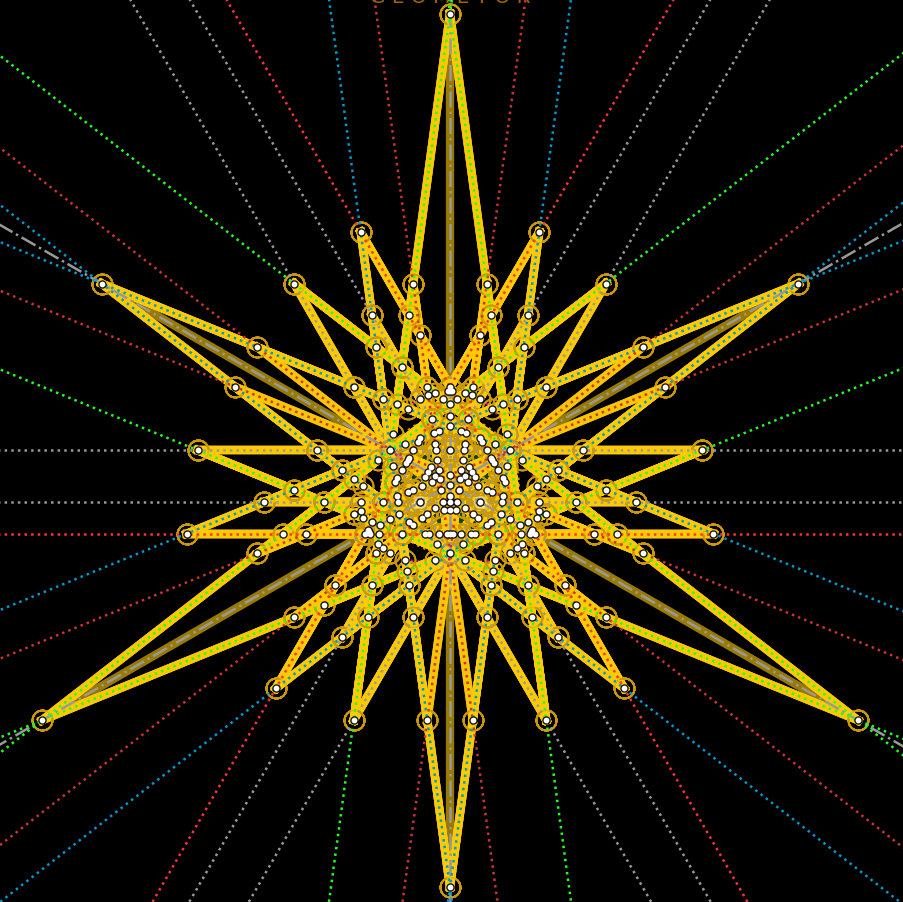
modules
geometor.phyllotaxis
Symbolic modeling, 2D planar analysis, and 3D recursive meristem path propagation.
Everything centers around Phyllotaxis, MeristemNode, and MeristemConfig.
Submodules
Attributes
Classes
Mixin for Phyllotaxis class containing divergence angle functionality. |
|
Mixin for Phyllotaxis class containing geometor.model.Model construction helpers. |
|
Configuration for 3D Node-as-Path and recursive meristem propagation. |
|
A 3D phyllotaxic node that grows as a path from its origin and may act as a meristem. |
|
Mixin for Phyllotaxis class containing 3D path and meristem propagation methods. |
|
Main class for symbolic and parametric 2D/3D phyllotaxis modeling. |
|
Mixin for Phyllotaxis class containing 2D planar growth and parastichy methods. |
Functions
|
Return the $n$-th Fibonacci number ($F_0 = 0, F_1 = 1$). |
|
Return consecutive Fibonacci rational approximations $(F_k, F_{k+2}, text{degrees})$. |
|
Return a catalog of short/long golden sweeps, $phi^{-k}$ powers, and rational sweep factors. |
|
Return the exact symbolic Lucas divergence angle $2pi / (3 + 1/phi) approx 99.5^circ$. |
|
Return the exact symbolic short golden sweep $2pi(1 - 1/phi) = 2pi / phi^2$. |
|
Return a rational factor $(text{numerator}/text{denominator})$ of the short or long golden sweep. |
|
Return the exact symbolic long golden sweep $2pi / phi approx 222.492236^circ$. |
|
Return the $k$-th golden section sweep $2pi / phi^k$ ($k=1$: Long, $k=2$: Short). |
|
Return the exact symbolic short golden sweep $2pi / phi^2 approx 137.507764^circ$. |
|
Return a rational divergence angle $2pi(1 - n/m)$ from two integers. |
|
Construct a geometor.model.Model containing phyllotaxic node points and dot circles. |
|
Evaluate a node's 3D trajectory $gamma(s)$ for $s in [0, text{age}]$ from origin. |
|
Propagate a 3D phyllotaxic meristem system for steps plastochrons. |
|
Count parastichy curves in each closest-neighbor rank and radial zone until they bend. |
|
Classify a node's ontogenetic organ type in the meristem's production life cycle. |
|
For each point in test_points, find the num_nearest closest subsequent points. |
|
Group node indices into parastichy spiral chains for each modulo family $m in text{families}$. |
|
Compute Euclidean distances from pt to each point in other_pts. |
|
Generate a single planar growth frame with num_nodes symbolic points. |
|
Grow planar frames from $0$ up to steps - 1 nodes. |
|
Compute 2D apical meristem coordinates with radial acceleration, node growth, and life-cycle phases. |
Package Contents
- geometor.phyllotaxis.__version__ = '0.2.2'
- class geometor.phyllotaxis.AnglesMixin
Mixin for Phyllotaxis class containing divergence angle functionality.
- get_sweep_phi() sympy.Expr
- get_sweep_phi_short() sympy.Expr
- get_sweep_phi_long() sympy.Expr
- get_sweep_phi_factor(numerator: int = 1, denominator: int = 1, *, long_sweep: bool = False) sympy.Expr
- get_sweep_lucas() sympy.Expr
- geometor.phyllotaxis.PHI: sympy.Expr
- geometor.phyllotaxis.fibonacci(n: int) int
Return the $n$-th Fibonacci number ($F_0 = 0, F_1 = 1$).
- geometor.phyllotaxis.fibonacci_convergents(count: int = 8) list[tuple[int, int, float]]
Return consecutive Fibonacci rational approximations $(F_k, F_{k+2}, text{degrees})$.
- Parameters:
count – Number of convergent pairs to generate starting from $(1, 2)$.
- Returns:
List of tuples (numerator, denominator, angle_degrees).
- geometor.phyllotaxis.golden_sweep_presets() list[dict[str, str | float]]
Return a catalog of short/long golden sweeps, $phi^{-k}$ powers, and rational sweep factors.
- geometor.phyllotaxis.sweep_lucas() sympy.Expr
Return the exact symbolic Lucas divergence angle $2pi / (3 + 1/phi) approx 99.5^circ$.
- geometor.phyllotaxis.sweep_phi() sympy.Expr
Return the exact symbolic short golden sweep $2pi(1 - 1/phi) = 2pi / phi^2$.
- geometor.phyllotaxis.sweep_phi_factor(numerator: int = 1, denominator: int = 1, *, long_sweep: bool = False) sympy.Expr
Return a rational factor $(text{numerator}/text{denominator})$ of the short or long golden sweep.
- geometor.phyllotaxis.sweep_phi_long() sympy.Expr
Return the exact symbolic long golden sweep $2pi / phi approx 222.492236^circ$.
- geometor.phyllotaxis.sweep_phi_power(k: int = 2) sympy.Expr
Return the $k$-th golden section sweep $2pi / phi^k$ ($k=1$: Long, $k=2$: Short).
- geometor.phyllotaxis.sweep_phi_short() sympy.Expr
Return the exact symbolic short golden sweep $2pi / phi^2 approx 137.507764^circ$.
- geometor.phyllotaxis.sweep_rational(n: int, m: int) sympy.Expr
Return a rational divergence angle $2pi(1 - n/m)$ from two integers.
- class geometor.phyllotaxis.ModelBuilderMixin
Mixin for Phyllotaxis class containing geometor.model.Model construction helpers.
- geometor.phyllotaxis.build_rings_model(num_rings: int = 8, sweep: sympy.Expr | float | None = None, name: str = 'phyllotaxis_rings') geometor.model.Model
Construct a geometor.model.Model containing phyllotaxic node points and dot circles.
- Parameters:
num_rings – Number of primordia rings to construct.
sweep – Symbolic or numeric divergence angle (defaults to sweep_phi()).
name – Name of the created Model.
- Returns:
Populated geometor.model.Model instance.
- class geometor.phyllotaxis.MeristemConfig
Configuration for 3D Node-as-Path and recursive meristem propagation.
- class geometor.phyllotaxis.MeristemNode
A 3D phyllotaxic node that grows as a path from its origin and may act as a meristem.
- class geometor.phyllotaxis.Propagation3DMixin
Mixin for Phyllotaxis class containing 3D path and meristem propagation methods.
- propagate_3d(steps: int, config: MeristemConfig | None = None) list[MeristemNode]
- geometor.phyllotaxis.compute_node_path(origin: Vec3, parent_tangent: Vec3, radial_dir: Vec3, binormal_dir: Vec3, age: int, generation: int, config: MeristemConfig) tuple[list[Vec3], Vec3, Vec3, Vec3]
Evaluate a node’s 3D trajectory $gamma(s)$ for $s in [0, text{age}]$ from origin.
At $s = 0$, $gamma(0) = text{origin}$. As $s to text{age}$, the path advances outward along radial_dir and lifts/curves along parent_tangent with optional helical twist around binormal_dir.
- Parameters:
origin – 3D point on the parent meristem where this node originated.
parent_tangent – Unit tangent of the parent meristem at origin.
radial_dir – Unit radial outward vector at the node’s divergence angle.
binormal_dir – Unit binormal vector perpendicular to parent_tangent and radial_dir.
age – Plastochron age ($t - t_{text{birth}} ge 0$) of the node.
generation – Branching depth ($1$ = primary lateral node, $2$ = secondary, etc.).
config – Propagation parameters.
- Returns:
Tuple (path_points, tip_tangent, tip_normal, tip_binormal).
- geometor.phyllotaxis.propagate_3d(steps: int, config: MeristemConfig | None = None) list[MeristemNode]
Propagate a 3D phyllotaxic meristem system for steps plastochrons.
Node 0 is the primary apical meristem growing along $+Z$. At each step $t$, active meristems grow along their paths and emit new lateral child nodes at the divergence angle $Phi$ around their local tangent frame.
- Parameters:
steps – Number of plastochron steps to simulate.
config – Optional MeristemConfig instance.
- Returns:
List of MeristemNode instances (including the root stem and all lateral/recursive paths).
- class geometor.phyllotaxis.Phyllotaxis(name: str = 'phyllotaxis')
Bases:
geometor.phyllotaxis.angles.AnglesMixin,geometor.phyllotaxis.planar.PlanarMixin,geometor.phyllotaxis.paths3d.Propagation3DMixin,geometor.phyllotaxis.builder.ModelBuilderMixinMain class for symbolic and parametric 2D/3D phyllotaxis modeling.
- name = 'phyllotaxis'
- class geometor.phyllotaxis.PlanarMixin
Mixin for Phyllotaxis class containing 2D planar growth and parastichy methods.
- get_node_points(num_nodes: int, sweep: sympy.Expr | float | None = None) list[sympy.geometry.Point2D]
- vogel_points(num_nodes: int, scale: float = 5.0, angle_rad: float = GOLDEN_ANGLE_RAD, base_size: float = 1.5, growth_factor: float = 0.25, radial_acceleration: float = 0.0, leaf_span: int = 34) list[dict[str, float | int | str]]
- find_point_distances(pt: sympy.geometry.Point2D, other_pts: list[sympy.geometry.Point2D]) dict[float, sympy.geometry.Point2D]
- find_nearest_points(test_points: list[sympy.geometry.Point2D], num_nearest: int = 3) dict[sympy.geometry.Point2D, list[sympy.geometry.Point2D]]
- geometor.phyllotaxis.analyze_parastichy_curves(nodes: list[dict[str, float | int | str]], num_nearest: int = 3) dict[str, object]
Count parastichy curves in each closest-neighbor rank and radial zone until they bend.
Demonstrates that the two primary closest-neighbor curve families wind in opposite directions (CW vs CCW) and always form a consecutive pair of Fibonacci numbers $(F_m, F_{m+1})$ within each radial zone between curve bends.
- Parameters:
nodes – List of node dictionaries from
vogel_points().num_nearest – Number of closest inner nodes connected per node ($1 le k le 4$).
- Returns:
outer_counts: Curve count $Delta$, winding direction ("CW"or"CCW"), and Fibonacci status for each rank at the outer rim.opposing_pair: Tuple(cw_count, ccw_count)of the two primary opposing spiral families in the outer zone.is_fibonacci_pair:Trueifopposing_pairconsists of consecutive Fibonacci numbers with opposite chirality.zones: Radial zones from inner to outer separated by bend radii.
- Return type:
Dictionary containing
- geometor.phyllotaxis.classify_meristem_phase(node_id: int, total_nodes: int, leaf_span: int = 34) str
Classify a node’s ontogenetic organ type in the meristem’s production life cycle.
In a composite capitulum (such as a sunflower), the apical meristem transitions through distinct organ-production phases as the sequence progresses: 1. “leaf”: Early vegetative/involucral bracts (0 <= node_id < leaf_span). 2. “petal”: Ray florets / corolla petals (leaf_span <= node_id < leaf_span + round(leaf_span * φ)). 3. “floret”: Mature tubular disc florets in the capitulum interior. 4. “bud”: Newly initiated unopened primordia at the apical center (age < round(leaf_span / φ)).
- geometor.phyllotaxis.find_nearest_points(test_points: list[sympy.geometry.Point2D], num_nearest: int = 3) dict[sympy.geometry.Point2D, list[sympy.geometry.Point2D]]
For each point in test_points, find the num_nearest closest subsequent points.
- geometor.phyllotaxis.find_parastichies(num_nodes: int, families: tuple[int, ...] = (5, 8, 13, 21)) dict[int, list[list[int]]]
Group node indices into parastichy spiral chains for each modulo family $m in text{families}$.
- Parameters:
num_nodes – Total number of nodes.
families – Parastichy numbers (typically consecutive Fibonacci numbers).
- Returns:
Mapping from family number $m$ to a list of $m$ index chains [r, r+m, r+2m, …].
- geometor.phyllotaxis.find_point_distances(pt: sympy.geometry.Point2D, other_pts: list[sympy.geometry.Point2D]) dict[float, sympy.geometry.Point2D]
Compute Euclidean distances from pt to each point in other_pts.
- geometor.phyllotaxis.get_node_points(num_nodes: int, sweep: sympy.Expr | float | None = None) list[sympy.geometry.Point2D]
Generate a single planar growth frame with num_nodes symbolic points.
Each node $i in [0, N-1]$ has radius $N - i$ and angle $i cdot text{sweep}$.
- Parameters:
num_nodes – Number of primordia in the frame.
sweep – Divergence angle in radians (symbolic or float). Defaults to sweep_phi().
- Returns:
List of SymPy Point2D instances.
- geometor.phyllotaxis.grow(steps: int, sweep: sympy.Expr | float | None = None) list[list[sympy.geometry.Point2D]]
Grow planar frames from $0$ up to steps - 1 nodes.
- geometor.phyllotaxis.vogel_points(num_nodes: int, scale: float = 5.0, angle_rad: float = GOLDEN_ANGLE_RAD, base_size: float = 1.5, growth_factor: float = 0.25, radial_acceleration: float = 0.0, leaf_span: int = 34) list[dict[str, float | int | str]]
Compute 2D apical meristem coordinates with radial acceleration, node growth, and life-cycle phases.
New primordia emerge at the center ($k_{text{eff}} = (N - 1) - i$) while older primordia are displaced radially as $r = csqrt{k_{text{eff}}}left(frac{k_{text{eff}} + 1}{K_0}right)^{a}$, and node size grows as $s = s_0 + gsqrt{k_{text{eff}}}left(frac{k_{text{eff}} + 1}{K_0}right)^{1.15a}$.
- Parameters:
num_nodes – Total number of primordia.
scale – Radial spread constant $c$.
angle_rad – Divergence angle in radians.
base_size – Initial radius of a newly emerged primordium ($s_0$).
growth_factor – Rate $g$ at which primordium size scales as it moves outward.
radial_acceleration – Acceleration exponent $a ge 0$ controlling how much faster older outer nodes move and expand compared to young inner primordia.
leaf_span – Characteristic Fibonacci cohort span for meristem life-cycle phases.
- Returns:
List of dictionaries with keys id, age, phase, x, y, r, theta, size.