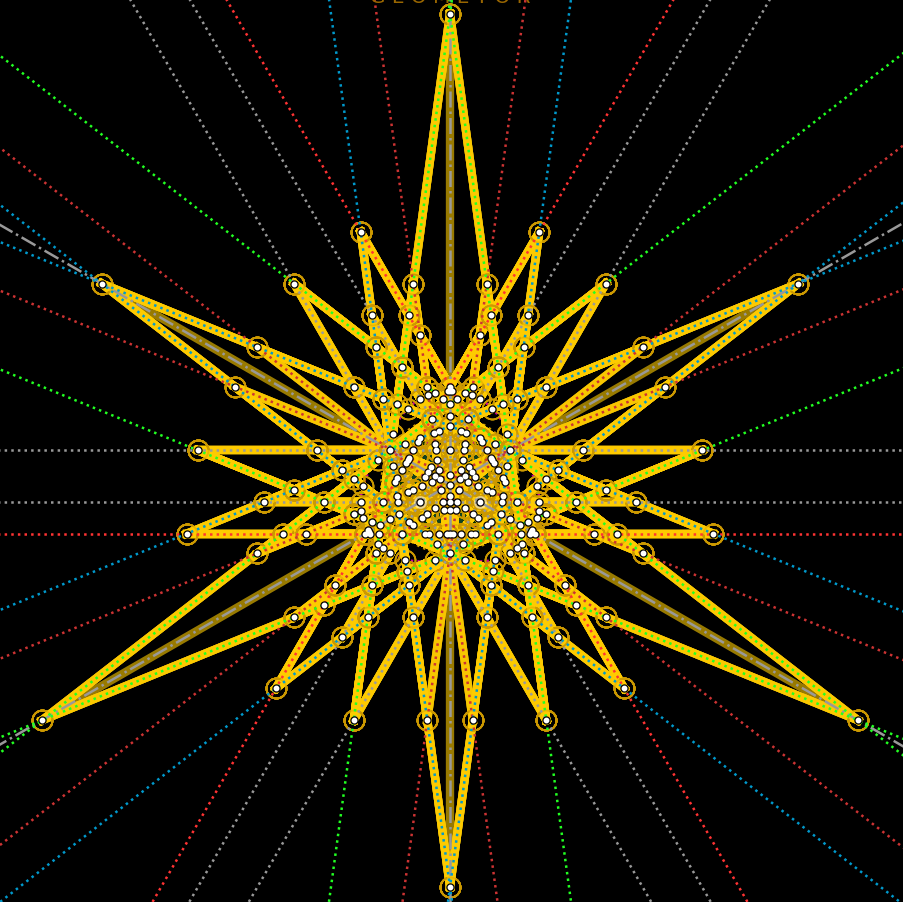
Chapter III — The Theory of Revolution — Summary¶
Structural & Heuristic Overview — Drittes Kapitel: Die Drehungstheorie / Drejningstheorien (pp. 70–94 · §§ 1–5 & Problems 349–402)
Architectural Overview (pp. 70–94)¶
Chapter III presents The Theory of Revolution (Drejningstheorien, pp. 70–94, §§ 1–5 & Problems 349–402):
Planar Spiral Revolution \(\mathcal{R}(O, v, f)\): - Rotates every ray \(Oa\) through angle of revolution \(v\) and scales its length by ratio of revolution \(f = OA / Oa\) around pivot point \(O\). - Fundamental Placement Principle (§ 4, p. 66): To place \(\triangle OQR\) of given shape with \(O\) fixed, \(Q \in k_1\), and \(R \in k_2\), revolve \(k_1\) by \((O, \angle QOR, OR/OQ)\) into \(K_1\) and intersect \(K_1 \cap k_2\)! - Equilateral Specializations (
v = 60°, f = 1): Solves placing an equilateral triangle on three parallel lines (Problem 349) and on three concentric circles (Problem 350) in two compass-and-straightedge steps. - Miquel Pivot Theorem (§ 5, p. 68): Proves that any two directly similar non-translated figures possess a unique finite pivot point \(O\), constructed as the second intersection of circles \((PAa)\) and \((PBb)\) where \(P = AB \cap ab\).