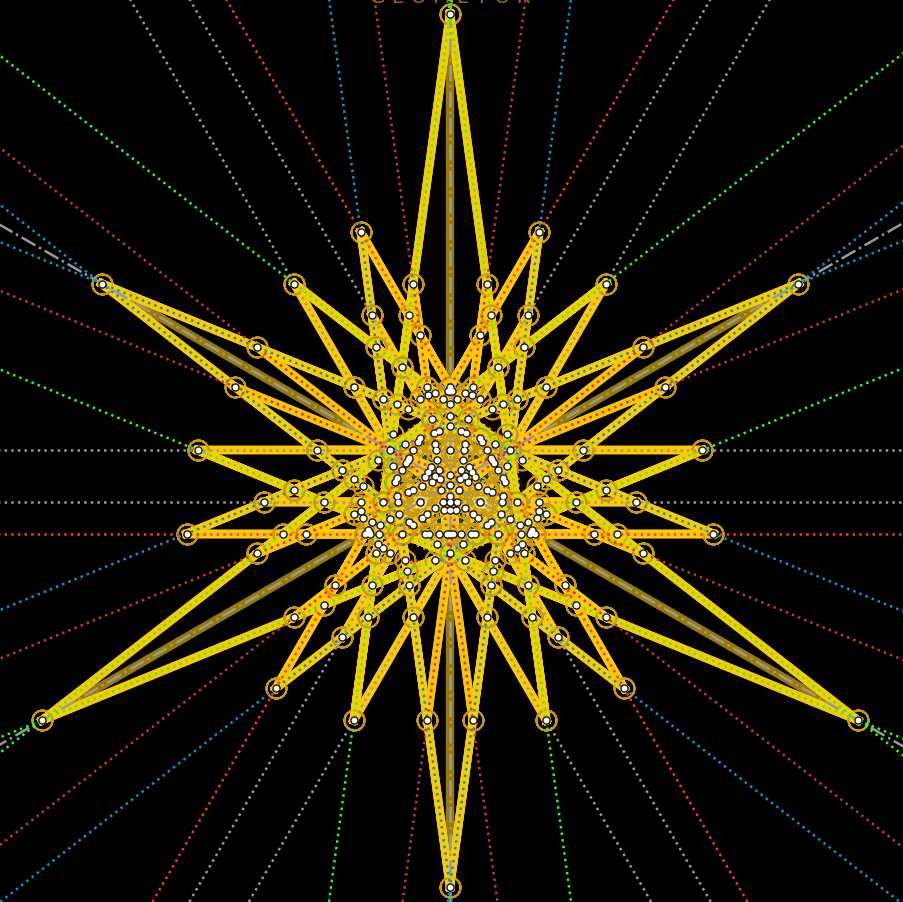
Book II: Reverse Reduction, Polygonal Solids, Proportions & the Ten Musical Means
Ἀριθμητικὴ Εἰσαγωγή βʹ — Nicomachus of Gerasa (ed. R. Hoche 1866 & M. L. D’Ooge 1926)
Book II begins by proving that just as all species of inequality unfold from primordial Equality, so conversely all inequalities are resolved and reduced back to Equality by three inverse subtractions—demonstrating that the monad and equality are the elementary root of all reality. Nicomachus then expounds the geometric and figurate dimension of numbers using alpha-graphia pebble notation (psēphoi), building plane polygons, solid pyramids, and cubes via arithmetic gnomons.
In the second half of the book, Nicomachus establishes the comprehensive theory of proportion (analogia), synthesizing the classical Pythagorean and Archytan means into a complete ten-mean system, culminating in the teleiotatē analogia (6 : 8 :: 9 : 12) embodied in the solid geometry of the cube.
Inverse Reduction to Equality (Chs. 1–2; \(s - 2m + f\))
Figurate & Polygonal Numbers via Arithmetic Gnomons (Chs. 6–12; Triangular, Square, Pentagonal, Hexagonal, Heptagonal)
Solid Pyramidal, Cubic, and Scalene Numbers (Chs. 13–17)
Plato’s *Same* & *Other* and the Square–Oblong Weave (Chs. 18–19)
Nicomachus’s Sum-of-Cubes Theorem from Odd Blocks (Ch. 20; \(\sum_{i=1}^n i^3 = T_n^2\))
The Ten Neo-Pythagorean Means (Chs. 21–28; Arithmetic, Geometric, Harmonic, and the 7 Additional Means)
The Most Perfect Proportion & Philolaus’s Cube (Ch. 29; 6 : 8 :: 9 : 12)
Sections
Inverse Reduction, Polygonal Gnomons, Same/Other & Sum of Cubes
«ἐντεῦθεν ἐκφανέστατα κριθήσεται τό τε ταὐτοῦ καὶ τὸ θατέρου μετέχον…»
“From this will be judged most clearly what partakes of the Same and what partakes of the Other…” — Book II, Ch. 18.1 (Hoche p. 112)
The Ten Neo-Pythagorean Means & the Cube’s Most Perfect Proportion
«λοιπὸν ἐπὶ τέλει τῆς εἰσαγωγῆς καιρὸς ἂν εἴη τὴν τελειοτάτην καὶ τριχῇ διαστατὴν καὶ πασῶν περιεκτικωτάτην ἀναλογίαν ἐν τέσσαρσιν ὅροις… ἐκθέσθαι, χρησιμεύουσαν εἴς τε πάσας τὰς ἐν μουσικῇ προκοπὰς καὶ εἰς πάσας φυσιολογίας.»
“Finally, at the close of our Introduction, it would be seasonable to set forth the most perfect proportion—three-dimensional, four-termed, and most comprehensive of all—serviceable for all advances in music and all investigations of nature.” — Book II, Ch. 29.1 (Hoche p. 144)