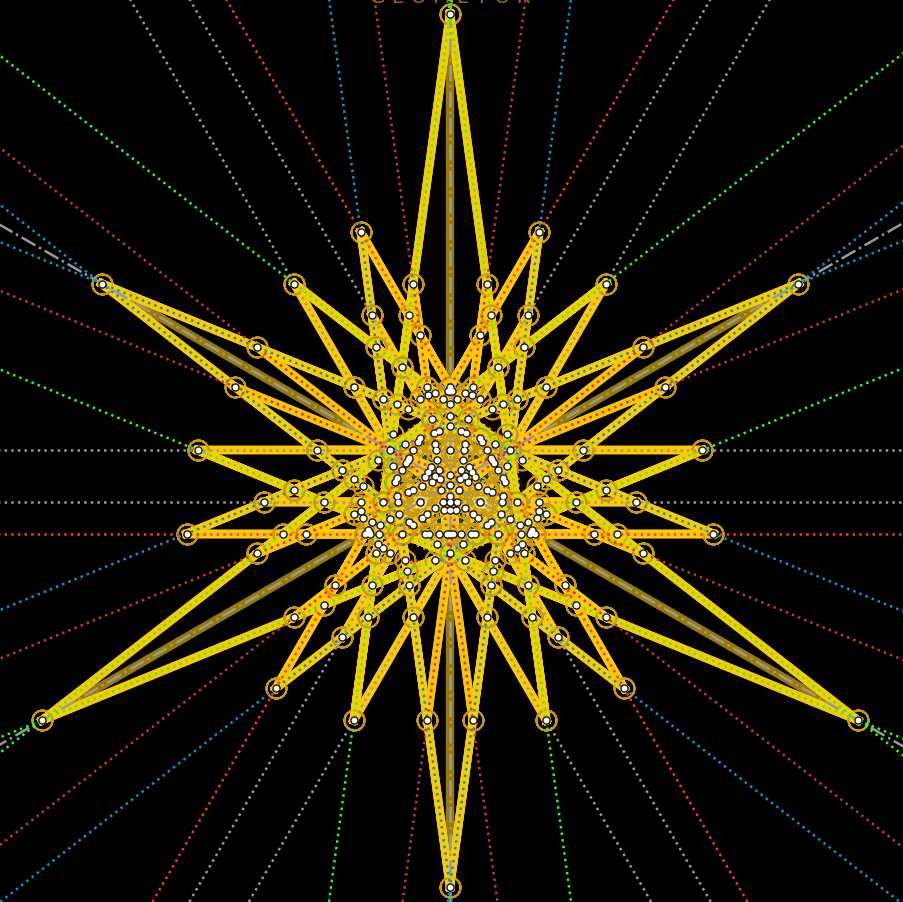
Book I: Philosophy of Number, Prime & Figurate Numbers, Multiple & Superparticular Ratios
Ἀριθμητικὴ Εἰσαγωγή αʹ — Nicomachus of Gerasa (ed. R. Hoche 1866 & M. L. D’Ooge 1926)
Book I opens with the foundational charter of mathematical philosophy in the Neo-Pythagorean tradition: philosophy as the desire for and comprehension of eternal, unchanging, immaterial reality as opposed to the perpetual flux of sensible bodies. Nicomachus defines the ontological division of quantity into discrete multitude (poson) and continuous magnitude (pēlikon), establishing the four sister mathematical sciences (mathemata)—Arithmetic, Music, Geometry, and Astronomy—ordered by asymmetric co-removal (synanairein).
Proceeding from the divine exemplar of number in the mind of the Creator, Book I develops:
Definitions of Number, Even, and Odd (Chs. 6–7)
Prime & Incomposite Numbers and the Sieve (*Koskinon*) of Eratosthenes (Ch. 13)
Superabundant, Deficient, and Perfect Numbers (Ch. 16; 6, 28, 496, 8128)
The Five Species of Relative Inequality (Chs. 17–22; Multiple, Superparticular, Superpartient, Multiple Superparticular, Multiple Superpartient)
The Three Prostagma Commands Unfolding Every Ratio from Equality (Ch. 23; \(a, a+b, a+2b+c\))
Sections
Philosophy, the Quadrivium, the Odd Sieve & Perfect Numbers
«ταῦτα γὰρ τὰ μαθήματα δοκοῦντι εἶμεν ἀδελφεά· περὶ γὰρ ἀδελφεὰ τὰ τοῦ ὄντος πρώτιστα δύο εἴδεα τὰν ἀναστροφὰν ἔχει.»
“For these sciences seem to be sisters; for they deal with sister subjects, the first two forms of being.” — Archytas of Tarentum (DK 47 B 1), quoted in Book I, Ch. 3.4 (Hoche p. 6)
Five Species of Inequality & the Equality Unfolding Tree
«ἵνα δέ σοι ἀποδειχθῇ σαφῶς καὶ ἀδιστάκτως, ὅτι ἄρα ἐξ ἰσότητος ἡ τῶν ἐν ταῖς σχέσεσιν εἰδῶν σύμπασα σύστασις πρόεισι πρῶτόν τε καὶ στοιχειῶδες ὑφισταμένης, ἔφοδός τις ἔσται ἡμῖν γλαφυρὰ καὶ ἀναγκαιοτάτη πρὸς πᾶσαν φυσιολογίαν…»
“And that you may have demonstrated to you clearly and indisputably that the whole system of species in relations proceeds from equality as its primordial and elementary root, there will be for us a graceful method, most indispensable for every study of nature…” — Book I, Ch. 23.4 (Hoche p. 65)