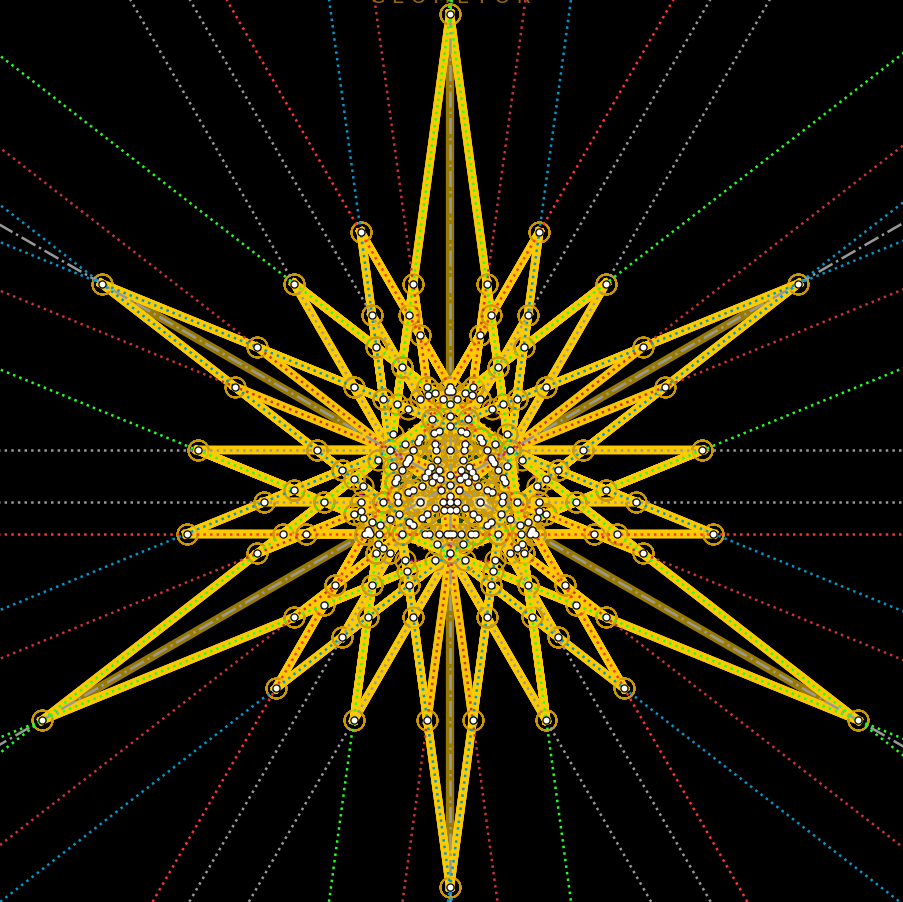
Geometrography
La Géométrographie, ou Art des constructions géométriques — Émile Lemoine (1902)
“Geometrography aims to evaluate with precision the simplicity and exactitude of geometric constructions, and to replace habitual speculative constructions with genuinely geometrographic constructions.”
—Émile Lemoine, lemoine-1902 (Préliminaires, p. 1)
Table of Contents
Division |
Topics & Benchmarks |
Parallel Tracks |
|---|---|---|
I. The Five Elementary Operations |
Historical genesis, methodological criteria, and definition of the five fundamental operations ($R_1, R_2, C_1, C_2, C_3$), coefficients of simplicity ($S$) and exactitude ($E$) (Préliminaires & Opérations I–X, pp. 1–5, 52–65). |
|
II. Fundamental Euclidean Benchmarks |
Speculative textbook proofs vs. minimal géométrographique constructions across Euclid’s Elements Book I (Constructions élémentaires d’Euclide, XI–XXIV, pp. 6–14). |
|
III. Circles, Tangency & Triangle Centers |
Tangent circles, Apollonian problems, golden section division, projective polarity, and modern triangle centers ($X(1), X(2), X(3), X(6), X(7), X(8), X(10)$, Brocard points) (Problèmes XXI & XXV–LXIII, pp. 12–51). |
Scholarly Apparatus
Dual Minimal-Instrument Concordance — Canonical construction benchmarks comparing speculative textbook execution with Lemoine’s Géométrographie ($R_1, R_2, C_1, C_2, C_3$).
Bibliography — Primary treatises, archival witnesses, and modern constructive literature.
People — Biographical register of geometers from Euclid to Lemoine, Brocard, and Tarry.
Glossary — Operational and constructive geometric terminology.